Law garden / District of Columbia
If you're Jane Doe in DC
What District of Columbia's crime victim compensation law says, in plain words. Each line links to the exact sentence it comes from.
Crime Victims Compensation Program (CVCP), run by Superior Court of the District of Columbia.
Show the law for this line: D.C. Superior Court, Crime Victims Compensation Program overview page
D.C. Superior Court, Crime Victims Compensation Program overview pageDC-S1
The program's own page, saved by Tend.
- $25,000the most you can ask for in totalD.C. Code § 4-507(b)
- 1 yearto apply, from the date it happenedD.C. Code § 4-506(a)(1)
- Police reportthe program asks for one within 7 daysD.C. Code § 4-506(a)(2)
- $0what a forensic exam should cost youD.C. Code § 4-561.03
What the program can pay for
The most the program can pay for all costs together is $25,000.
Show the law for this line: D.C. Code § 4-507(b)
D.C. Code § 4-507(b)DC-CAP-1
The program may not award more than $25,000 per victimization. A victim who cares for more than 2 children living with them may get up to $5,000 more per child, starting with the third child.
The Court shall not award compensation in an amount exceeding $25,000 per victimization; except, that: (1) If the victim is or was the parent, guardian, custodian, or primary caregiver to more than 2 children who reside or resided with the victim, the Court may award additional compensation to the claimant of up to $5,000 for each child who resides with the claimant, beginning with the third child
Read this sentence on code.dccouncil.gov (opens in a new tab)
Medical care
Show the law for this line: D.C. Code § 4-501(7)(A)(i)and 1 more
D.C. Code § 4-501(7)(A)(i)DC-COV-1
Reasonable medical expenses are covered, whether the care was provided in D.C. or elsewhere.
Reasonable medical expenses incurred, whether provided in the District or elsewhere;
Read this sentence on code.dccouncil.gov (opens in a new tab)
D.C. Super. Ct. CVCP Rule 24(c)DC-COV-2
Costs from a pregnancy resulting from a sexual assault are covered, including an abortion or prenatal care and delivery, but not the cost of raising the child.
Compensation may be awarded for costs incurred for pregnancy resulting from a sexual assault. This includes the cost of an abortion, or prenatal care and delivery, but not the cost of raising a child conceived through sexual assault.
Counseling
- Mental health counseling is capped at $3,000 for adults and $6,000 for minor children.
Show the law for this line: D.C. Code § 4-501(9)(D)and 1 more
D.C. Code § 4-501(9)(D)DC-COV-3
Out-patient mental health counseling needed because of the crime is covered when provided by a licensed psychiatrist, psychologist, social worker, marriage, family, or child counselor, or a counselor licensed by the Board of Professional Counseling.
Out-patient mental health counseling expenses which became necessary as a direct result of the crime and which are provided by a: (i) Licensed psychiatrist or psychologist; (ii) Licensed social worker; (iii) Licensed marriage, family, or child counselor practicing within the scope of licensure; or (iv) Individual licensed by the Board of Professional Counseling
Read this sentence on code.dccouncil.gov (opens in a new tab)
D.C. Super. Ct. CVCP Rule 24(d)DC-CAP-2
Compensation for mental health expenses shall not exceed $ 3,000 for adults and $ 6,000 for minor children.
Dental care
Show the law for this line: D.C. Code § 4-501(9)(A)
D.C. Code § 4-501(9)(A)DC-COV-6
Dental care is part of covered medical expenses.
Ambulance, hospital, surgical, medical, nursing, dental, optometric, ophthalmologic, chiropractic, podiatric, in-patient mental health, and pregnancy-related care;
Read this sentence on code.dccouncil.gov (opens in a new tab)
Travel
- Transportation is capped at $500 for necessary out-of-state travel and $100 for local transportation, with a $600 total per claim. It covers trips to court, to take part in the investigation or prosecution, to get medical care, and to get other services needed because of the crime.
Show the law for this line: D.C. Super. Ct. CVCP Rule 35
D.C. Super. Ct. CVCP Rule 35DC-CAP-6
Up to $500 for necessary out of state travel and up to $100 for all local transportation, not to exceed a total of $600 per claim, may be awarded for reasonable transportation expenses incurred by the victim or secondary victim
Lost pay
- Lost earnings can be paid for up to 52 weeks after the crime, capped at the lesser of 80% of the victim's net pay or $10,000.
Show the law for this line: D.C. Code § 4-501(7)(A)(iv)and 1 more
D.C. Code § 4-501(7)(A)(iv)DC-COV-4
Lost income incurred as a direct or indirect result of the injury is covered.
Loss of income or support incurred as a direct or indirect result of an injury or death;
Read this sentence on code.dccouncil.gov (opens in a new tab)
D.C. Super. Ct. CVCP Rule 28DC-CAP-3
Loss of earnings may be compensated for a total period of up to 52 weeks after the date of the crime, in an amount not to exceed the lesser of 80 % of the victim's net pay or $10,000.
Home security
- Up to $1,000 may be paid to replace doors, windows, locks, or other items needed to secure the victim's home. Guard dogs, other animals, and guns or other weapons are not covered.
Show the law for this line: D.C. Super. Ct. CVCP Rule 32
D.C. Super. Ct. CVCP Rule 32DC-CAP-7
Compensation of up to $1,000 may be awarded for the reasonable cost of replacement of doors, windows, locks or other items necessary to secure the victim's home or other place of residence, except that the costs of guard dogs, other animals, guns or other weapons shall not be awarded.
Moving
- Moving expenses of up to $1,500 may be paid when needed for health or safety, on referral from a prosecutor, police officer, judicial officer, medical or mental health provider, or victim advocate.
Show the law for this line: D.C. Code § 4-501(7)(A)(xii)and 1 more
D.C. Code § 4-501(7)(A)(xii)DC-COV-5
Reasonable moving expenses are covered when needed for health or safety.
Reasonable moving expenses where necessary for health or safety;
Read this sentence on code.dccouncil.gov (opens in a new tab)
D.C. Super. Ct. CVCP Rule 34DC-CAP-4
Upon referral by a prosecutor, law enforcement officer, judicial officer, medical or mental health services provider, or victims advocate, compensation of up to $1,500 may be awarded for reasonable moving expenses where necessary for health or safety.
Temporary housing
- Temporary emergency housing is capped at $3,000, for a period of up to 120 days, on referral from a prosecutor, police officer, judicial officer, or victim advocate.
Show the law for this line: D.C. Super. Ct. CVCP Rule 29
D.C. Super. Ct. CVCP Rule 29DC-CAP-5
Upon referral by a prosecutor, law enforcement officer, judicial officer, or victims advocate, the cost of temporary emergency food and housing for a period of up to 120 days may be awarded. The maximum award for temporary emergency housing shall be $3,000.
Child care
- Loss of services, meaning replacement services such as child care or housekeeping the victim can no longer provide because of the injury or death, is paid at no more than the D.C. minimum hourly wage, up to $200 per week and $2,500 per victimization.
- Loss of services (replacement child care, housekeeping, and similar services the victim can no longer provide) is capped at $2,500 per victimization, on top of the $200 weekly limit.
Show the law for this line: D.C. Super. Ct. CVCP Rule 31and 1 more
D.C. Super. Ct. CVCP Rule 31DC-CAP-10
Compensation for loss of services shall be limited to the minimum hourly wage for the District of Columbia, and shall not exceed $ 200 per week and $ 2,500 per victimization.
D.C. Super. Ct. CVCP Rule 31DC-CAP-12
Compensation for loss of services shall be limited to the minimum hourly wage for the District of Columbia, and shall not exceed $ 200 per week and $ 2,500 per victimization.
Clothing and bedding
- Up to $100 may be paid to replace a living victim's clothing held by police as evidence.
Show the law for this line: D.C. Super. Ct. CVCP Rule 27
D.C. Super. Ct. CVCP Rule 27DC-CAP-8
Reasonable compensation up to $100 may be awarded for the replacement value of clothing of a living victim which is held by law enforcement officials for evidentiary purposes.
Crime scene cleanup
- Up to $1,000 may be paid for reasonable crime scene clean-up costs.
Show the law for this line: D.C. Super. Ct. CVCP Rule 26
D.C. Super. Ct. CVCP Rule 26DC-CAP-9
Compensation of up to $1000 may be awarded to claimants for reasonable costs associated with cleaning up the crime scene.
Funeral costs
- Funeral and burial expenses are capped at $10,000. An older court rule gives a lower figure, but the statute controls.
Show the law for this line: D.C. Code § 4-501(7)(A)(ii)
D.C. Code § 4-501(7)(A)(ii)DC-CAP-13
Reasonable funeral and burial expenses, including the reasonable cost of embalming, burial containers, cremation, and the chosen method of interment; provided, that a claimant's economic loss under this sub-subparagraph shall not exceed $10,000
Read this sentence on code.dccouncil.gov (opens in a new tab)
What it does not pay for
Pain and suffering, and the value of property damaged or taken during the crime (for example a phone or other belongings), are not economic loss and are not paid.
Show the law for this line: D.C. Code § 4-501(7)(B)
D.C. Code § 4-501(7)(B)DC-EXC-1
“Economic loss” does not mean: (i) Pain and suffering; (ii) The value of any property damaged or taken during the crime;
Read this sentence on code.dccouncil.gov (opens in a new tab)
The program cannot pay attorney's fees for help filing an application. A fee may be awarded only for an appeal.
Show the law for this line: CVCP Application page, Information on Attorneys
CVCP Application page, Information on AttorneysDC-EXC-2
The Crime Victims Compensation Program cannot pay attorney's fees for assisting a victim with the filing of a compensation application.
The forensic exam
You should not get a bill for a sexual assault forensic exam.
Show the law for this line: D.C. Code § 4-561.03and 1 more
D.C. Code § 4-561.03DC-EXAM-1
The hospital may not bill a sexual assault survivor for the evidence kit (PERK), including the kit itself, its administration, and processing of the kit or any biological specimens. The statute does not say whether the survivor's insurance may be billed.
The hospital shall not bill a sexual assault victim for costs associated with a PERK, including the costs of the PERK, its administration, and the processing of the PERK or any biological specimens.
Read this sentence on code.dccouncil.gov (opens in a new tab)
D.C. Code § 23-1908(a)(1)DC-EXAM-2
A sexual assault survivor has the right to have a PERK (evidence kit) performed at no cost.
a sexual assault victim shall have the right to have: (1) A PERK performed at no cost;
Read this sentence on code.dccouncil.gov (opens in a new tab)
Police report
The program asks for a police report. The rules below say when other records can count instead, like a forensic exam or a protective order.
Show the law for this line: D.C. Code § 4-506(a)(2)and 2 more
D.C. Code § 4-506(a)(2)DC-REP-1
Generally the crime must be reported to law enforcement within 7 days, or within 7 days of when a report could reasonably be made.
The crime was reported to a law enforcement office within 7 days after its occurrence or, if the crime could not be reasonably reported within that time period, within 7 days from the time a report can reasonably be made.
Read this sentence on code.dccouncil.gov (opens in a new tab)
D.C. Code § 4-506(c)(3)DC-REP-2
A sexual assault survivor can meet the reporting requirement without a police report by getting a temporary or final civil protection order or a forensic medical exam, or by reporting to law enforcement any time before the statute of limitations runs out.
In the case of a sexual assault victim: (A) Obtaining a: (i) Temporary civil protection order or civil protection order from the Court; or (ii) Forensic medical examination; or (B) Reporting the offense to a law enforcement office before expiration of the applicable statute of limitations for that offense
Read this sentence on code.dccouncil.gov (opens in a new tab)
D.C. Code § 4-506(c)(5)DC-REP-3
If the program finds a victim's ability to report was affected by age, physical condition, psychological state, cultural or language barriers, or a health or safety concern, the victim can instead submit a court order, law enforcement records, or records from a medical professional.
if the Program determines that the claimant's ability to report the crime may be impacted due to the claimant's age, physical condition, psychological state, cultural or linguistic barriers, or any other health or safety concern that jeopardizes the claimant's well-being
Read this sentence on code.dccouncil.gov (opens in a new tab)
Generally the crime must be reported to law enforcement within 7 days, or within 7 days of when a report could reasonably be made.
Show the law for this line: D.C. Code § 4-506(a)(2)
D.C. Code § 4-506(a)(2)DC-REP-1
The crime was reported to a law enforcement office within 7 days after its occurrence or, if the crime could not be reasonably reported within that time period, within 7 days from the time a report can reasonably be made.
Read this sentence on code.dccouncil.gov (opens in a new tab)
A sexual assault survivor can meet the reporting requirement without a police report by getting a temporary or final civil protection order or a forensic medical exam, or by reporting to law enforcement any time before the statute of limitations runs out.
Show the law for this line: D.C. Code § 4-506(c)(3)
D.C. Code § 4-506(c)(3)DC-REP-2
In the case of a sexual assault victim: (A) Obtaining a: (i) Temporary civil protection order or civil protection order from the Court; or (ii) Forensic medical examination; or (B) Reporting the offense to a law enforcement office before expiration of the applicable statute of limitations for that offense
Read this sentence on code.dccouncil.gov (opens in a new tab)
If the program finds a victim's ability to report was affected by age, physical condition, psychological state, cultural or language barriers, or a health or safety concern, the victim can instead submit a court order, law enforcement records, or records from a medical professional.
Show the law for this line: D.C. Code § 4-506(c)(5)
D.C. Code § 4-506(c)(5)DC-REP-3
if the Program determines that the claimant's ability to report the crime may be impacted due to the claimant's age, physical condition, psychological state, cultural or linguistic barriers, or any other health or safety concern that jeopardizes the claimant's well-being
Read this sentence on code.dccouncil.gov (opens in a new tab)
Deadline to apply
Apply within 1 year of the date it happened.
Show the law for this line: D.C. Code § 4-506(a)(1)
D.C. Code § 4-506(a)(1)DC-DEAD-1
A claim must be filed within one year after the crime, or within one year after learning of the program if the delay in learning of it was reasonable. Other one-year windows run from certain post-conviction filings.
The claimant filed a claim under this subchapter within one year after: (A) The crime occurred; (B) Learning of the Program, with an adequate showing that the delay in learning of the Program was reasonable;
Read this sentence on code.dccouncil.gov (opens in a new tab)
Keeping your name and address private
D.C.'s Address Confidentiality Program, run by the Office of Victim Services and Justice Grants, gives eligible D.C. residents who fear for their safety and have experienced sexual assault, domestic violence, stalking, or human trafficking a legal substitute address that District agencies must accept, plus forwarding of first-class, certified, and registered mail. Applicants must also have moved recently, plan to move soon, or have kept their current address off public records, and apply through an application assistant.
Show the law for this line: OVSJG Address Confidentiality Program page, program description
OVSJG Address Confidentiality Program page, program descriptionDC-ACP-1
The District’s Address Confidentiality Program (ACP), administered by the Office of Victim Services and Justice Grants (OVSJG), provides a legal substitute address for eligible DC residents to maintain the confidentiality of her or his actual address.
Information, records, and hearing transcripts in compensation claim files are confidential and not open to public inspection; only the claimant, a representative with the claimant's signed authorization, treating or advising physicians at the Court's discretion, and people assisting the Court with administering the claim may see them. The annual report to the D.C. Council leaves out claimant names unless the claimant agrees.
Show the law for this line: D.C. Code § 4-511(a)
D.C. Code § 4-511(a)DC-RECCONF-1
Information, records, and transcripts of hearings contained in the claims files under the provisions of this chapter are confidential and not open to public inspection
Read this sentence on code.dccouncil.gov (opens in a new tab)
How to apply
Online https://lawhelpinteractive.org/Interview/GenerateInterview/8116/engine
Show the law for this line: CVCP Information Brochure, Where can I get an application?
CVCP Information Brochure, Where can I get an application?DC-SUB-5
Apply online through the self-guided interactive interview linked from the D.C. Courts.
OR ONLINE AT Self-Guided Interactive Interview Application https://lawhelpinteractive.org/Interview/Gene rateInterview/8116/engine
Email CVCPapplications@dcsc.gov
Show the law for this line: CVCP Application (rev. 4/21/23), p.7, submission instructions
CVCP Application (rev. 4/21/23), p.7, submission instructionsDC-SUB-1
Email the completed application and supporting documents to CVCPapplications@dcsc.gov.
Please submit completed application by email to CVCPapplications@dcsc.gov or by mail or in person to 515 5th Street, NW #109, Washington, D.C. 20001; or see remote sites.
Mail 515 5th Street, NW #109, Washington, D.C. 20001
Show the law for this line: CVCP Application (rev. 4/21/23), p.7, submission instructions
CVCP Application (rev. 4/21/23), p.7, submission instructionsDC-SUB-2
Mail the completed application to the CVCP office at 515 5th Street, NW #109, Washington, D.C. 20001.
Please submit completed application by email to CVCPapplications@dcsc.gov or by mail or in person to 515 5th Street, NW #109, Washington, D.C. 20001; or see remote sites.
Fax 202-879-4230
Show the law for this line: CVCP Application page, ways to submit
CVCP Application page, ways to submitDC-SUB-4
The application page also lists fax as a way to submit: 202-879-4230.
Fax: 202-879-4230
In person 515 5th Street, NW #109, Washington, D.C. 20001
Show the law for this line: CVCP Application (rev. 4/21/23), p.7, submission instructions
CVCP Application (rev. 4/21/23), p.7, submission instructionsDC-SUB-3
Drop off the completed application in person at the CVCP office, 515 5th Street, NW #109, Washington, D.C. 20001, or at a remote site.
Please submit completed application by email to CVCPapplications@dcsc.gov or by mail or in person to 515 5th Street, NW #109, Washington, D.C. 20001; or see remote sites.
Phone 202-879-4216
Show the law for this line: D.C. Superior Court, Crime Victims Compensation Program overview page
D.C. Superior Court, Crime Victims Compensation Program overview pageDC-S1
The program's own page, saved by Tend.
If you need money soon
An emergency award of up to $1,000 may be made before the final decision if an award is likely and the claimant would face undue financial or emotional hardship without immediate help. It is deducted from the final award.
Show the law for this line: D.C. Code § 4-510(a)
D.C. Code § 4-510(a)DC-EMER-1
If it appears likely that a final award will be made and that the claimant will suffer undue financial or emotional hardship if immediate financial assistance is not granted, an emergency award not exceeding $1,000 may be made prior to the final determination.
Read this sentence on code.dccouncil.gov (opens in a new tab)
Good to know before you apply
Anyone injured by a crime in D.C. can apply. D.C. residents injured outside D.C. qualify only for terrorism or mass violence abroad, or when the state where it happened has no federally funded compensation program.
Show the law for this line: D.C. Code § 4-501(14)
D.C. Code § 4-501(14)DC-RES-1
“Victim” means a person who suffers personal injury or death in the District, a person who is a resident of the District and suffers personal injury or death as a result of a terrorist act or act of mass violence committed outside of the United States, or a person who is a resident of the District and who suffers personal injury or death outside the District in a state that does not have a crime victims compensation program
Read this sentence on code.dccouncil.gov (opens in a new tab)
The award equals the claimant's economic loss minus the amount available from collateral sources.
Show the law for this line: D.C. Code § 4-507(a)
D.C. Code § 4-507(a)DC-COL-1
The Court shall award compensation in an amount equal to the claimant’s economic loss, decreased by the amount available to the claimant from collateral sources.
Read this sentence on code.dccouncil.gov (opens in a new tab)
If the victim is a dependent on someone else's insurance policy, that policy does not count as a collateral source unless the victim chooses to use it.
Show the law for this line: D.C. Code § 4-507(a-1)
D.C. Code § 4-507(a-1)DC-COL-2
if a victim or secondary victim is a dependent on a primary insurance holder's insurance policy, the primary insurance holder's insurance policy shall not constitute a collateral source for the purposes of subsection (a) of this section, unless the victim or secondary victim chooses to avail themselves of the benefits or compensation from the primary insurance holder's insurance policy.
Read this sentence on code.dccouncil.gov (opens in a new tab)
Share this page
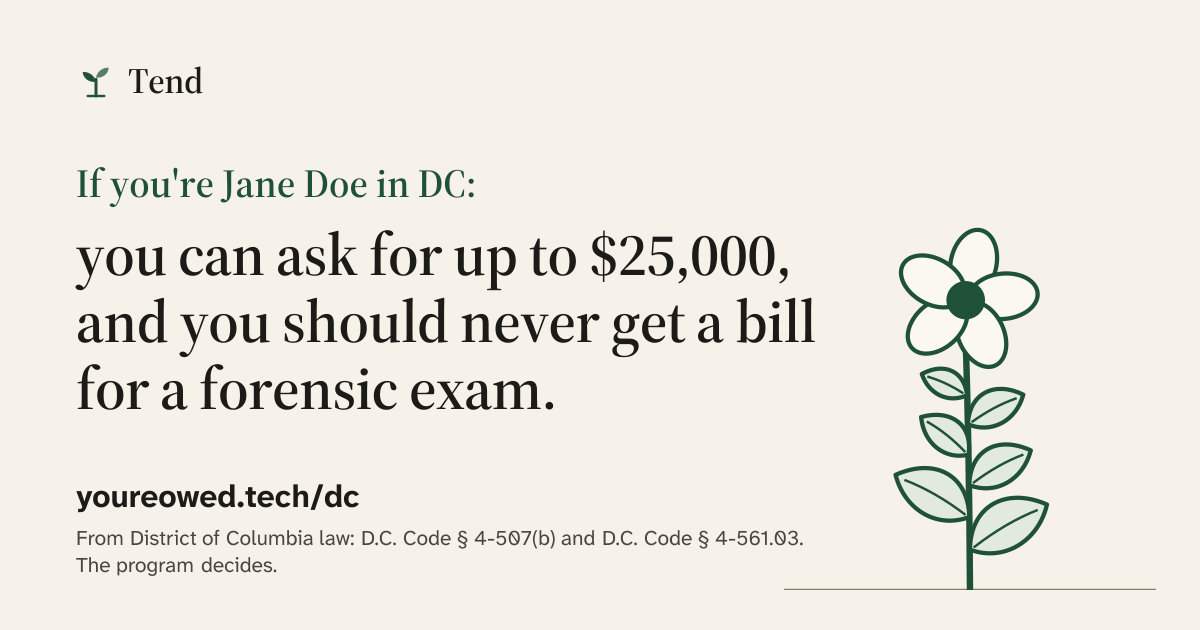
If you're Jane Doe in DC: you can ask for up to $25,000, and you should never get a bill for a forensic exam.
Anyone can post this card. It says nothing about the person who shares it, and this page keeps no record of who opens it.
When you are ready
Tend can check your own costs against this law on your device. It never asks what happened, and nothing leaves your device unless you send it.