Law garden / Georgia
If you're Jane Doe in Georgia
What Georgia's crime victim compensation law says, in plain words. Each line links to the exact sentence it comes from.
Georgia Crime Victims Compensation Program, run by Criminal Justice Coordinating Council (CJCC), Victims Compensation Division.
Show the law for this line: Crime Victims Compensation Program Application and Instructions (English)
Crime Victims Compensation Program Application and Instructions (English)GA-S10
The program's own page, saved by Tend.
- $25,000the most you can ask for in totalO.C.G.A. 17-15-8(c)(1)
- 3 yearsto apply, from the date it happenedO.C.G.A. 17-15-5(b)(1)
- Police reportthe program asks for oneO.C.G.A. 17-15-8(a)(3)
- $0what a forensic exam should cost youO.C.G.A. 17-5-72
What the program can pay for
The most the program can pay for all costs together is $25,000.
Show the law for this line: O.C.G.A. 17-15-8(c)(1)
O.C.G.A. 17-15-8(c)(1)GA-CAP-1
For crimes on or after July 1, 2002, the total award to a claimant cannot exceed $25,000.
with respect to any claim filed with the board as a result of a crime occurring on or after July 1, 2002, no award made under the provisions of this chapter payable to a claimant sustaining economic loss because of injury to or death of a victim shall exceed $25,000.00 in the aggregate
Medical care
- Medical expenses are capped at $15,000.
Show the law for this line: CJCC What Our Programs Coverand 1 more
CJCC What Our Programs CoverGA-COV-MED
Medical and dental bills, including prescriptions and copays, are covered up to $15,000.
Medical and Dental Expenses (including prescriptions and copays) Up to $15,000
O.C.G.A. 17-15-8(c)(2)GA-CAP-MED
No award under this chapter for the following losses shall exceed the maximum amount authorized: Category Maximum Award Lost wages $ 10,000.00 Funeral expenses 6,000.00 Financial hardship or loss of support 10,000.00 Medical 15,000.00 Counseling 3,000.00 Crime scene sanitization 1,500.00
Counseling
- Counseling is capped at $3,000.
Show the law for this line: CJCC What Our Programs Coverand 1 more
CJCC What Our Programs CoverGA-COV-COUNS
Mental health counseling is covered up to $3,000; itemized counseling bills must be submitted.
Mental Health Counseling Up to $3,000 Submit copies of any itemized counseling bills related to the victimization.
O.C.G.A. 17-15-8(c)(2)GA-CAP-COUNS
No award under this chapter for the following losses shall exceed the maximum amount authorized: Category Maximum Award Lost wages $ 10,000.00 Funeral expenses 6,000.00 Financial hardship or loss of support 10,000.00 Medical 15,000.00 Counseling 3,000.00 Crime scene sanitization 1,500.00
Prescriptions
Show the law for this line: CJCC What Our Programs Cover
CJCC What Our Programs CoverGA-COV-RX
Prescriptions and copays are covered within the $15,000 medical and dental limit.
Medical and Dental Expenses (including prescriptions and copays) Up to $15,000
Dental care
Show the law for this line: CJCC What Our Programs Cover
CJCC What Our Programs CoverGA-COV-DENTAL
Dental expenses are covered within the $15,000 medical and dental limit.
Medical and Dental Expenses (including prescriptions and copays) Up to $15,000
Lost pay
- Lost wages are capped at $10,000.
Show the law for this line: CJCC What Our Programs Coverand 1 more
CJCC What Our Programs CoverGA-COV-WAGES
Lost wages are covered only for work missed without pay or with only partial pay.
You can only be reimbursed when you missed work and were not paid, or your wages were only partially covered.
O.C.G.A. 17-15-8(c)(2)GA-CAP-WAGES
No award under this chapter for the following losses shall exceed the maximum amount authorized: Category Maximum Award Lost wages $ 10,000.00 Funeral expenses 6,000.00 Financial hardship or loss of support 10,000.00 Medical 15,000.00 Counseling 3,000.00 Crime scene sanitization 1,500.00
Crime scene cleanup
- Crime scene sanitization is capped at $1,500.
Show the law for this line: CJCC What Our Programs Coverand 1 more
CJCC What Our Programs CoverGA-COV-CLEAN
Crime scene sanitization by a trained company is covered up to $1,500.
Crime Scene Sanitization Up to $1,500 Submit an itemized bill from a company trained in crime scene and biohazard clean-up.
O.C.G.A. 17-15-8(c)(2)GA-CAP-CLEAN
No award under this chapter for the following losses shall exceed the maximum amount authorized: Category Maximum Award Lost wages $ 10,000.00 Funeral expenses 6,000.00 Financial hardship or loss of support 10,000.00 Medical 15,000.00 Counseling 3,000.00 Crime scene sanitization 1,500.00
Funeral costs
- Funeral expenses are capped at $6,000.
Show the law for this line: O.C.G.A. 17-15-8(c)(2)
O.C.G.A. 17-15-8(c)(2)GA-CAP-FUNERAL
No award under this chapter for the following losses shall exceed the maximum amount authorized: Category Maximum Award Lost wages $ 10,000.00 Funeral expenses 6,000.00 Financial hardship or loss of support 10,000.00 Medical 15,000.00 Counseling 3,000.00 Crime scene sanitization 1,500.00
What it does not pay for
No award is made for loss of property, so items like a damaged or taken phone are not reimbursed.
Show the law for this line: O.C.G.A. 17-15-7(g)
O.C.G.A. 17-15-7(g)GA-EXCL-PROP
No award of any kind shall be made under this chapter to a victim of a crime for loss of property.
Compensation funds are not awarded to pay attorney's fees for a claimant who hires a lawyer for a Board hearing.
Show the law for this line: Ga. Comp. R. & Regs. 144-4-.06(9)(b)3
Ga. Comp. R. & Regs. 144-4-.06(9)(b)3GA-EXCL-LEGAL
if a claimant chooses to be represented by an attorney, that claimant shall be responsible for the payment of their attorney's fees. Compensation funds shall not be awarded to pay attorney's fees.
The forensic exam
You should not get a bill for a sexual assault forensic exam.
Show the law for this line: O.C.G.A. 17-5-72and 2 more
O.C.G.A. 17-5-72GA-EXAM-1
A survivor cannot be made to pay, directly or indirectly, for a forensic medical exam; the Georgia Crime Victims Emergency Fund pays, whether or not the survivor reports or cooperates with police.
A victim shall have the right to have a forensic medical examination regardless of whether the victim participates in the criminal justice system or cooperates with law enforcement in pursuing prosecution of the underlying crime. A victim shall not be required to pay, directly or indirectly, for the cost of a forensic medical examination. The cost of a forensic medical examination shall be paid for by the Georgia Crime Victims Emergency Fund, as provided for in Chapter 15 of this title.
CJCC Victims Compensation FAQGA-EXAM-3
The program says providers may not bill law enforcement or the patient's insurance for exam costs above the $1,000 limit.
If FME expenses are over $1,000.00, can we bill law enforcement or the patient’s insurance for the difference? No. The maximum allowable amount is $1,000.00 for the collection of evidence for a FME.
Ga. Comp. R. & Regs. 144-4-.08(2)(d)GA-EXAM-5
Whatever the program pays a provider for a forensic medical exam counts as payment in full, so the provider cannot bill the balance to anyone else.
Payment made by the CVCP for an FME must be considered as payment in full.
The provider should not bill your insurance for it either.
Show the law for this line: O.C.G.A. 17-5-72and 1 more
O.C.G.A. 17-5-72GA-EXAM-1
A survivor cannot be made to pay, directly or indirectly, for a forensic medical exam; the Georgia Crime Victims Emergency Fund pays, whether or not the survivor reports or cooperates with police.
A victim shall have the right to have a forensic medical examination regardless of whether the victim participates in the criminal justice system or cooperates with law enforcement in pursuing prosecution of the underlying crime. A victim shall not be required to pay, directly or indirectly, for the cost of a forensic medical examination. The cost of a forensic medical examination shall be paid for by the Georgia Crime Victims Emergency Fund, as provided for in Chapter 15 of this title.
CJCC Victims Compensation FAQGA-EXAM-3
The program says providers may not bill law enforcement or the patient's insurance for exam costs above the $1,000 limit.
If FME expenses are over $1,000.00, can we bill law enforcement or the patient’s insurance for the difference? No. The maximum allowable amount is $1,000.00 for the collection of evidence for a FME.
The state fund pays for the forensic medical exam up to $1,000, even if the survivor has health insurance or other coverage.
Show the law for this line: O.C.G.A. 17-15-15
O.C.G.A. 17-15-15GA-EXAM-2
When a forensic medical examination is conducted, the cost of such forensic medical examination shall be paid for by the fund in an amount not to exceed $1,000.00. The fund shall be responsible for payment of such cost notwithstanding whether the person receiving such forensic medical examination has health insurance or any other source of health care coverage.
The program pays for a forensic medical exam done in another state as long as the assault happened in Georgia and the provider meets program criteria.
Show the law for this line: Ga. Comp. R. & Regs. 144-4-.08(1)(b)
Ga. Comp. R. & Regs. 144-4-.08(1)(b)GA-EXAM-6
The Georgia Crime Victims Compensation Program ("CVCP") will pay for FMEs performed in another state as long as the crime occurred in Georgia
Police report
The program asks for a police report. The rules below say when other records can count instead, like a forensic exam or medical or counseling records.
Show the law for this line: O.C.G.A. 17-15-8(a)(3)and 2 more
O.C.G.A. 17-15-8(a)(3)GA-REPORT-1
By statute, no award is made if records show the crime was reported more than 72 hours after it happened, unless the board finds good cause for the delay.
In no case may an award be made where the police records, records of an investigating agency, or records created pursuant to a mandatory reporting requirement show that such report was made more than 72 hours after the occurrence of such crime unless the board, for good cause shown, finds the delay to have been justified
Application and Instructions, Please NoteGA-REPORT-3
The application says the incident must be reported to law enforcement or an investigative agency, which can include medical authorities, DFCS, APS, the courts or the school system; an arrest or prosecution is not required.
While the incident must be reported to law enforcement or an investigative agency (DFCS, APS, the courts, medical authorities, or the school system), arrest and/or prosecution of an offender is not a program or eligibility requirement.
CJCC Victims Compensation FAQGA-REPORT-2
For sexual assaults after May 12, 2008, the program says no police report is required; it may use documentation from the forensic medical exam instead.
If the sexual assault occurred after May 12, 2008 you are not required to have a police report to apply for the CVCP. The program may use documentation from the forensic medical exam which shows that a sexual assault occurred.
By statute, no award is made if records show the crime was reported more than 72 hours after it happened, unless the board finds good cause for the delay.
Show the law for this line: O.C.G.A. 17-15-8(a)(3)
O.C.G.A. 17-15-8(a)(3)GA-REPORT-1
In no case may an award be made where the police records, records of an investigating agency, or records created pursuant to a mandatory reporting requirement show that such report was made more than 72 hours after the occurrence of such crime unless the board, for good cause shown, finds the delay to have been justified
For sexual assaults after May 12, 2008, the program says no police report is required; it may use documentation from the forensic medical exam instead.
Show the law for this line: CJCC Victims Compensation FAQ
CJCC Victims Compensation FAQGA-REPORT-2
If the sexual assault occurred after May 12, 2008 you are not required to have a police report to apply for the CVCP. The program may use documentation from the forensic medical exam which shows that a sexual assault occurred.
The application says the incident must be reported to law enforcement or an investigative agency, which can include medical authorities, DFCS, APS, the courts or the school system; an arrest or prosecution is not required.
Show the law for this line: Application and Instructions, Please Note
Application and Instructions, Please NoteGA-REPORT-3
While the incident must be reported to law enforcement or an investigative agency (DFCS, APS, the courts, medical authorities, or the school system), arrest and/or prosecution of an offender is not a program or eligibility requirement.
Deadline to apply
Apply within 3 years of the date it happened.
Show the law for this line: O.C.G.A. 17-15-5(b)(1)
O.C.G.A. 17-15-5(b)(1)GA-DEADLINE-1
A claim must be filed within three years of the crime, and the board may extend that for good cause.
A claim shall be filed by a victim not later than three years after the occurrence of the crime upon which such claim is based or not later than three years after the death of the victim; provided, however, that if such victim was a minor at the time of the commission of the crime, he or she shall have until three years after his or her eighteenth birthday to file such claim; and provided, further, that upon good cause shown, the board may extend the time for filing a claim.
A victim who was a minor at the time of the crime has until three years after their eighteenth birthday to file.
Show the law for this line: O.C.G.A. 17-15-5(b)(1)
O.C.G.A. 17-15-5(b)(1)GA-DEADLINE-2
if such victim was a minor at the time of the commission of the crime, he or she shall have until three years after his or her eighteenth birthday to file such claim
Keeping your name and address private
Georgia's Safe at Home program, run by the Secretary of State, gives survivors of sexual assault and other eligible people a designated substitute address for public records, forwards their mail, and seals their address on voter rolls.
Show the law for this line: Program Services; O.C.G.A. 50-18-150 et seq.
Program Services; O.C.G.A. 50-18-150 et seq.GA-ACP-1
The Georgia Safe at Home Program is an address confidentiality program that helps survivors of domestic violence, sexual assault, human trafficking, stalking, or other eligible individuals whose safety may be compromised by public disclosure of their residential address.
When the compensation board requests records from police, prosecutors, courts, or other agencies to decide a claim, it must keep those records confidential.
Show the law for this line: O.C.G.A. 17-15-4(a)(2)
O.C.G.A. 17-15-4(a)(2)GA-RECCONF-1
provided, however, that the board shall preserve the confidentiality of any such records received
How to apply
Online victimscompportal.cjcc.ga.gov
Show the law for this line: GA application instructions (Revised Sept 2026), Instructions item 4
GA application instructions (Revised Sept 2026), Instructions item 4GA-SUBMIT-2
A survivor can instead register and apply online through the Victims Comp Portal.
You can also register to apply online, by visiting victimscompportal.cjcc.ga.gov.
Mail Criminal Justice Coordinating Council, Crime Victims Compensation Program 104 Marietta Street NW, Suite 400 Atlanta, GA 30303
Show the law for this line: GA application instructions (Revised Sept 2026), Instructions item 4
GA application instructions (Revised Sept 2026), Instructions item 4GA-SUBMIT-1
Mail the complete application packet to the CJCC Crime Victims Compensation Program office in Atlanta.
Mail the complete application packet to Criminal Justice Coordinating Council, Crime Victims Compensation Program 104 Marietta Street NW, Suite 400 Atlanta, GA 30303
Phone 404-657-2222
Show the law for this line: Crime Victims Compensation Program Application and Instructions (English)
Crime Victims Compensation Program Application and Instructions (English)GA-S10
The program's own page, saved by Tend.
Good to know before you apply
Victims may be Georgia residents or nonresidents.
Show the law for this line: O.C.G.A. 17-15-7(b)(1)
O.C.G.A. 17-15-7(b)(1)GA-RES-1
Victims may be legal residents or nonresidents of this state.
A covered crime includes an act in Georgia, or for a Georgia resident, an act in a state with no compensation program or a state that paid less than Georgia would.
Show the law for this line: O.C.G.A. 17-15-2(3)(A)
O.C.G.A. 17-15-2(3)(A)GA-RES-2
An act which is committed in this state; in a state which does not have a victims’ compensation program, if the claimant is a resident of this state; or in a state which has compensated the claimant in an amount less than the claimant would be entitled to pursuant to this chapter, if the claimant is a resident of this state
An award may be reduced by payments received from the offender or from other private or public sources such as workers' compensation; gifts from family or charitable donations do not count.
Show the law for this line: O.C.G.A. 17-15-8(f)
O.C.G.A. 17-15-8(f)GA-COLLAT-1
Any award made pursuant to this chapter may be reduced by or set off by the amount of any payments received or to be received as a result of the injury, serious mental or emotional trauma: (1) From or on behalf of the person who committed the crime; and (2) From any other private or public source, including an award of workers’ compensation pursuant to the laws of this state, provided that private sources shall not include contributions received from family members or persons or private organizations making charitable donations to a claimant.
No award is made until the claimant has used other available resources such as health insurance, employee benefits, workers' compensation and Medicaid/Medicare.
Show the law for this line: Ga. Comp. R. & Regs. 144-4-.06(5)(b)
Ga. Comp. R. & Regs. 144-4-.06(5)(b)GA-COLLAT-2
No award will be made until the claimant has exhausted all other public and private resources available to him or her (such as health insurance, employee benefits, worker's compensation, other state government assistance, Medicaid/Medicare).
A sexual assault victim who is not the primary policyholder may opt out of giving insurance information by checking the opt-out box on the application.
Show the law for this line: Application and Instructions, Please Note
Application and Instructions, Please NoteGA-COLLAT-3
If you are not the primary policyholder and are a victim of sexual assault or family violence, you may opt out of providing insurance information for this incident by checking the opt-out box in Section 6 of the application.
Share this page
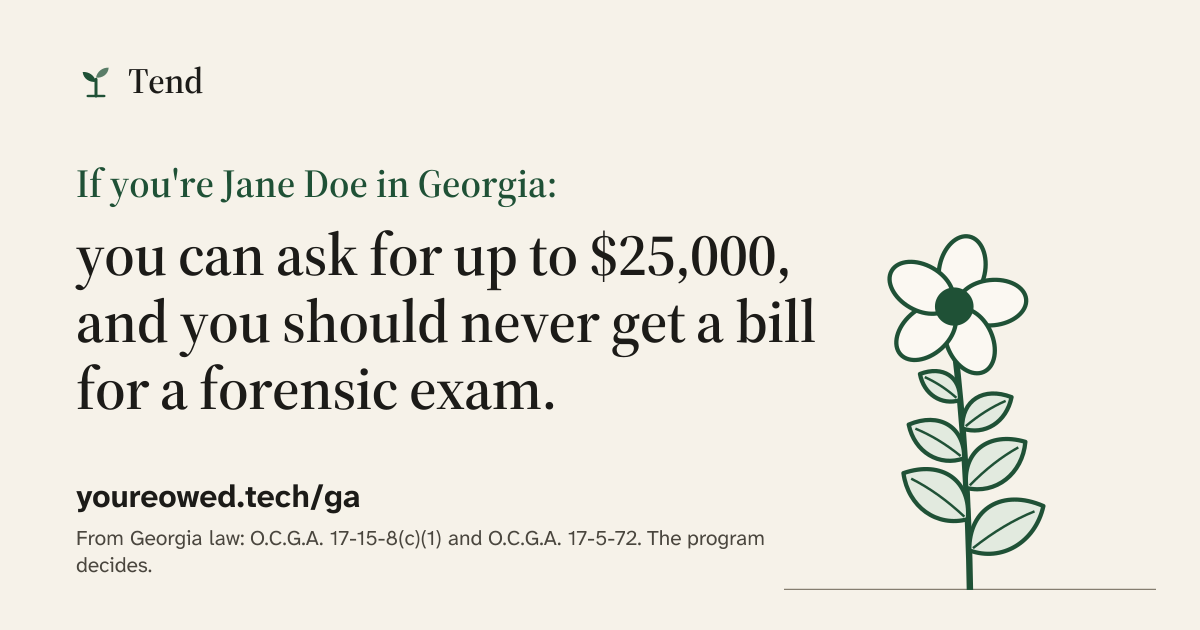
If you're Jane Doe in Georgia: you can ask for up to $25,000, and you should never get a bill for a forensic exam.
Anyone can post this card. It says nothing about the person who shares it, and this page keeps no record of who opens it.
When you are ready
Tend can check your own costs against this law on your device. It never asks what happened, and nothing leaves your device unless you send it.