Law garden / Maryland
If you're Jane Doe in Maryland
What Maryland's crime victim compensation law says, in plain words. Each line links to the exact sentence it comes from.
Criminal Injuries Compensation Board (CICB), run by Governor's Office of Crime Prevention and Policy, Criminal Injuries Compensation Board.
Show the law for this line: CICB Application for Crime Victim Compensation with instructions (rev. Nov 2021)
CICB Application for Crime Victim Compensation with instructions (rev. Nov 2021)MD-S9
An application form, saved by Tend.
- $45,000the most you can ask for in total, except in some casesMd. Code, Crim. Proc. 11-811(b)(4)
- Police reportnot the only record that countsMd. Code, Crim. Proc. 11-810(b)
- Forensic examyou should not have to pay for it if done within 15 days of the assaultMd. Code, Crim. Proc. 11-1007(c)(1)-(2)
Tend saved copies of this page's sources on and checked every quote against those copies word for word. Laws change, so ask the program before you rely on a date or amount.
What the program can pay for
Note: The program's 2021 application lists mileage, lock changes, moving, and child care as not covered. The law changed on July 1, 2025, and now lists these costs.
The most the program can pay in total is $45,000, or up to $25,000 more if the injury leaves you fully disabled for life.
Show the law for this line: Md. Code, Crim. Proc. 11-811(b)(4)and 1 more
Md. Code, Crim. Proc. 11-811(b)(4)MD-CAP-1
Total compensation is capped at $45,000, including later and supplemental awards.
a total of $45,000, including any subsequent and supplemental awards
Read this sentence on mgaleg.maryland.gov (opens in a new tab)
Md. Code, Crim. Proc. 11-811(b)(1)(ii)MD-CAP-8
If the injury results in permanent total disability, up to $25,000 more can be awarded after a disability-related claim has been awarded to the victim.
(ii) if the injury to the victim results in permanent total disability, up to an additional $25,000 after a disability–related claim has been awarded to the victim
Read this sentence on mgaleg.maryland.gov (opens in a new tab)
Medical care
- Medical claims are capped at $45,000.
Show the law for this line: Md. Code, Crim. Proc. 11-810(d)(1)(i)and 2 more
Md. Code, Crim. Proc. 11-810(d)(1)(i)MD-COV-1
Medical care and medical supplies count as covered losses.
medical care, including the cost of medical supplies
Read this sentence on mgaleg.maryland.gov (opens in a new tab)
Md. Code, Crim. Proc. 11-810(d)(1)(ii)MD-COV-9
Eyeglasses and other corrective lenses count as covered losses.
expenses for eyeglasses and other corrective lenses
Read this sentence on mgaleg.maryland.gov (opens in a new tab)
Md. Code, Crim. Proc. 11-811(b)(2)MD-CAP-2
$45,000 for a medical claim
Read this sentence on mgaleg.maryland.gov (opens in a new tab)
Counseling
- Counseling for a person eligible because of psychological injury is capped at $45,000 per claimant.
Show the law for this line: Md. Code, Crim. Proc. 11-810(d)(1)(iii)and 1 more
Md. Code, Crim. Proc. 11-810(d)(1)(iii)MD-COV-2
Mental health counseling counts as a covered loss.
mental health counseling;
Read this sentence on mgaleg.maryland.gov (opens in a new tab)
Md. Code, Crim. Proc. 11-811(b)(3)MD-CAP-3
$45,000 for each claimant for psychiatric, psychological, or mental health counseling under subsection (a)(5) of this section
Read this sentence on mgaleg.maryland.gov (opens in a new tab)
Trips to get medical or mental health care
Show the law for this line: Md. Code, Crim. Proc. 11-810(d)(1)(ix)
Md. Code, Crim. Proc. 11-810(d)(1)(ix)MD-COV-5
Travel costs to get medical or psychological care count as covered losses.
transportation costs incurred by travel to seek medical or psychological care
Read this sentence on mgaleg.maryland.gov (opens in a new tab)
Lost pay
- Lost earnings are covered at up to two-thirds of the victim's gross average wage.
- Disability-related claims, which is how Maryland pays lost earnings after an injury, are capped at $25,000, with up to another $25,000 for permanent total disability.
Show the law for this line: Md. Code, Crim. Proc. 11-811(a)(2)and 1 more
Md. Code, Crim. Proc. 11-811(a)(2)MD-COV-3
An award for loss of earnings or support made under this subtitle may be up to two-thirds of the victim's gross average wage
Read this sentence on mgaleg.maryland.gov (opens in a new tab)
Md. Code, Crim. Proc. 11-811(b)(1)MD-CAP-5
for a disability-related or dependency-related claim: (i) except as provided in item (ii) of this paragraph, $25,000
Read this sentence on mgaleg.maryland.gov (opens in a new tab)
Replacing locks
Show the law for this line: Md. Code, Crim. Proc. 11-811(b)(5)
Md. Code, Crim. Proc. 11-811(b)(5)MD-COV-8
Replacing locks is covered inside the property cap.
including the cost of replacing locks
Read this sentence on mgaleg.maryland.gov (opens in a new tab)
One move, with any security deposit
Show the law for this line: Md. Code, Crim. Proc. 11-810(d)(1)(vii)
Md. Code, Crim. Proc. 11-810(d)(1)(vii)MD-COV-4
A one-time relocation, including a security deposit, counts as a covered loss. No dollar cap for relocation was found in the statute.
the costs of one-time relocation, including any security deposit
Read this sentence on mgaleg.maryland.gov (opens in a new tab)
Child care while you get medical or mental health care
Show the law for this line: Md. Code, Crim. Proc. 11-810(d)(1)(viii)
Md. Code, Crim. Proc. 11-810(d)(1)(viii)MD-COV-6
Child care needed while seeking medical or psychological care counts as a covered loss.
child care expenses incurred as a result of seeking medical or psychological care
Read this sentence on mgaleg.maryland.gov (opens in a new tab)
Replacing belongings
- Repairing, replacing, or cleaning property damaged by the crime or by the police investigation, including replacing locks, is capped at $2,000 per claimant.
Show the law for this line: Md. Code, Crim. Proc. 11-810(d)(1)(v)and 1 more
Md. Code, Crim. Proc. 11-810(d)(1)(v)MD-COV-7
Repairing, replacing, or cleaning property counts as a covered loss, subject to the separate property cap.
repairing, replacing, or cleaning property;
Read this sentence on mgaleg.maryland.gov (opens in a new tab)
Md. Code, Crim. Proc. 11-811(b)(5)MD-CAP-6
$2,000 for each claimant for repair, replacement, or cleaning of property damaged, soiled, or littered as a result of a crime or law enforcement investigation of a crime, including the cost of replacing locks
Read this sentence on mgaleg.maryland.gov (opens in a new tab)
Funeral costs
- Funeral expenses are capped at $10,000.
Show the law for this line: Md. Code, Crim. Proc. 11-811(a)(4)
Md. Code, Crim. Proc. 11-811(a)(4)MD-CAP-7
An award for funeral expenses may not exceed $10,000.
Read this sentence on mgaleg.maryland.gov (opens in a new tab)
Household family members of an injured victim can get their own counseling, capped at $10,000 per claimant and $20,000 per incident. This cap is for those family members, not for the victim's own counseling.
Show the law for this line: Md. Code, Crim. Proc. 11-811(a)(6), (b)(6)
Md. Code, Crim. Proc. 11-811(a)(6), (b)(6)MD-COV-10
for an award for psychiatric, psychological, or mental health counseling made under subsection (a)(6) of this section: (i) $10,000 for each claimant; and (ii) $20,000 for each incident
Read this sentence on mgaleg.maryland.gov (opens in a new tab)
A parent or guardian who lives with a child victim can get up to 30 days of lost earnings for time spent caring for the child.
Show the law for this line: Md. Code, Crim. Proc. 11-811(a)(3)
Md. Code, Crim. Proc. 11-811(a)(3)MD-COV-11
The parent or guardian of a victim who is a child and who resides with the victim may be eligible for an award of up to 30 days of lost earnings as a result of caring for the victim.
Read this sentence on mgaleg.maryland.gov (opens in a new tab)
The forensic exam
You should not have to pay for a sexual assault forensic exam if done within 15 days of the assault.
Show the law for this line: Md. Code, Crim. Proc. 11-1007(c)(1)-(2)and 2 more
Md. Code, Crim. Proc. 11-1007(c)(1)-(2)MD-EXAM-3
The free-exam rule covers a forensic exam done within 15 days of the assault (or longer if regulation allows) and emergency hospital treatment plus follow-up testing for up to 90 days after the exam.
a physical and sexual assault forensic examination to gather information and evidence as to an alleged crime when the examination is conducted within 15 days of the alleged crime or a longer period as provided by regulation; (2) emergency hospital treatment and follow-up medical testing for up to 90 days after the initial physical examination
Read this sentence on mgaleg.maryland.gov (opens in a new tab)
Md. Code, Crim. Proc. 11-1007(b)(1)MD-EXAM-1
When a physician, qualified provider, or hospital gives a rape or sexual offense victim a forensic exam or the related emergency care listed in the statute, the services must be free to the survivor. The statute itself does not mention insurance; the exam billing regulation does.
the services shall be provided without charge to the individual
Read this sentence on mgaleg.maryland.gov (opens in a new tab)
COMAR 10.12.02.05A(2)-(3)MD-EXAM-5
A provider may not bill the survivor, the survivor's family, or the survivor's private insurance for any difference between its charges and the state's payment, and must take the state's payment as payment in full.
May not bill a victim of an alleged rape, sexual offense, or child sexual abuse, or the victim's family or private insurance, for any difference between charges and Department reimbursement; and (3) Shall accept the Department's reimbursement as payment in full.
Read this sentence on regs.maryland.gov (opens in a new tab)
The provider is paid by the Governor's Office of Crime Prevention and Policy (its Sexual Assault Reimbursement Unit), not by the survivor.
Show the law for this line: Md. Code, Crim. Proc. 11-1007(b)(2)(i)
Md. Code, Crim. Proc. 11-1007(b)(2)(i)MD-EXAM-2
is entitled to be paid by the Governor's Office of Crime Prevention and Policy for the costs of providing the services
Read this sentence on mgaleg.maryland.gov (opens in a new tab)
The free-exam rule covers a forensic exam done within 15 days of the assault (or longer if regulation allows) and emergency hospital treatment plus follow-up testing for up to 90 days after the exam.
Show the law for this line: Md. Code, Crim. Proc. 11-1007(c)(1)-(2)
Md. Code, Crim. Proc. 11-1007(c)(1)-(2)MD-EXAM-3
a physical and sexual assault forensic examination to gather information and evidence as to an alleged crime when the examination is conducted within 15 days of the alleged crime or a longer period as provided by regulation; (2) emergency hospital treatment and follow-up medical testing for up to 90 days after the initial physical examination
Read this sentence on mgaleg.maryland.gov (opens in a new tab)
The state's reimbursement unit says the forensic exam is covered whether or not the survivor reports to police.
Show the law for this line: SARU FAQ question 6
SARU FAQ question 6MD-EXAM-4
Yes, any victim of sexual assault or rape is entitled to a forensic medical examination regardless of their decision to report sexual assault to police.
Read this sentence on gocpp.maryland.gov (opens in a new tab)
Police report
Note: Maryland's law changed on July 1, 2025. The program's 2021 application and its website still say to report the crime within 48 hours. The application also asks for a police report for all claims. This page follows the law in force now. The program may still ask you for a police report.
A police report is not the only way to qualify. The rules below say which other records can count and when, like a protective order or medical records.
Show the law for this line: Md. Code, Crim. Proc. 11-810(b)and 1 more
Md. Code, Crim. Proc. 11-810(b)MD-REPORT-1
A police report is one kind of evidence the Board must accept. It is not the only one. The Board must also accept medical records showing an injury that fits the crime. It must accept a sworn statement from a qualified third party, and a peace order or protective order. It must also accept any other evidence it thinks helps prove what happened.
The Board shall accept as evidence: (1) a report produced by a law enforcement agency; (2) medical records documenting an injury consistent with the alleged crime; (3) a sworn statement from a qualified third party; (4) a peace order issued under Title 3, Subtitle 15 of the Courts Article; (5) a protective order issued under Title 4, Subtitle 5 of the Family Law Article; and (6) any other evidence the Board considers probative.
Read this sentence on mgaleg.maryland.gov (opens in a new tab)
Md. Code, Crim. Proc. 11-801(g)(3)MD-REPORT-2
A sexual assault program advocate counts as a qualified third party whose sworn statement the Board accepts as evidence.
an advocate or victim service provider from a domestic violence or sexual assault prevention or assistance program
Read this sentence on mgaleg.maryland.gov (opens in a new tab)
A police report is one kind of evidence the Board must accept. It is not the only one. The Board must also accept medical records showing an injury that fits the crime. It must accept a sworn statement from a qualified third party, and a peace order or protective order. It must also accept any other evidence it thinks helps prove what happened.
Show the law for this line: Md. Code, Crim. Proc. 11-810(b)
Md. Code, Crim. Proc. 11-810(b)MD-REPORT-1
The Board shall accept as evidence: (1) a report produced by a law enforcement agency; (2) medical records documenting an injury consistent with the alleged crime; (3) a sworn statement from a qualified third party; (4) a peace order issued under Title 3, Subtitle 15 of the Courts Article; (5) a protective order issued under Title 4, Subtitle 5 of the Family Law Article; and (6) any other evidence the Board considers probative.
Read this sentence on mgaleg.maryland.gov (opens in a new tab)
A sexual assault program advocate counts as a qualified third party whose sworn statement the Board accepts as evidence.
Show the law for this line: Md. Code, Crim. Proc. 11-801(g)(3)
Md. Code, Crim. Proc. 11-801(g)(3)MD-REPORT-2
an advocate or victim service provider from a domestic violence or sexual assault prevention or assistance program
Read this sentence on mgaleg.maryland.gov (opens in a new tab)
Deadline to apply
Note: The program's 2021 application and the Board's older rules still say you have 3 years to apply. The law now says 4 years.
A claim must be filed within 4 years after the crime is discovered, or later in some cases.
Show the law for this line: Md. Code, Crim. Proc. 11-809(a)(1)
Md. Code, Crim. Proc. 11-809(a)(1)MD-DEADLINE-1
a claimant shall file a claim within 4 years after the later of: (i) the discovery of the occurrence of the crime or delinquent act or the death of the victim
Read this sentence on mgaleg.maryland.gov (opens in a new tab)
In a case of child abuse, a claim can be filed at any time.
Show the law for this line: Md. Code, Crim. Proc. 11-809(a)(2)
Md. Code, Crim. Proc. 11-809(a)(2)MD-DEADLINE-4
In a case of child abuse, a claimant may file a claim at any time.
Read this sentence on mgaleg.maryland.gov (opens in a new tab)
If filing was delayed because of a delay in testing a sexual assault kit or matching a DNA profile, the 4 years run from notification of the results.
Show the law for this line: Md. Code, Crim. Proc. 11-809(a)(3)
Md. Code, Crim. Proc. 11-809(a)(3)MD-DEADLINE-2
In a case where the filing of a claim was delayed as the result of a delay in the testing of DNA or a delay in DNA profile matching from a sexual assault forensic examination kit or biological material related to a sexual offense, a claimant shall file a claim within 4 years after notification of the results of the testing or DNA profile matching.
Read this sentence on mgaleg.maryland.gov (opens in a new tab)
The Board can accept a late claim if there was good cause for missing the deadline.
Show the law for this line: Md. Code, Crim. Proc. 11-809(a)(4)
Md. Code, Crim. Proc. 11-809(a)(4)MD-DEADLINE-3
A claimant may file a claim at any time if the Board determines that there was good cause for failure to file a claim within the time limits
Read this sentence on mgaleg.maryland.gov (opens in a new tab)
Keeping your address private
Maryland's Secretary of State runs an Address Confidentiality Program. It is for survivors of threatened, attempted, or actual sexual assault, domestic violence, stalking, harassment, or human trafficking.
Show the law for this line: Md. Code, State Gov't 7-303
Md. Code, State Gov't 7-303MD-ACP-1
The Secretary of State shall establish and administer an Address Confidentiality Program for survivors of threatened, attempted, or actual domestic violence, sexual assault, stalking, harassment, or human trafficking.
Read this sentence on mgaleg.maryland.gov (opens in a new tab)
Tend has not verified a law that keeps compensation records private in Maryland.
How to apply
Email cicb.info@maryland.gov
Show the law for this line: CICB Application with instructions (Rev. November, 2021), Instruction Sheet header and Application Instructions
CICB Application with instructions (Rev. November, 2021), Instruction Sheet header and Application InstructionsMD-SUBMIT-EMAIL
The completed application can be emailed to the CICB office at cicb.info@maryland.gov. State law allows claims to be filed electronically under Board procedures.
Email: cicb.info@maryland.gov
Mail 6776 Reisterstown Rd, Ste. 206, Baltimore, MD 21215
Show the law for this line: CICB Application with instructions (Rev. November, 2021), Instruction Sheet header and Application Instructions
CICB Application with instructions (Rev. November, 2021), Instruction Sheet header and Application InstructionsMD-SUBMIT-MAIL
The instructions say to mail, email, or deliver the completed application to the CICB office; this is the office address printed on the application and instruction sheet.
6776 Reisterstown Rd, Ste. 206, Baltimore, MD 21215
In person 6776 Reisterstown Rd, Ste. 206, Baltimore, MD 21215
Show the law for this line: CICB Application with instructions (Rev. November, 2021), Instruction Sheet header and Application Instructions
CICB Application with instructions (Rev. November, 2021), Instruction Sheet header and Application InstructionsMD-SUBMIT-INPERSON
The completed application can also be delivered in person to the CICB office in Baltimore. State law lists in person, by mail, or electronically as the ways to file.
6776 Reisterstown Rd, Ste. 206, Baltimore, MD 21215
Phone 410-585-3010
Show the law for this line: CICB Application for Crime Victim Compensation with instructions (rev. Nov 2021)
CICB Application for Crime Victim Compensation with instructions (rev. Nov 2021)MD-S9
An application form, saved by Tend.
If you need money soon
Note: The Board's rules, last changed in 2016, still say an emergency award needs a police report and can be no more than $2,000. The law now allows up to $10,000.
The Board can make an emergency award before deciding the claim if an award is likely and the claimant faces undue hardship. It may not exceed $10,000 and is deducted from the final award.
Show the law for this line: Md. Code, Crim. Proc. 11-813(b)(1)
Md. Code, Crim. Proc. 11-813(b)(1)MD-EMERG-1
The amount of an emergency award under this section: (1) may not exceed $10,000
Read this sentence on mgaleg.maryland.gov (opens in a new tab)
Unless an application is clearly without merit, the Board must make emergency awards for funeral costs, crime scene cleanup, and emergency relocation.
Show the law for this line: Md. Code, Crim. Proc. 11-813(c)
Md. Code, Crim. Proc. 11-813(c)MD-EMERG-2
the Board shall make emergency awards for: (1) funeral expenses; (2) crime scene cleanup; and (3) emergency relocation
Read this sentence on mgaleg.maryland.gov (opens in a new tab)
Good to know before you apply
Covers crimes committed in Maryland against anyone, and crimes in another state against a Maryland resident.
Show the law for this line: Md. Code, Crim. Proc. 11-801(d)(1)(i)
Md. Code, Crim. Proc. 11-801(d)(1)(i)MD-RES-1
a criminal offense under state, federal, or common law that is committed in: 1. this State; or 2. another state against a resident of this State
Read this sentence on mgaleg.maryland.gov (opens in a new tab)
A Maryland resident hurt in another state can apply here if that state has no program, the victim is ineligible there, or that program has no money.
Show the law for this line: Md. Code, Crim. Proc. 11-808(b)
Md. Code, Crim. Proc. 11-808(b)MD-RES-2
A resident of the State is eligible for an award under this subtitle if the resident becomes a victim in another state other than this State that: (1) does not operate a criminal injuries compensation program; (2) operates a criminal injuries compensation program for which the victim is ineligible
Read this sentence on mgaleg.maryland.gov (opens in a new tab)
The award is reduced by money from the offender, insurance, workers' compensation, and other public or private sources. Life insurance counts only above a set amount.
Show the law for this line: Md. Code, Crim. Proc. 11-811(c)
Md. Code, Crim. Proc. 11-811(c)MD-COLL-1
An award made under this subtitle shall be reduced by the amount of any payments received or to be received as a result of the injury
Read this sentence on mgaleg.maryland.gov (opens in a new tab)
If the claimant has no private insurance, the program requires applying for Medicaid first.
Show the law for this line: Application instruction sheet, Benefits and Required Documentation
Application instruction sheet, Benefits and Required DocumentationMD-COLL-2
If the claimant has no private insurance, CICB requires the claimant to apply for Medicaid.
The claimant must have at least $100 in unreimbursed expenses, or have lost at least $100 in earnings or support.
Show the law for this line: Md. Code, Crim. Proc. 11-810(d)
Md. Code, Crim. Proc. 11-810(d)MD-MIN-1
The Board may make an award only if the claimant, as a result of the injury on which the claim is based, has: (1) incurred at least $100 in unreimbursed and unreimbursable expenses
Read this sentence on mgaleg.maryland.gov (opens in a new tab)
Share this page
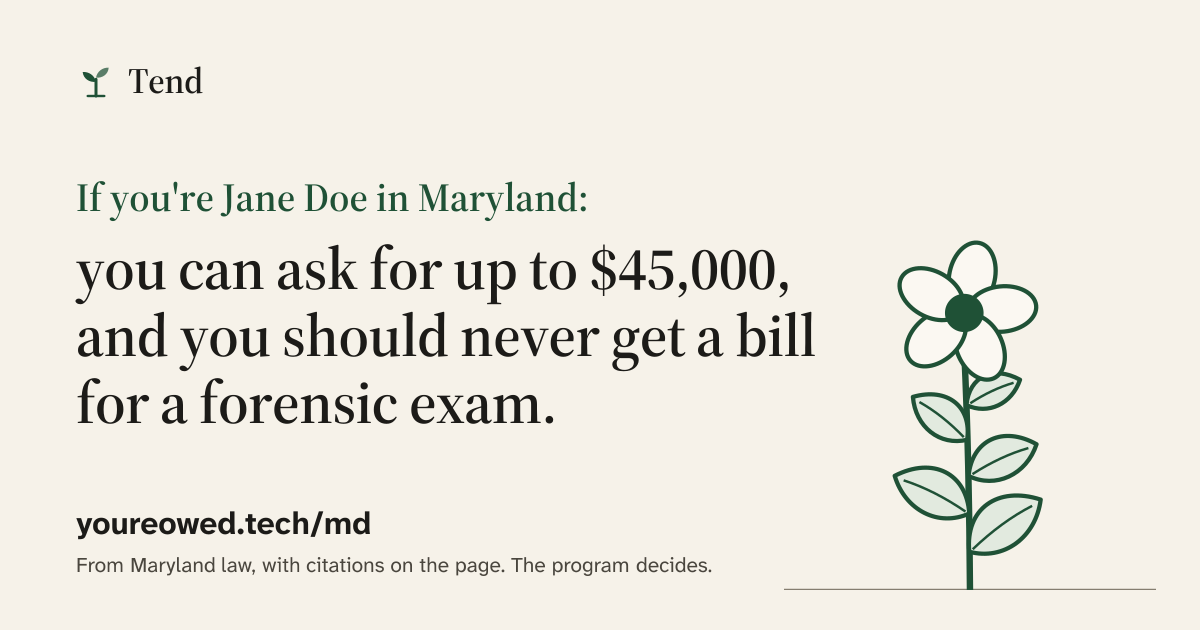
If you're Jane Doe in Maryland: you can ask for up to $45,000, or more in some cases.
Anyone can post this card. It says nothing about the person who shares it. Tend keeps no list of who opens it, though like any website its host logs each visit's IP address.
When you are ready
Tend can check your own costs against this law on your device. It never asks what happened. Your costs and answers stay on your device unless you send them; the state you pick goes to Tend's server to get its law.