Law garden / North Carolina
If you're Jane Doe in North Carolina
What North Carolina's crime victim compensation law says, in plain words. Each line links to the exact sentence it comes from.
Victim Compensation Program, run by North Carolina Department of Public Safety, Office of Victim Compensation Services (Crime Victims Compensation Commission).
Show the law for this line: NC DPS Rape Victim Assistance Program page and FAQ
NC DPS Rape Victim Assistance Program page and FAQNC-S6
The program's own page, saved by Tend.
- $45,000the most you can ask for in totalN.C. Gen. Stat. 15B-11(g)
- 2 yearsto apply, from the date it happenedN.C. Gen. Stat. 15B-11(a)(1)
- Police reportthe program asks for oneN.C. Gen. Stat. 15B-11(a)(3)
- $0what a forensic exam should cost youN.C. Gen. Stat. 143B-1200(c)
What the program can pay for
The most the program can pay for all costs together is $45,000.
Show the law for this line: N.C. Gen. Stat. 15B-11(g)
N.C. Gen. Stat. 15B-11(g)NC-CAP-1
Total compensation for one victim's injury is capped at $45,000, not counting allowable funeral, cremation, and burial expenses.
Compensation payable to a victim and to all other claimants sustaining economic loss because of injury to, or the death of, that victim may not exceed forty-five thousand dollars ($45,000) in the aggregate in addition to allowable funeral, cremation, and burial expenses.
Medical care
Show the law for this line: N.C. Gen. Stat. 15B-2(1)and 1 more
N.C. Gen. Stat. 15B-2(1)NC-MED-1
Medical care is a covered expense, paid at a set share (66 2/3%) of the provider's usual charge.
Allowable expense for medical care, counseling, rehabilitation, medically-related property, and other remedial treatment and care of a victim shall be limited to sixty-six and two-thirds percent (66 2/3%) of the amount usually charged by the provider for the treatment or care.
N.C. Gen. Stat. 15B-2(1)NC-MED-2
A provider that accepts the program's payment for treatment or care must treat it as payment in full and cannot bill the claimant for the rest.
By accepting the compensation paid as allowable expense pursuant to this subdivision, the provider agrees that the compensation is payment in full for the treatment or care and shall not charge or otherwise hold a claimant financially responsible for the cost of services in addition to the amount of allowable expense.
Counseling
Show the law for this line: N.C. Gen. Stat. 15B-2(1)
N.C. Gen. Stat. 15B-2(1)NC-COUN-1
Counseling for the victim is a covered expense, paid at a set share (66 2/3%) of the provider's usual charge.
Allowable expense for medical care, counseling, rehabilitation, medically-related property, and other remedial treatment and care of a victim shall be limited to sixty-six and two-thirds percent (66 2/3%) of the amount usually charged by the provider for the treatment or care.
Dental care
Show the law for this line: NC DPS Victim Compensation Program page, Accepted Expenses
NC DPS Victim Compensation Program page, Accepted ExpensesNC-DENT-1
The program lists medical, counseling, dental or orthodontic, funeral, crime scene cleanup, and lost wages as accepted expenses.
Accepted Expenses ✓ Medical ✓ Counseling ✓ Dental or orthodontic ✓ Burial and funeral expenses ✓ Crime scene cleanup ✓ Lost wages
Lost pay
- Lost wages are paid at no more than $400 per week for up to 26 weeks from the date of the injury.
Show the law for this line: N.C. Gen. Stat. 15B-2(14)and 1 more
N.C. Gen. Stat. 15B-2(14)NC-WAGE-2
Lost wages are covered when the survivor was employed at the time of the crime and a physician certifies the survivor was unable to work.
A claim for work loss will be paid only upon proof that the injured person was gainfully employed at the time of the criminally injurious conduct and, by physician's certificate, that the injured person was unable to work.
N.C. Gen. Stat. 15B-2(14)NC-WAGE-1
Compensation for work loss will be limited to 26 weeks commencing from the date of the injury, and compensation shall not exceed four hundred dollars ($400.00) per week.
Crime scene cleanup
Show the law for this line: NC DPS Victim Compensation Program page, FAQ: What paperwork do I need to submit? (Crime scene cleanup)
NC DPS Victim Compensation Program page, FAQ: What paperwork do I need to submit? (Crime scene cleanup)NC-CLEAN-1
Crime scene cleanup is an accepted expense when billed by a certified biohazard cleanup company; it may include repairing or replacing doors, locks, and windows as well as cleaning blood stains.
Crime scene cleanup Submit the itemized bill from a certified biohazard cleanup company. Services may include repair or replacement of doors, locks and windows, as well as cleanup of blood stains.
Funeral costs
- Funeral, cremation, and burial expenses are covered up to $10,000.
Show the law for this line: N.C. Gen. Stat. 15B-2(1)
N.C. Gen. Stat. 15B-2(1)NC-FUN-1
Allowable expense includes a total charge not in excess of ten thousand dollars ($10,000) for expenses related to funeral, cremation, and burial, including transportation of a body, but excluding expenses for flowers, gravestone, and other items not directly related to the funeral service.
What it does not pay for
Property damage or loss, lost or stolen money, and replacing property taken as evidence (for example a phone or clothing) are not accepted.
Show the law for this line: NC DPS Victim Compensation Program page, Not Accepted
NC DPS Victim Compensation Program page, Not AcceptedNC-EXCL-1
Not Accepted X Property damage or loss X Lost or stolen money X Replacement of property taken as evidence
Travel is listed as not accepted.
Show the law for this line: NC DPS Victim Compensation Program page, Not Accepted
NC DPS Victim Compensation Program page, Not AcceptedNC-EXCL-2
X Travel
Utilities and mortgage or rent are not accepted.
Show the law for this line: NC DPS Victim Compensation Program page, Not Accepted
NC DPS Victim Compensation Program page, Not AcceptedNC-EXCL-3
X Utilities X Mortgage or rent
The program pays only economic loss, not pain and suffering or other noneconomic harm.
Show the law for this line: N.C. Gen. Stat. 15B-4(a)
N.C. Gen. Stat. 15B-4(a)NC-EXCL-4
Compensation shall only be paid for economic loss and not for noneconomic detriment.
Court fees and expenses are not accepted.
Show the law for this line: NC DPS Victim Compensation Program page, Not Accepted
NC DPS Victim Compensation Program page, Not AcceptedNC-EXCL-5
X Court fees and expenses
The forensic exam
You should not get a bill for a sexual assault forensic exam.
Show the law for this line: N.C. Gen. Stat. 143B-1200(c)
N.C. Gen. Stat. 143B-1200(c)NC-EXAM-1
A provider that performs a sexual assault forensic exam may not bill the survivor, the survivor's insurance, Medicaid, Medicare, or any other collateral source for it.
A medical facility or medical professional that performs a forensic medical examination shall not bill the victim, the victim's personal insurance, Medicaid, Medicare, or any other collateral source for the examination and other eligible expenses.
The provider should not bill your insurance for it either.
Show the law for this line: N.C. Gen. Stat. 143B-1200(c)
N.C. Gen. Stat. 143B-1200(c)NC-EXAM-1
A provider that performs a sexual assault forensic exam may not bill the survivor, the survivor's insurance, Medicaid, Medicare, or any other collateral source for it.
A medical facility or medical professional that performs a forensic medical examination shall not bill the victim, the victim's personal insurance, Medicaid, Medicare, or any other collateral source for the examination and other eligible expenses.
The state's Assistance Program for Victims of Rape and Sex Offenses (the Rape Victim Assistance Program at NC DPS) pays for forensic exams after a sexual assault or attempted sexual assault in North Carolina.
Show the law for this line: N.C. Gen. Stat. 143B-1200(b)
N.C. Gen. Stat. 143B-1200(b)NC-EXAM-2
Whenever a forensic medical examination is conducted as a result of a sexual assault or an attempted sexual assault that occurred in this State, the Program shall pay for the cost of the examination.
The provider must accept the program's payment as payment in full for the exam, so no balance can be passed to the survivor.
Show the law for this line: N.C. Gen. Stat. 143B-1200(c)
N.C. Gen. Stat. 143B-1200(c)NC-EXAM-3
A medical facility or medical professional that performs a forensic medical examination shall accept payment made under this section as payment in full of the amount owed for the cost of the examination and other eligible expenses.
Police report
The program asks that the crime be reported to police.
Show the law for this line: N.C. Gen. Stat. 15B-11(a)(3)
N.C. Gen. Stat. 15B-11(a)(3)NC-REPORT-1
The crime must be reported to law enforcement within six months unless there was good cause for the delay.
The criminally injurious conduct was not reported to a law enforcement officer or agency within six months of its occurrence, and there was no good cause for the delay.
The crime must be reported to law enforcement within six months unless there was good cause for the delay.
Show the law for this line: N.C. Gen. Stat. 15B-11(a)(3)
N.C. Gen. Stat. 15B-11(a)(3)NC-REPORT-1
The criminally injurious conduct was not reported to a law enforcement officer or agency within six months of its occurrence, and there was no good cause for the delay.
Deadline to apply
Apply within 2 years of the date it happened.
Show the law for this line: N.C. Gen. Stat. 15B-11(a)(1)
N.C. Gen. Stat. 15B-11(a)(1)NC-DEAD-1
An application must be filed within two years after the date of the crime.
The claimant fails to file an application for an award within two years after the date of the criminally injurious conduct that caused the injury or death for which the claimant seeks the award.
Keeping your name and address private
North Carolina's Address Confidentiality Program, run by the Attorney General, gives relocated victims of domestic violence, sexual offense, or stalking a substitute address so assailants cannot find them through public records.
Show the law for this line: N.C. Gen. Stat. 15C-2(2)
N.C. Gen. Stat. 15C-2(2)NC-ACP-1
A program in the Office of the Attorney General to protect the confidentiality of the address of a relocated victim of domestic violence, sexual offense, or stalking to prevent the victim's assailants or potential assailants from finding the victim through public records.
To enroll, the survivor files an application with the Attorney General with help from a designated application assistant (an advocate at a victim services agency or nonprofit).
Show the law for this line: N.C. Gen. Stat. 15C-4(a)
N.C. Gen. Stat. 15C-4(a)NC-ACP-2
An individual who wants to participate in the Address Confidentiality Program shall file an application with the Attorney General with the assistance of an application assistant.
Victims' and claimants' personal information and all information about how claims were decided (except the total amount awarded) are held confidential by the Commission and Director; medical and law enforcement records are also confidential.
Show the law for this line: N.C. Gen. Stat. 15B-8.1(b)
N.C. Gen. Stat. 15B-8.1(b)NC-CONF-1
All personal information, as that term is defined in 18 U.S.C. § 2725(3), of victims and claimants and all information concerning the disposition of claims for compensation, except for the total amount awarded a victim or claimant, shall be held confidential by the Commission and Director.
How to apply
Online ncdps.gov/4victims
Show the law for this line: NC DPS Rape Victim Assistance Program FAQ, 'Is financial help available for medical expenses beyond the cost of the forensic exam?'
NC DPS Rape Victim Assistance Program FAQ, 'Is financial help available for medical expenses beyond the cost of the forensic exam?'NC-SUBMIT-2
Survivors can start an application online through ncdps.gov/4victims, which leads to the program's online portal.
To learn more about the program and start an application, visit ncdps.gov/4victims.
Mail Office of Victim Compensation Services 4232 Mail Service Center Raleigh, NC 27699-4232
Show the law for this line: NC DPS Victim Compensation Program page, How to Apply
NC DPS Victim Compensation Program page, How to ApplyNC-SUBMIT-1
A paper application can be mailed to the Office of Victim Compensation Services, 4232 Mail Service Center, Raleigh, NC 27699-4232.
If you prefer to apply by mail, you may download and print a paper form . Mail your application to: Office of Victim Compensation Services 4232 Mail Service Center Raleigh, NC 27699-4232
Phone 800-826-6200
Show the law for this line: NC DPS Rape Victim Assistance Program page and FAQ
NC DPS Rape Victim Assistance Program page and FAQNC-S6
The program's own page, saved by Tend.
Good to know before you apply
The crime must have happened in North Carolina, except that a North Carolina resident hurt in a state with no compensation program may qualify.
Show the law for this line: N.C. Gen. Stat. 15B-4(b)
N.C. Gen. Stat. 15B-4(b)NC-RES-1
Compensation shall only be awarded for criminally injurious conduct that occurs or is attempted in this State except that criminally injurious conduct that occurs or is attempted against a resident of this State while in another state which does not have a victims compensation program of any type may be a basis of compensation.
Survivors do not need to be North Carolina residents if the crime happened in North Carolina.
Show the law for this line: NC DPS Victim Compensation Program page, FAQ: Am I eligible?
NC DPS Victim Compensation Program page, FAQ: Am I eligible?NC-RES-2
Victims do not need to be residents of North Carolina.
An award is reduced by anything insurance or another collateral source pays or will pay for the same loss.
Show the law for this line: N.C. Gen. Stat. 15B-11(d)
N.C. Gen. Stat. 15B-11(d)NC-COLL-1
An award that has been approved shall nevertheless be denied or reduced to the extent that the economic loss upon which the claim is based is or will be recouped from a collateral source.
The program pays last, after private or public insurance; deductibles and co-pays may be reimbursed.
Show the law for this line: NC DPS Victim Compensation Program page, FAQ: Do I need to file a claim with my insurance?
NC DPS Victim Compensation Program page, FAQ: Do I need to file a claim with my insurance?NC-COLL-2
Like other compensation programs, North Carolina is a payer of last resort, meaning victims should first submit expenses to private or public insurance companies. Deductibles and co-pays may be reimbursed.
Share this page
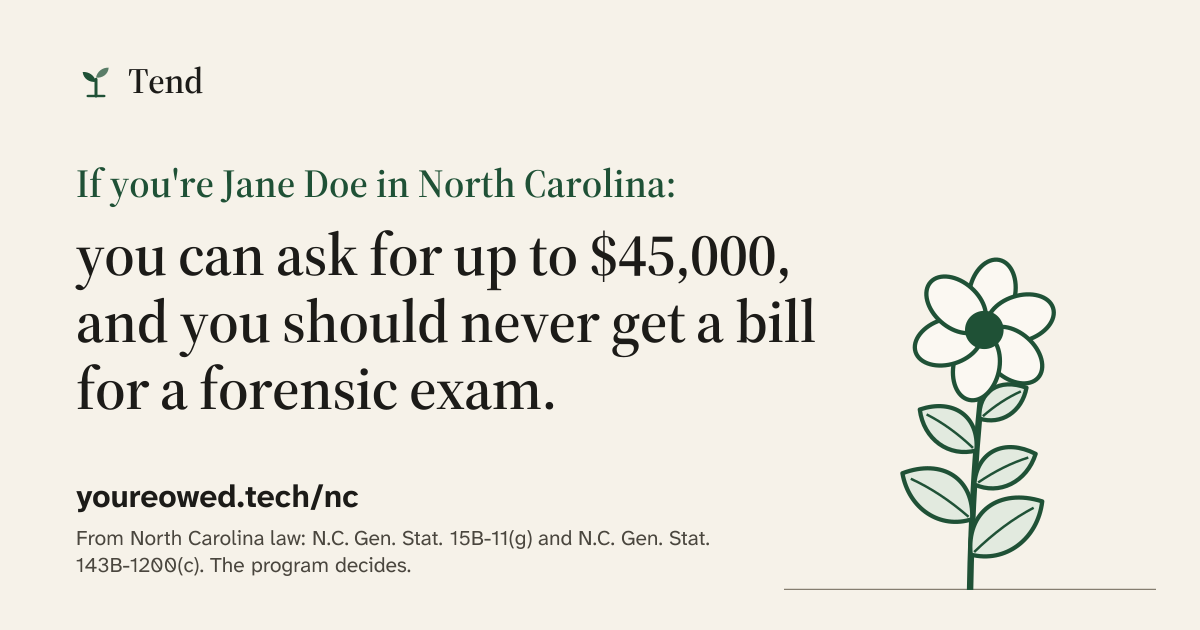
If you're Jane Doe in North Carolina: you can ask for up to $45,000, and you should never get a bill for a forensic exam.
Anyone can post this card. It says nothing about the person who shares it, and this page keeps no record of who opens it.
When you are ready
Tend can check your own costs against this law on your device. It never asks what happened, and nothing leaves your device unless you send it.