Law garden / Ohio
If you're Jane Doe in Ohio
What Ohio's crime victim compensation law says, in plain words. Each line links to the exact sentence it comes from.
Ohio Victims of Crime Compensation Program, run by Ohio Attorney General, Crime Victim Services Section.
Show the law for this line: Ohio Attorney General, Application for Crime Victim Compensation (with program overview)
Ohio Attorney General, Application for Crime Victim Compensation (with program overview)OH-S9
The program's own page, saved by Tend.
- $50,000the most you can ask for in totalORC 2743.60(H)
- 3 yearsto apply, from the date it happenedORC 2743.56(B); ORC 2743.60(A)(2)(d)
- Police reportthe program asks for oneORC 2743.60(A)(1)
- $0what a forensic exam should cost youORC 2907.28(B)
What the program can pay for
The most the program can pay for all costs together is $50,000.
Show the law for this line: ORC 2743.60(H)
ORC 2743.60(H)OH-CAP-1
Total compensation for an injured victim, together with everyone else claiming for that victim's injury, is capped at $50,000.
Reparations payable to a victim described in division (L)(1) of section 2743.51 of the Revised Code and to all other claimants sustaining economic loss because of injury to or the death of that victim shall not exceed fifty thousand dollars in the aggregate.
Medical care
Show the law for this line: ORC 2743.51(F)(1)
ORC 2743.51(F)(1)OH-COV-1
Medical care, rehabilitation, and other remedial treatment are allowable expenses for an injured victim.
"allowable expense" means reasonable charges incurred for reasonably needed products, services, and accommodations, including those for medical care, rehabilitation, rehabilitative occupational training, and other remedial treatment and care
Counseling
- An immediate family member living with a sexual assault victim can claim counseling on their own, capped at $5,000; for this kind of claimant counseling is the only payable expense.
Show the law for this line: Application for Crime Victim Compensation, Section 4and 1 more
Application for Crime Victim Compensation, Section 4OH-COV-3
The application lets the victim request counseling expenses for themselves.
Counseling expenses for victim
Open the source on ohioattorneygeneral.gov (opens in a new tab)
ORC 2743.60(H); ORC 2743.51(L)(2) and (F)(2)OH-CAP-2
Reparations payable to a victim described in division (L)(2) of section 2743.51 of the Revised Code shall not exceed five thousand dollars.
Dental care
Show the law for this line: ORC 2743.51(F)(1)
ORC 2743.51(F)(1)OH-COV-2
Replacement of dentures, retainers, and other dental appliances is an allowable expense, along with hearing aids, mobility aids, and eyeglasses.
including replacement costs for hearing aids; dentures, retainers, and other dental appliances; canes, walkers, and other mobility tools; and eyeglasses and other corrective lenses
Lost pay
Show the law for this line: ORC 2743.51(G)
ORC 2743.51(G)OH-COV-4
Lost income from work the victim could not do because of the injury is covered as work loss.
(G) "Work loss" means loss of income from work that the injured person would have performed if the person had not been injured
Child care
Show the law for this line: Application for Crime Victim Compensation, Section 4; see ORC 2743.51(H)
Application for Crime Victim Compensation, Section 4; see ORC 2743.51(H)OH-COV-6
Replacement services, meaning paying someone to do what the victim would normally do such as child care, housecleaning, or errands, can be claimed.
Replacement services (paying someone to do what the victim would normally do such as housecleaning, child care, errands, etc.)
Open the source on ohioattorneygeneral.gov (opens in a new tab)
Clothing and bedding
Show the law for this line: ORC 2743.51(T)(1)
ORC 2743.51(T)(1)OH-COV-5
Clothing removed from the victim so injuries could be assessed or treated can be replaced.
(1) The replacement cost for items of clothing removed from a victim in order to make an assessment of possible physical harm or to treat physical harm;
Replacing belongings
- Replacing property that police took as evidence (such as a phone or clothing) is capped at $750 per claim.
Show the law for this line: ORC 2743.51(U)
ORC 2743.51(U)OH-CAP-4
(U) "Cost of evidence replacement" means costs for replacement of property confiscated for evidentiary purposes related to the criminally injurious conduct, not to exceed seven hundred fifty dollars in the aggregate per claim.
Crime scene cleanup
- Cleanup of the crime scene and repairs to damaged property for personal security (for example doors and windows) are capped at $750 per claim.
Show the law for this line: ORC 2743.51(T)(2)
ORC 2743.51(T)(2)OH-CAP-3
(2) Reasonable and necessary costs of cleaning the scene and repairing, for the purpose of personal security, property damaged at the scene where the criminally injurious conduct occurred, not to exceed seven hundred fifty dollars in the aggregate per claim.
Legal help
- Attorney's fees to get a protective, restraining, or custody order that physically separates the victim from the offender are covered up to $1,000, at no more than $100 an hour.
Show the law for this line: ORC 2743.51(F)(5)(b)
ORC 2743.51(F)(5)(b)OH-CAP-5
(b) Attorney's fees not exceeding one thousand dollars, at a rate not exceeding one hundred dollars per hour, incurred to successfully obtain a restraining order, custody order, or other order to physically separate a victim from an offender.
What it does not pay for
The program does not pay for stolen, damaged, or lost property (for example a broken or stolen phone), or for pain and suffering. Property police kept as evidence is handled separately as evidence replacement.
Show the law for this line: Application for Crime Victim Compensation, program overview (Are there limits on compensation?)
Application for Crime Victim Compensation, program overview (Are there limits on compensation?)OH-EXCL-1
Yes. Compensation cannot be paid for pain and suffering, stolen, damaged, or lost property.
Open the source on ohioattorneygeneral.gov (opens in a new tab)
Pain, suffering, and other noneconomic harm are not compensable economic loss.
Show the law for this line: ORC 2743.51(E)
ORC 2743.51(E)OH-EXCL-2
Noneconomic detriment is not economic loss
The forensic exam
You should not get a bill for a sexual assault forensic exam.
Show the law for this line: ORC 2907.28(B)
ORC 2907.28(B)OH-EXAM-1
Hospitals may not bill a sexual assault survivor, or the survivor's insurance, for the medical exam and test done to gather evidence. This covers the evidence exam itself, not every service at the same visit; emergency contraception, late adult exams, and treatment of other injuries are handled in the other SAFE exam rules.
No costs incurred by a hospital or emergency facility in conducting a medical examination and test of any victim of an offense under any provision of sections 2907.02 to 2907.06 of the Revised Code for the purpose of gathering physical evidence for a possible prosecution of a person shall be billed or charged directly or indirectly to the victim or the victim's insurer.
The provider should not bill your insurance for it either.
Show the law for this line: ORC 2907.28(B)
ORC 2907.28(B)OH-EXAM-1
Hospitals may not bill a sexual assault survivor, or the survivor's insurance, for the medical exam and test done to gather evidence. This covers the evidence exam itself, not every service at the same visit; emergency contraception, late adult exams, and treatment of other injuries are handled in the other SAFE exam rules.
No costs incurred by a hospital or emergency facility in conducting a medical examination and test of any victim of an offense under any provision of sections 2907.02 to 2907.06 of the Revised Code for the purpose of gathering physical evidence for a possible prosecution of a person shall be billed or charged directly or indirectly to the victim or the victim's insurer.
The state reparations fund pays the hospital for the forensic exam, including antibiotics and HIV post-exposure prophylaxis given as part of the exam.
Show the law for this line: ORC 2907.28(A)
ORC 2907.28(A)OH-EXAM-2
Any cost incurred by a hospital or emergency medical facility in conducting a medical examination of a victim of an offense under any provision of sections 2907.02 to 2907.06 of the Revised Code for the purpose of gathering physical evidence for a possible prosecution, including the cost of any antibiotics administered as part of the examination and the cost of HIV post-exposure prophylaxis provided as part of the examination, shall be paid out of the reparations fund established pursuant to section 2743.191 of the Revised Code
The hospital must accept a flat fee of $632 from the state as payment in full for the forensic exam, including antibiotics given during it.
Show the law for this line: OAC 109:7-1-02(A)
OAC 109:7-1-02(A)OH-EXAM-3
A hospital, children's advocacy center, or other emergency medical facility shall accept a flat fee payment of: (A) Six hundred thirty-two dollars as payment in full for any cost incurred in conducting a medical examination and test of a victim of an offense under any provision of sections 2907.02 to 2907.06 of the Revised Code for the purpose of gathering physical evidence for a possible prosecution of a person, including the cost of any antibiotics administered as part of the examination.
State payment for the forensic exam does not depend on the survivor cooperating with police; an adult who does not want to report can have the exam billed to the SAFE Program under a Jane or John Doe name.
Show the law for this line: SAFE Reimbursement Instructions, item 12 (Law enforcement reporting); Jane/John Doe submission at item 5
SAFE Reimbursement Instructions, item 12 (Law enforcement reporting); Jane/John Doe submission at item 5OH-EXAM-4
The sexual assault forensic exam and reimbursement is not dependent on the patient cooperating with law enforcement.
Open the source on ohioattorneygeneral.gov (opens in a new tab)
For an adult patient, the SAFE Program pays for evidence collection when the last incident was less than 96 hours before the exam; after 96 hours the procedures are billable to the patient unless the protocol's extenuating circumstances apply.
Show the law for this line: SAFE Reimbursement Instructions, mandated examination components table (18 and over); see item 9
SAFE Reimbursement Instructions, mandated examination components table (18 and over); see item 9OH-EXAM-5
Last incident(s) greater than 96 hours**** - procedures billable to patient
Open the source on ohioattorneygeneral.gov (opens in a new tab)
Emergency contraception given to an adult or adolescent at the sexual assault exam is not part of the state-paid exam and can be billed to the patient or the patient's insurer.
Show the law for this line: SAFE Reimbursement Instructions, Billing
SAFE Reimbursement Instructions, BillingOH-EXAM-6
If an adult/adolescent patient presenting in the emergency department as a victim of sexual assault is provided emergency contraception those costs are billable to the patient/insurer
Open the source on ohioattorneygeneral.gov (opens in a new tab)
The facility is paid the actual amount billed for HIV post-exposure prophylaxis, up to $2,500, as payment in full.
Show the law for this line: OAC 109:7-1-02(B)
OAC 109:7-1-02(B)OH-EXAM-7
(B) A hospital, children's advocacy center, or other emergency medical facility shall accept payment of the actual amount billed; not to exceed twenty-five hundred dollars, as payment in full for any cost incurred in administration of HIV post-exposure prophylaxis protocol in rule 109:7-1-01 of the Administrative Code.
Police report
The program asks that the crime be reported to police.
Show the law for this line: ORC 2743.60(A)(1)and 1 more
ORC 2743.60(A)(1)OH-REPORT-1
The crime must have been reported to police at some point. Ohio no longer has a reporting deadline, and the statute lists no alternative to a police report for sexual assault.
The attorney general or the court of claims shall not make or order an award of reparations to a claimant if the criminally injurious conduct upon which the claimant bases a claim never was reported to a law enforcement officer or agency.
Court of Claims FAQ: Do I need to File a police report in order to qualify for the program?OH-REPORT-2
The Court of Claims confirms the old 72-hour police report deadline is gone, but a police report is still required.
Although the former 72-hour deadline for filing a police report has been eliminated, the victim must File a police report.
Read this sentence on ohiocourtofclaims.gov (opens in a new tab)
The crime must have been reported to police at some point. Ohio no longer has a reporting deadline, and the statute lists no alternative to a police report for sexual assault.
Show the law for this line: ORC 2743.60(A)(1)
ORC 2743.60(A)(1)OH-REPORT-1
The attorney general or the court of claims shall not make or order an award of reparations to a claimant if the criminally injurious conduct upon which the claimant bases a claim never was reported to a law enforcement officer or agency.
The Court of Claims confirms the old 72-hour police report deadline is gone, but a police report is still required.
Show the law for this line: Court of Claims FAQ: Do I need to File a police report in order to qualify for the program?
Court of Claims FAQ: Do I need to File a police report in order to qualify for the program?OH-REPORT-2
Although the former 72-hour deadline for filing a police report has been eliminated, the victim must File a police report.
Read this sentence on ohiocourtofclaims.gov (opens in a new tab)
Deadline to apply
Apply within 3 years of the date it happened.
Show the law for this line: ORC 2743.56(B); ORC 2743.60(A)(2)(d)
ORC 2743.56(B); ORC 2743.60(A)(2)(d)OH-DEADLINE-1
Apply within three years of the crime. The statute points to ORC 2743.60 for exceptions: claimants who were minors or young adults at the time get extra time, and the Attorney General may accept a late claim at any time for good cause shown.
All applications for an award of reparations may be filed at any time within three years after the occurrence of the criminally injurious conduct, except as provided in divisions (A)(2)(b) to (d) of section 2743.60 of the Revised Code.
If the claimant was under twenty-one when the crime happened, the claim is not time-barred until after the claimant's twenty-fourth birthday.
Show the law for this line: ORC 2743.60(A)(2)(b)
ORC 2743.60(A)(2)(b)OH-DEADLINE-2
If the claimant was under twenty-one years of age at the time of the criminally injurious conduct, the claim is not barred under division (A)(2)(a) of this section until after the claimant's twenty-fourth birthday.
Keeping your name and address private
Ohio's Safe at Home program, run by the Secretary of State, gives survivors of rape, sexual battery, domestic violence, stalking, or human trafficking a substitute address to use on government records instead of their real one. You apply with a certified Application Assistant at a survivor services organization.
Show the law for this line: ORC 111.42(A)(3)
ORC 111.42(A)(3)OH-ACP-1
The applicant fears for the safety of the applicant, a member of the applicant's household, or the minor, incompetent, or ward on whose behalf the application is made because the applicant, household member, minor, incompetent, or ward is a victim of domestic violence, menacing by stalking, human trafficking, trafficking in persons, rape, or sexual battery.
Records the Attorney General or Court of Claims gets for a compensation claim (such as medical or counseling records) that were confidential or exempt from public records law in the hands of whoever created them stay confidential once the program has them. This does not make the whole claim file confidential, and the records can still be used in hearings and written decisions on the claim.
Show the law for this line: ORC 2743.62(A)(2)(a)
ORC 2743.62(A)(2)(a)OH-RECORDS-1
any record or report that the court of claims or the attorney general has obtained prior to, or obtains on or after, June 30, 1998, under the provisions of sections 2743.51 to 2743.72 of the Revised Code and that is confidential or otherwise exempt from public disclosure under section 149.43 of the Revised Code while in the possession of the creator of the record or report shall remain confidential or exempt from public disclosure under section 149.43 of the Revised Code while in the possession of the court of claims or the attorney general.
How to apply
Online https://cvonlinecompensationapp.ohioattorneygeneral.gov/
Show the law for this line: AG Apply for Victims Compensation, Two options for filing a claim
AG Apply for Victims Compensation, Two options for filing a claimOH-SUBMIT-ONLINE
Register on the Attorney General's Crime Victim's Compensation Portal and file the claim application online.
Register and file a claim application online.
Read this sentence on ohioattorneygeneral.gov (opens in a new tab)
Email CrimeVictimsCompensationApplications@OhioAGO.gov
Show the law for this line: AG Apply for Victims Compensation, Two options for filing a claim
AG Apply for Victims Compensation, Two options for filing a claimOH-SUBMIT-EMAIL
New applications can be emailed, but only as a PDF or Word attachment; photos or screenshots of the pages are rejected.
New applications can also be emailed to CrimeVictimsCompensationApplications@OhioAGO.gov but they must be attached as a PDF or Word document . No photos or screenshots of the pages will be accepted.
Read this sentence on ohioattorneygeneral.gov (opens in a new tab)
Mail Crime Victim Services Section 30 E. Broad Street, 26th Floor Columbus, OH 43215
Show the law for this line: AG Apply for Victims Compensation, Two options for filing a claim
AG Apply for Victims Compensation, Two options for filing a claimOH-SUBMIT-MAIL
Print the paper application, fill it out, and mail it to the Attorney General's Crime Victim Services Section in Columbus.
Download and print an application , fill it out and mail it to Crime Victim Services Section 30 E. Broad Street, 26th Floor Columbus, OH 43215
Read this sentence on ohioattorneygeneral.gov (opens in a new tab)
Fax 614-752-2732 or 855-229-0600
Show the law for this line: AG Apply for Victims Compensation, Two options for filing a claim
AG Apply for Victims Compensation, Two options for filing a claimOH-SUBMIT-FAX
The completed paper application can be faxed to either of the Attorney General's fax numbers.
or fax it to 614-752-2732 or 855-229-0600.
Read this sentence on ohioattorneygeneral.gov (opens in a new tab)
Phone 614-466-5610
Show the law for this line: Ohio Attorney General, Application for Crime Victim Compensation (with program overview)
Ohio Attorney General, Application for Crime Victim Compensation (with program overview)OH-S9
The program's own page, saved by Tend.
If you need money soon
If a final award looks likely and waiting would cause undue hardship, the Attorney General can make an emergency award of up to $2,000, which is taken out of the final award.
Show the law for this line: ORC 2743.67
ORC 2743.67OH-EMERG-1
An emergency award shall not exceed two thousand dollars.
Good to know before you apply
For a crime in Ohio, a victim who was a resident of the United States can apply (or a resident of a foreign country that gives Ohio residents reciprocal compensation).
Show the law for this line: ORC 2743.51(A)(1)(a) and (C)(1)
ORC 2743.51(A)(1)(a) and (C)(1)OH-RES-1
(i) A resident of the United States; (ii) A resident of a foreign country the laws of which permit residents of this state to recover compensation as victims of offenses committed in that country.
An Ohio resident hurt by a crime in another state or country can apply if they also met one listed condition, such as working in Ohio, being a full-time student at a school in another state, or being temporarily out of state for treatment or work.
Show the law for this line: ORC 2743.51(A)(2)(a) and (C)(2)
ORC 2743.51(A)(2)(a) and (C)(2)OH-RES-2
A victim who had a permanent place of residence within this state at the time of the criminally injurious conduct and who, at the time of the criminally injurious conduct, complied with any one of the following:
The award is reduced by anything recovered from other sources, such as insurance, so the program pays after those sources.
Show the law for this line: ORC 2743.60(D)
ORC 2743.60(D)OH-COLL-1
The attorney general or the court of claims shall reduce an award of reparations or deny a claim for an award of reparations that is otherwise payable to a claimant to the extent that the economic loss upon which the claim is based is recouped from other persons, including collateral sources.
If a claimant unreasonably fails to file a timely claim with insurance or another source that would have paid, the award can be reduced or denied to that extent.
Show the law for this line: ORC 2743.60(G)
ORC 2743.60(G)OH-COLL-2
If a claimant unreasonably fails to present a claim timely to a source of benefits or advantages that would have been a collateral source and that would have reimbursed the claimant for all or a portion of a particular expense, the attorney general or the court of claims may reduce an award of reparations or deny a claim for an award of reparations to the extent that it is reasonable to do so.
The state only pays an award that comes to $50 or more.
Show the law for this line: ORC 2743.191(B)(1)
ORC 2743.191(B)(1)OH-MIN-1
The attorney general shall provide for payment of the claimant or providers in the amount of the award only if the amount of the award is fifty dollars or more.
Share this page
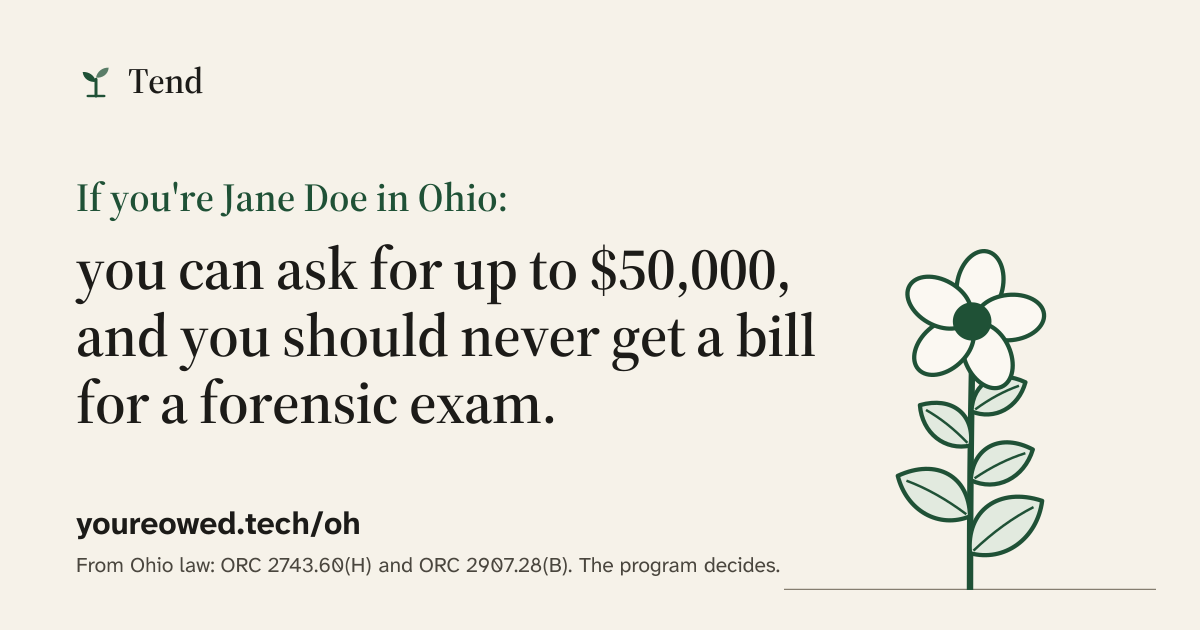
If you're Jane Doe in Ohio: you can ask for up to $50,000, and you should never get a bill for a forensic exam.
Anyone can post this card. It says nothing about the person who shares it, and this page keeps no record of who opens it.
When you are ready
Tend can check your own costs against this law on your device. It never asks what happened, and nothing leaves your device unless you send it.