Law garden / Oregon
If you're Jane Doe in Oregon
What Oregon's crime victim compensation law says, in plain words. Each line links to the exact sentence it comes from.
Crime Victims' Compensation (CVC) Program, run by Oregon Department of Justice, Crime Victim and Survivor Services Division.
Show the law for this line: Oregon DOJ: Compensation for Victims of Crime
Oregon DOJ: Compensation for Victims of CrimeOR-S2
The program's own page, saved by Tend.
- $47,000the most you can ask for in totalORS 147.035(1)(b)
- 1 yearto apply, from the date it happenedORS 147.015(1)(e)
- Exam can countin place of a police reportORS 147.015(2)(a)(E), (2)(b), (2)(c)
- $0what a forensic exam should cost youORS 147.397(4)
What the program can pay for
The most the program can pay for all costs together is $47,000.
Show the law for this line: ORS 147.035(1)(b)
ORS 147.035(1)(b)OR-CAP-1
The most compensation that can be awarded in total is $47,000.
The maximum amount of compensation that may be awarded, in aggregate, to the victim and the survivors and dependents of a deceased victim is $47,000.
Read this sentence on oregonlegislature.gov (opens in a new tab)
Medical care
- Medical and hospital expenses, including counseling and medications, are covered up to $20,000 combined.
Show the law for this line: Compensation for Victims of Crime page, benefits listand 1 more
Compensation for Victims of Crime page, benefits listOR-COV-DEVICES
Damaged eyeglasses, hearing aids, dentures and other medically necessary devices can be replaced if mentioned in the police report or medical chart notes.
Replacement of damaged eyeglasses, hearing aids, dentures and other medically necessary devices and expenses (must be mentioned in the police report or medical chart notes)
ORS 147.035(2)(a)OR-CAP-MED
The victim's reasonable medical and hospital expenses, including counseling expenses and the cost of any medications, up to a maximum amount of $20,000
Read this sentence on oregonlegislature.gov (opens in a new tab)
Counseling
- The victim's counseling counts toward the same $20,000 limit as medical and hospital expenses.
- An applicant who does not meet the eligibility requirements (for example, the reporting requirement) may still get a limited counseling award of up to $5,000.
Show the law for this line: OAR 137-084-0020(1)(k)and 3 more
OAR 137-084-0020(1)(k)OR-EXAM-6
The SAVE Fund also covers 5 counseling sessions, which must be used within 18 months of the exam.
Five (5) counseling sessions; counseling sessions expire 18 months from the date of the sexual assault exam.
Read this sentence on secure.sos.state.or.us (opens in a new tab)
CVC FAQ, How much do compensation benefits cover?OR-COUNS-SESS
On an approved claim, CVC pays for 30 counseling sessions and needs a treatment plan from the provider for more.
If CVC approves the claim, we can pay for 30 counseling sessions. We require a treatment plan from the provider for any further sessions.
ORS 147.035(2)(a)OR-CAP-COUNS
The victim's reasonable medical and hospital expenses, including counseling expenses and the cost of any medications, up to a maximum amount of $20,000
Read this sentence on oregonlegislature.gov (opens in a new tab)
OAR 137-076-0016(6)OR-CAP-COUNS-LTD
If the applicant files an application for a compensable crime and does not meet the eligibility requirements set forth in ORS 147.015, the Department may grant a limited counseling award of up to $5,000.00.
Read this sentence on secure.sos.state.or.us (opens in a new tab)
Dental care
Show the law for this line: CVC FAQ, dental work
CVC FAQ, dental workOR-COV-DENTAL
Crime-related dental work is covered; without insurance, CVC must first approve a treatment plan from a licensed dental provider.
If you do not have insurance, CVC must review and approve a treatment plan provided by a licensed dental provider. All treatment needs to be directly related to the crime.
Travel
- Travel for the victim's covered medical care or counseling is paid up to $3,000, only when the care is more than 30 miles from home and adequate care is not available closer.
Show the law for this line: CVC brochure (2024), What Does CVC Pay For?and 1 more
CVC brochure (2024), What Does CVC Pay For?OR-TRANS-RATE
Mileage to medical and mental health treatment is reimbursed at 50 cents per mile, up to $3,000.
Reimbursement of mileage (50¢ per mile) for travel to medical and mental health treatment, up to $3,000.
ORS 147.035(2)(g)OR-CAP-TRANS
Expenses related to transportation for the victim's medical care or counseling, at a rate determined by the Department of Justice, up to a maximum amount of $3,000, when: (A) The medical care or counseling is compensable under this section; (B) The medical care or counseling is provided more than 30 miles away from the victim's residence; and (C) Adequate medical care or counseling is not available in closer proximity to the victim's residence.
Read this sentence on oregonlegislature.gov (opens in a new tab)
Lost pay
- Lost earnings are paid at up to $600 per week.
- Lost earnings are capped at $20,000 in total.
- A parent or guardian who misses work to care for a minor victim can get up to $5,000 in lost earnings.
Show the law for this line: OAR 137-076-0025(3)and 4 more
OAR 137-076-0025(3)OR-WAGE-RATE
Lost earnings are figured at 75% of the victim's documented gross earnings on the date of the crime.
Compensation for lost earnings under ORS 147.035(2)(b) shall be computed on the basis of 75% of the victim's documented gross earnings on the date of the compensable crime.
Read this sentence on secure.sos.state.or.us (opens in a new tab)
OAR 137-076-0025(1)(c)(C)OR-WAGE-DOC
Missing more than 10 working days requires confirmation from a health provider, or a licensed therapist for an emotional injury.
Lost earnings compensation for periods of disability in excess of 10 working days may be paid only if the period of disability is confirmed by a health provider , or a licensed therapist when the victim has missed work due to an emotional injury.
Read this sentence on secure.sos.state.or.us (opens in a new tab)
ORS 147.035(2)(b)OR-CAP-WAGE-WK
Loss of the victim's earnings, at a maximum rate of $600 per week, up to a maximum amount of $20,000
Read this sentence on oregonlegislature.gov (opens in a new tab)
ORS 147.035(2)(b)OR-CAP-WAGE
Loss of the victim's earnings, at a maximum rate of $600 per week, up to a maximum amount of $20,000
Read this sentence on oregonlegislature.gov (opens in a new tab)
OAR 137-076-0025(2)(d)(C)OR-CAP-WAGE-PARENT
Loss of earnings for the parent or guardian are compensable up to a maximum of $5,000.00 under the child victim's claim under ORS 147.035 (2)(f).
Read this sentence on secure.sos.state.or.us (opens in a new tab)
Crime scene cleanup
- Crime scene cleaning is covered up to $2,500.
Show the law for this line: ORS 147.035(2)(d)
ORS 147.035(2)(d)OR-CAP-CLEAN
Reasonable cleaning expenses, up to a maximum of $2,500
Read this sentence on oregonlegislature.gov (opens in a new tab)
What it does not pay for
Compensation is not paid for property damage or for noneconomic damages.
Show the law for this line: ORS 147.035(5)
ORS 147.035(5)OR-EXCL-PROP
Compensation may not be awarded under ORS 147.005 to 147.367 for property damage or noneconomic damages as defined in ORS 31.705.
Read this sentence on oregonlegislature.gov (opens in a new tab)
CVC cannot pay for lost items or property damage.
Show the law for this line: CVC brochure (2024)
CVC brochure (2024)OR-EXCL-PROP-2
The CVC Program cannot pay for lost items or property damage.
CVC does not pay relocation costs.
Show the law for this line: Compensation for Victims of Crime page
Compensation for Victims of Crime pageOR-EXCL-RELO
CVC can not reimburse damages for property crimes, or pay for relocation costs.
The SAVE Fund does not pay for DNA testing, prescriptions filled off-site, follow-up services, anesthesia, or transportation; the provider may bill these to the survivor or insurance, and CVC may cover them on an accepted claim.
Show the law for this line: OAR 137-084-0030(1)
OAR 137-084-0030(1)OR-EXCL-SAVE
Examples of services not covered by the Fund include, but are not limited to: DNA testing; prescriptions filled off-site of the location of a medical examination; follow-up services; anesthesia services; and transportation.
Read this sentence on secure.sos.state.or.us (opens in a new tab)
The forensic exam
You should not get a bill for a sexual assault forensic exam.
Show the law for this line: ORS 147.397(4)and 1 more
ORS 147.397(4)OR-EXAM-1
A provider that bills the SAVE Fund for a sexual assault medical assessment may not bill the survivor for it, unless the Fund lacks money or declines to pay. The statute does not address billing the survivor's insurance; the SAVE Fund rule does, and it bars billing insurance too.
A provider who submits a bill under this subsection may not bill the victim for the medical assessment except to the extent that the department is unable to pay the bill due to lack of funds or declines to pay the bill.
Read this sentence on oregonlegislature.gov (opens in a new tab)
OAR 137-084-0020(4)OR-EXAM-2
A provider that bills the SAVE Fund may not bill the survivor or the survivor's insurance for the exam, evidence collection, or other services given with the exam (exceptions: the Fund lacks money or declines to pay for reasons other than a late or incomplete bill).
An eligible medical services provider (including subcontractor or other designee) who submits a bill to the Fund under these rules may not bill the victim or the victim's insurance carrier for a medical examination, collection of forensic evidence using the Oregon State Police SAFE Kit, or other services provided in conjunction with the sexual assault exam
Read this sentence on secure.sos.state.or.us (opens in a new tab)
The provider should not bill your insurance for it either.
Show the law for this line: OAR 137-084-0020(4)
OAR 137-084-0020(4)OR-EXAM-2
A provider that bills the SAVE Fund may not bill the survivor or the survivor's insurance for the exam, evidence collection, or other services given with the exam (exceptions: the Fund lacks money or declines to pay for reasons other than a late or incomplete bill).
An eligible medical services provider (including subcontractor or other designee) who submits a bill to the Fund under these rules may not bill the victim or the victim's insurance carrier for a medical examination, collection of forensic evidence using the Oregon State Police SAFE Kit, or other services provided in conjunction with the sexual assault exam
Read this sentence on secure.sos.state.or.us (opens in a new tab)
The Oregon Department of Justice pays for a sexual assault medical assessment through the SAVE Fund, subject to available funds and the time frame set by rule.
Show the law for this line: ORS 147.397(1)
ORS 147.397(1)OR-EXAM-3
Subject to the availability of funds from gifts, grants and donations in the Sexual Assault Victims' Emergency Medical Response Fund, the Department of Justice shall pay the costs of a medical assessment obtained by a victim if the victim obtains the medical assessment within the time frame established in rules adopted by the department.
Read this sentence on oregonlegislature.gov (opens in a new tab)
A survivor can get a SAVE Fund paid medical assessment without reporting the assault to police.
Show the law for this line: ORS 147.397(8)
ORS 147.397(8)OR-EXAM-4
A victim may obtain a medical assessment and complete and submit a form under this section regardless of whether the victim reports the sexual assault to a law enforcement agency.
Read this sentence on oregonlegislature.gov (opens in a new tab)
Police report
The program asks for a police report. The rules below say when other records can count instead, like a forensic exam or a protective order.
Show the law for this line: ORS 147.015(1)(b)and 4 more
ORS 147.015(1)(b)OR-REPORT-1
The crime must be reported to law enforcement, unless the department finds the applicant acted reasonably in not reporting. No fixed number of days is set.
The appropriate law enforcement officials were notified of the perpetration of the crime allegedly causing the death or injury to the victim, unless the Department of Justice finds that, notwithstanding the failure of notification, the applicant acted reasonably under the circumstances
Read this sentence on oregonlegislature.gov (opens in a new tab)
ORS 147.015(2)(a)(E), (2)(b), (2)(c)OR-REPORT-2
The reporting requirement is also met by a sexual assault medical assessment or other forensic exam, or a health or mental health provider certifying the victim reported to them, or other documentation the department accepts.
(E) A medical assessment, as defined in ORS 147.395, for sexual assault, or any other forensic exam or medical assessment; (b) A health provider, tribal health provider, student health provider or community mental health provider certifies that the victim reported the crime to the provider; or (c) The victim provides to the department documentation that qualifies as law enforcement notification under the rules of the department.
Read this sentence on oregonlegislature.gov (opens in a new tab)
ORS 147.015(2)(a)(B)OR-REPORT-5
Getting a sexual abuse restraining order (or a stalking, abuse prevention or no contact order) because of the crime also meets the reporting requirement.
A sexual abuse restraining order under ORS 163.760 to 163.777
Read this sentence on oregonlegislature.gov (opens in a new tab)
CVC brochure (2024), Reporting RequirementsOR-REPORT-3
Survivors can meet the reporting requirement by reporting to police, telling a medical or mental health provider, getting a protective order, or getting a forensic exam.
You may report your crime in one of the following ways: • Report to law enforcement • Report to a medical or mental health provider • Obtain a protective order • Obtain a forensic medical exam due to sexual assault or strangulation
OAR 137-076-0016(4)OR-REPORT-4
The report (or alternative) must happen before the department receives the application.
Notification of the perpetration of the crime as required by ORS 147.015 must have been done prior to the application being received by the Department in order for a person to be eligible for an award of compensation.
Read this sentence on secure.sos.state.or.us (opens in a new tab)
The crime must be reported to law enforcement, unless the department finds the applicant acted reasonably in not reporting. No fixed number of days is set.
Show the law for this line: ORS 147.015(1)(b)
ORS 147.015(1)(b)OR-REPORT-1
The appropriate law enforcement officials were notified of the perpetration of the crime allegedly causing the death or injury to the victim, unless the Department of Justice finds that, notwithstanding the failure of notification, the applicant acted reasonably under the circumstances
Read this sentence on oregonlegislature.gov (opens in a new tab)
The reporting requirement is also met by a sexual assault medical assessment or other forensic exam, or a health or mental health provider certifying the victim reported to them, or other documentation the department accepts.
Show the law for this line: ORS 147.015(2)(a)(E), (2)(b), (2)(c)
ORS 147.015(2)(a)(E), (2)(b), (2)(c)OR-REPORT-2
(E) A medical assessment, as defined in ORS 147.395, for sexual assault, or any other forensic exam or medical assessment; (b) A health provider, tribal health provider, student health provider or community mental health provider certifies that the victim reported the crime to the provider; or (c) The victim provides to the department documentation that qualifies as law enforcement notification under the rules of the department.
Read this sentence on oregonlegislature.gov (opens in a new tab)
Getting a sexual abuse restraining order (or a stalking, abuse prevention or no contact order) because of the crime also meets the reporting requirement.
Show the law for this line: ORS 147.015(2)(a)(B)
ORS 147.015(2)(a)(B)OR-REPORT-5
A sexual abuse restraining order under ORS 163.760 to 163.777
Read this sentence on oregonlegislature.gov (opens in a new tab)
Survivors can meet the reporting requirement by reporting to police, telling a medical or mental health provider, getting a protective order, or getting a forensic exam.
Show the law for this line: CVC brochure (2024), Reporting Requirements
CVC brochure (2024), Reporting RequirementsOR-REPORT-3
You may report your crime in one of the following ways: • Report to law enforcement • Report to a medical or mental health provider • Obtain a protective order • Obtain a forensic medical exam due to sexual assault or strangulation
The report (or alternative) must happen before the department receives the application.
Show the law for this line: OAR 137-076-0016(4)
OAR 137-076-0016(4)OR-REPORT-4
Notification of the perpetration of the crime as required by ORS 147.015 must have been done prior to the application being received by the Department in order for a person to be eligible for an award of compensation.
Read this sentence on secure.sos.state.or.us (opens in a new tab)
Deadline to apply
Apply within 1 year of the date it happened.
Show the law for this line: ORS 147.015(1)(e)
ORS 147.015(1)(e)OR-DEADLINE-1
The application must be filed within one year of the injury, or later if the department allows an extension for good cause.
Within one year of the date of the injury to the victim; or (B) Within such further extension of time as the department, for good cause shown, allows.
Read this sentence on oregonlegislature.gov (opens in a new tab)
Good cause for filing after one year includes not knowing about the program, police not giving the required information, or trauma that got in the way of filing on time.
Show the law for this line: OAR 137-076-0030(2)
OAR 137-076-0030(2)OR-DEADLINE-2
"Good cause" for failure to file an application for compensation within one year of the date of the crime as required by ORS 147.015(1)(e) includes but is not limited to the victim's lack of knowledge of the Crime Victims' Compensation Program, failure of a law enforcement official to provide information to the victim as required by ORS 147.365(1), or emotional or physical trauma sustained by the victim that was a barrier to timely filing the application for compensation.
Read this sentence on secure.sos.state.or.us (opens in a new tab)
Keeping your name and address private
Oregon DOJ's Address Confidentiality Program is a free mail forwarding service that gives survivors of sexual assault, domestic violence, stalking, human trafficking, and bias crimes a substitute address to use instead of their real one.
Show the law for this line: Oregon DOJ ACP page, 'Protecting Addresses for Victims'; program established by ORS 192.822
Oregon DOJ ACP page, 'Protecting Addresses for Victims'; program established by ORS 192.822OR-ACP-1
It helps survivors of domestic violence, sexual assault, stalking, human trafficking, bias crimes or bias incidents shield their physical address. Health care providers who provide physical and behavioral reproductive and gender-affirming health care also can participate in ACP. Program participants are provided with a substitute address to use instead of their real address.
Information an applicant gives the DOJ is open to the public by default, but the department may keep it confidential when the crime is rape, sodomy, sexual abuse, trafficking, or domestic violence and the victim's interests require it. The statute does not make the whole claim file confidential.
Show the law for this line: ORS 147.115(1)(b)
ORS 147.115(1)(b)OR-REC-1
All information submitted to the Department of Justice by an applicant and all hearings of the Workers’ Compensation Board under ORS 147.005 to 147.367 shall be open to the public unless the department or board determines that the information shall be kept confidential or that a closed hearing shall be held because: (a) The alleged assailant has not been brought to trial and disclosure of the information or a public hearing would adversely affect either the apprehension or the trial of the alleged assailant; (b) The offense allegedly perpetrated against the victim is rape, sodomy, sexual abuse, trafficking in persons or a crime involving domestic violence as defined in ORS 135.230, and the interests of the victim or of the victim’s dependents require that the information be kept confidential or that the public be excluded from the hearing;
Read this sentence on oregonlegislature.gov (opens in a new tab)
How to apply
Online doj.state.or.us/cvcportal
Show the law for this line: CVC Application (2026), page i, How do I apply?
CVC Application (2026), page i, How do I apply?OR-SUBMIT-ONLINE
Apply online through the CVC Portal, which also lets you upload documents and check claim status.
You can apply electronically through the Crime Victims’ Compensation Portal at doj.state.or.us/cvcportal.
Email cvssd@doj.oregon.gov
Show the law for this line: CVC Application (2026), page i, How do I apply?
CVC Application (2026), page i, How do I apply?OR-SUBMIT-EMAIL
Email the completed, signed application to the program.
You can also submit your application by email: cvssd@doj.oregon.gov
Mail Oregon Department of Justice Crime Victims' Compensation Program 1162 Court Street NE Salem, OR 97301-4096
Show the law for this line: CVC Application (2026), page i, How do I apply?
CVC Application (2026), page i, How do I apply?OR-SUBMIT-MAIL
Mail the signed paper application to the DOJ Crime Victims' Compensation Program in Salem.
You can mail a paper application to: Oregon Department of Justice Crime Victims’ Compensation Program 1162 Court Street NE Salem, OR 97301–4096
In person your local District Attorney's Office Victim Assistance Program or local community-based victim services agency
Show the law for this line: CVC brochure (2024), How Do I Submit an Application?
CVC brochure (2024), How Do I Submit an Application?OR-SUBMIT-INPERSON
You can also apply in person through a county District Attorney's victim assistance program or a community-based victim services agency.
Apply at your local District Attorney’s Office Victim Assistance Program or local community-based victim services agency.
Phone 503-378-5348
Show the law for this line: Oregon DOJ: Compensation for Victims of Crime
Oregon DOJ: Compensation for Victims of CrimeOR-S2
The program's own page, saved by Tend.
If you need money soon
The department may make an emergency award of up to $1,000 before a final decision when an award is likely and waiting would cause undue hardship.
Show the law for this line: ORS 147.055(2)(a)
ORS 147.055(2)(a)OR-EMERG-1
The amount of such emergency award shall not exceed $1,000.
Read this sentence on oregonlegislature.gov (opens in a new tab)
Good to know before you apply
Victims of crimes committed in Oregon can apply, regardless of where they live.
Show the law for this line: ORS 147.005(17)(a)(A)
ORS 147.005(17)(a)(A)OR-RES-1
Killed or injured in this state as a result of a compensable crime perpetrated or attempted against that person
Read this sentence on oregonlegislature.gov (opens in a new tab)
An Oregon resident hurt in another U.S. state can apply in Oregon only if that state has no reciprocal compensation program; otherwise the state where the crime happened pays.
Show the law for this line: ORS 147.005(17)(a)(E)
ORS 147.005(17)(a)(E)OR-RES-2
Who is an Oregon resident killed or injured as a result of a compensable crime perpetrated or attempted against the person in a state, within the United States, without a reciprocal crime victims' compensation program
Read this sentence on oregonlegislature.gov (opens in a new tab)
Immigration status is not asked about or considered.
Show the law for this line: CVC Application (2026), page 1
CVC Application (2026), page 1OR-RES-3
CVC does not request or consider immigration status when determining eligibility for compensation.
The award is reduced by benefits from workers' compensation, government funds, or any other source the victim received or is entitled to.
Show the law for this line: ORS 147.125(1)(c)
ORS 147.125(1)(c)OR-COLLATERAL-1
shall deduct the amount of benefits, payments or awards that are payable under the Workers' Compensation Law, from local governmental, state or federal funds or from any source, and that the victim or survivors or dependents of the victim have received or to which the victim or survivors or dependents of the victim are entitled as a result of the death or injury of the victim
Read this sentence on oregonlegislature.gov (opens in a new tab)
Health insurance (including OHP), auto, workers' comp, disability, homeowner's, Paid Leave Oregon, unemployment, restitution and settlements must be used first; Indian Health Services is not a prior resource.
Show the law for this line: OAR 137-076-0040
OAR 137-076-0040OR-COLLATERAL-2
A prior resource may include but is not limited to: private or public health insurance, automobile insurance, workers' compensation, disability insurance, homeowner's insurance, Paid Leave Oregon or equivalent plan, unemployment benefits, restitution, civil settlements, and tribal per capita payments. Indian Health Services insurance is not considered a prior resource.
Read this sentence on secure.sos.state.or.us (opens in a new tab)
After insurance pays, CVC can cover copays, deductibles, and crime-related treatment insurance does not cover.
Show the law for this line: CVC brochure (2024), Other Compensation
CVC brochure (2024), Other CompensationOR-COLLATERAL-3
CVC will pay for copays, deductibles, and crime-related treatment that insurance does not cover within the scope of this program.
Share this page
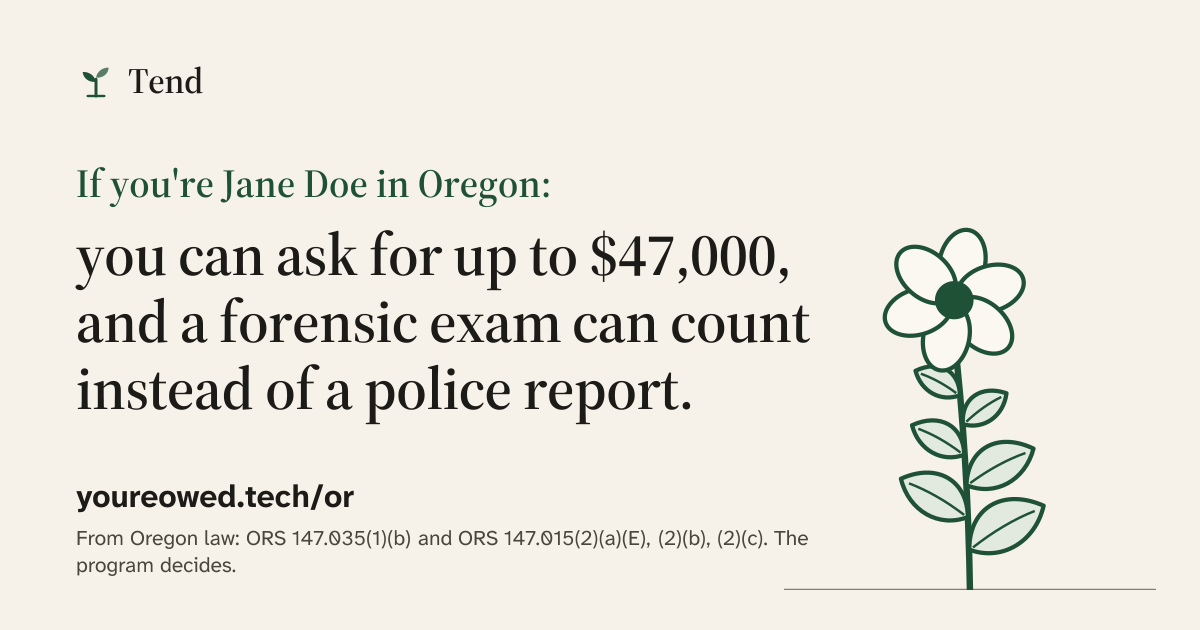
If you're Jane Doe in Oregon: you can ask for up to $47,000, and a forensic exam can count instead of a police report.
Anyone can post this card. It says nothing about the person who shares it, and this page keeps no record of who opens it.
When you are ready
Tend can check your own costs against this law on your device. It never asks what happened, and nothing leaves your device unless you send it.