Law garden / Vermont
If you're Jane Doe in Vermont
What Vermont's crime victim compensation law says, in plain words. Each line links to the exact sentence it comes from.
Vermont Victims Compensation Program, run by Vermont Center for Crime Victim Services (Victims Compensation Board).
Show the law for this line: Vermont CCVS, Application & Forms
Vermont CCVS, Application & FormsVT-S7
The program's own page, saved by Tend.
- $10,000the most you can ask for in total13 V.S.A. § 5356(a)
- Police reportthe program asks for one13 V.S.A. § 5353(a)(1)
- $0what a forensic exam should cost you32 V.S.A. § 1407(c)(2)
What the program can pay for
The most the program can pay for all costs together is $10,000.
Show the law for this line: 13 V.S.A. § 5356(a)
13 V.S.A. § 5356(a)VT-CAP-1
An approved claim can receive up to $10,000 in total, equal to the crime-related losses not paid by other sources.
the Board shall authorize cash payments, not to exceed $10,000.00, to or on behalf of the applicant, equal to the unreimbursed pecuniary loss directly resulting from the injury or death of the victim.
Read this sentence on legislature.vermont.gov (opens in a new tab)
Medical care
Show the law for this line: 13 V.S.A. § 5356(c)and 1 more
13 V.S.A. § 5356(c)VT-MED-1
For uninsured victims who do not qualify for hospital assistance, Medicaid, or Medicare, the Board may pay providers 60 percent of billed charges, and the provider may not bill the victim for the balance.
The Board may reimburse health care facilities and health care providers as defined in 18 V.S.A. § 9402 at 60 percent of the billed charges for compensation claims for uninsured crime victims who do not qualify for the hospital's patient assistance program, Medicaid, or Medicare. The health care facility or health care provider shall not bill any balance to the uninsured crime victim.
Read this sentence on legislature.vermont.gov (opens in a new tab)
13 V.S.A. § 5351(5)VT-MED-2
Pecuniary loss covers medical or medically related expenses, lost wages, and other expenses the Board finds became necessary as a direct result of the crime.
"Pecuniary loss" means, in the case of a victim, the amount of medical or medically related expenses, loss of wages, and any other expenses that the Board feels became necessary as a direct result of the crime.
Read this sentence on legislature.vermont.gov (opens in a new tab)
Counseling
- Victims Compensation pays at most $100 for a one-hour individual or family counseling session, prorated for shorter sessions.
- The Sexual Assault Program pays at most $100 for a one-hour individual counseling session.
Show the law for this line: CCVS Sexual Assault Program Mental Health Policy, Introductionand 3 more
CCVS Sexual Assault Program Mental Health Policy, IntroductionVT-COUNSEL-3
After a sexual assault exam, the Sexual Assault Program can pay for up to 20 sessions of mental health counseling.
The Sexual Assault Program can consider payment of up to 20 sessions of mental health counseling after a victim has obtained a medical sexual assault examination.
13 V.S.A. § 5351(5)VT-COUNSEL-4
Covered medical costs include individual or family psychological, psychiatric, or mental health counseling, and replacing eyeglasses, hearing aids, dentures, or prosthetic devices taken, lost, or destroyed during the crime.
Medical or medically related expenses may include, but are not limited to, the costs of individual or family psychological, psychiatric, or mental health counseling and the costs of replacing or repairing eyeglasses, hearing aids, dentures, or any prosthetic devices that were taken, lost, or destroyed during the commission of the crime.
Read this sentence on legislature.vermont.gov (opens in a new tab)
CCVS Mental Health Policy, Guidelines 1 (Fee Schedule)VT-COUNSEL-1
One-hour individual or family sessions will be paid at a maximum of $100.00 per session.
CCVS Sexual Assault Program Mental Health Policy, Guidelines & Fee ScheduleVT-COUNSEL-2
One-hour individual sessions will be paid at a maximum of $100.00 per session.
Travel
- In non-homicide cases, travel to attend criminal court proceedings, Parole Board hearings, and pre-sentence investigations is capped at $2,000 per claim.
Show the law for this line: Code Vt. R. 80-220-001, Section 5356(B)and 1 more
Code Vt. R. 80-220-001, Section 5356(B)VT-TRAVEL-2
Transportation for medical or mental health treatment can be paid as a medically related expense.
-transportation for medical/mental health treatment.
CCVS Policy for Reimbursement of Travel ExpensesVT-TRAVEL-1
For all non-homicide criminal cases there is a $2,000.00 travel expense cap per claim for the eligible victim to attend criminal court proceedings, Parole Board hearings, and to participate in pre-sentence investigations.
Lost pay
- For claims filed on or after 9/8/2025, lost wages are reimbursed up to $750 per week, for no more than 12 weeks per claim.
Show the law for this line: CCVS Policy for Reimbursement of Lost Wages, para. 2and 1 more
CCVS Policy for Reimbursement of Lost Wages, para. 2VT-WAGES-2
Lost wages are paid at 85% of the victim's gross wages at the time of the loss.
lost wages will be paid at 85% of the victim's gross wages at the time of the loss.
CCVS Policy for Reimbursement of Lost Wages, para. 5bVT-WAGES-1
5b) For Compensation claim filed on or after 9/8/2025: the Victims Compensation Program will reimburse lost wages not to exceed a maximum reimbursement of $750.00 per week per claim, and for not longer than 12 weeks per claim.
Home security
Show the law for this line: CCVS Eligibility page, Expenses the Victims Compensation Program may pay for
CCVS Eligibility page, Expenses the Victims Compensation Program may pay forVT-SEC-1
Safety and security expenses are listed among the costs the program may pay.
Safety/security
Moving
- Relocation costs such as rental trucks, movers, transportation, and up to three months of storage are capped at $1,500 in total.
Show the law for this line: CCVS Policy for Housing and Relocation, introductionand 1 more
CCVS Policy for Housing and Relocation, introductionVT-RELOC-3
The program can help with relocation when the victim's safety is at risk or the victim is displaced by the crime, generally no more than once in a 12-month period.
The Victims Compensation Program will generally pay relocation costs no more than once in a 12-month period.
CCVS Policy for Housing and Relocation, Relocation CostsVT-RELOC-1
Relocation costs could include the following: rental trucks, moving companies, transportation costs, storage fees not to exceed three months. Total relocation costs not to exceed $1,500.
Temporary housing
- Emergency housing is paid at up to $100 per night, for no more than 7 nights.
Show the law for this line: CCVS Policy for Housing and Relocation, Emergency Housing
CCVS Policy for Housing and Relocation, Emergency HousingVT-RELOC-2
Emergency housing will be paid at a maximum of $100.00 per night, for not more than 7 nights.
What it does not pay for
Lost, stolen, or damaged property is not paid, except medically necessary items.
Show the law for this line: CCVS Eligibility page, Expenses that cannot be paid by the Compensation Program
CCVS Eligibility page, Expenses that cannot be paid by the Compensation ProgramVT-EXCL-1
Expenses for lost, stolen or damaged property (except medically necessary items due to a qualifying crime)
Damages for pain and suffering are not paid.
Show the law for this line: CCVS Eligibility page, Expenses that cannot be paid by the Compensation Program
CCVS Eligibility page, Expenses that cannot be paid by the Compensation ProgramVT-EXCL-2
Damages for pain and suffering
Attorney fees are not paid.
Show the law for this line: CCVS Eligibility page, Expenses that cannot be paid by the Compensation Program
CCVS Eligibility page, Expenses that cannot be paid by the Compensation ProgramVT-EXCL-3
Attorney fees
The forensic exam
You should not get a bill for a sexual assault forensic exam.
Show the law for this line: 32 V.S.A. § 1407(c)(2)and 1 more
32 V.S.A. § 1407(c)(2)VT-EXAM-2
If the survivor's health coverage leaves a co-payment, coinsurance, deductible, or other cost-sharing for the exam, the Fund pays that share directly to the provider, so the survivor does not owe it.
If the victim's health coverage does not cover all of the medical care provided pursuant to this section and the victim would otherwise be responsible for any co-payment, coinsurance, deductible, or other cost-sharing, the Fund shall pay the victim's share directly to the health care facility or provider.
Read this sentence on legislature.vermont.gov (opens in a new tab)
32 V.S.A. § 1407(c)(1)VT-EXAM-3
Providers must bill the survivor's health plan, Medicaid, or Medicare for the exam first. If the survivor is uninsured or the plan denies the claim, the Fund pays Vermont providers 60 percent of billed charges and the provider may not bill the survivor for the balance.
Health care facilities and health care providers shall bill the victim's health insurance plan, Medicaid, Medicare, or another health benefit plan, as applicable, for the services described in subsection (b) of this section. If the victim does not have health coverage or if the victim's health benefit plan denies the claim, the Fund shall reimburse health care facilities and health care providers located in Vermont as defined in 18 V.S.A. § 9402 at 60 percent of the billed charges for these claims, and the health care provider or facility shall not bill any balance to the crime victim.
Read this sentence on legislature.vermont.gov (opens in a new tab)
The provider may bill your insurance, but not you.
Show the law for this line: 32 V.S.A. § 1407(c)(2)and 1 more
32 V.S.A. § 1407(c)(2)VT-EXAM-2
If the survivor's health coverage leaves a co-payment, coinsurance, deductible, or other cost-sharing for the exam, the Fund pays that share directly to the provider, so the survivor does not owe it.
If the victim's health coverage does not cover all of the medical care provided pursuant to this section and the victim would otherwise be responsible for any co-payment, coinsurance, deductible, or other cost-sharing, the Fund shall pay the victim's share directly to the health care facility or provider.
Read this sentence on legislature.vermont.gov (opens in a new tab)
32 V.S.A. § 1407(c)(1)VT-EXAM-3
Providers must bill the survivor's health plan, Medicaid, or Medicare for the exam first. If the survivor is uninsured or the plan denies the claim, the Fund pays Vermont providers 60 percent of billed charges and the provider may not bill the survivor for the balance.
Health care facilities and health care providers shall bill the victim's health insurance plan, Medicaid, Medicare, or another health benefit plan, as applicable, for the services described in subsection (b) of this section. If the victim does not have health coverage or if the victim's health benefit plan denies the claim, the Fund shall reimburse health care facilities and health care providers located in Vermont as defined in 18 V.S.A. § 9402 at 60 percent of the billed charges for these claims, and the health care provider or facility shall not bill any balance to the crime victim.
Read this sentence on legislature.vermont.gov (opens in a new tab)
The State pays for a sexual assault exam when the survivor has no health coverage or coverage does not pay the whole cost, even if the survivor gets the exam before police or a prosecutor ask for one.
Show the law for this line: 32 V.S.A. § 1407(b)
32 V.S.A. § 1407(b)VT-EXAM-1
The State shall also bear the costs of sexual assault examinations, as defined in 8 V.S.A. § 4083, administered to victims in cases of alleged sexual assault where the victim obtains such an examination prior to receiving such a request if the victim does not have health coverage or the victim's health coverage does not cover the entire cost of the examination.
Read this sentence on legislature.vermont.gov (opens in a new tab)
Through the CCVS Sexual Assault Program, the initial sexual assault medical exam is covered, including evidence collection, STI and HIV screening and prophylaxis, pregnancy testing, and treatment of related injuries.
Show the law for this line: CCVS Sexual Assault Program page, What is covered?
CCVS Sexual Assault Program page, What is covered?VT-EXAM-4
Resources are available to pay for the initial sexual assault medical examination to include: collection of evidence STI (sexually transmitted infections) and HIV screening prophylaxis pregnancy testing treatment of related injuries
Police report
The program asks for a police report. The rules below say when other records can count instead, like medical or counseling records.
Show the law for this line: 13 V.S.A. § 5353(a)(1)and 1 more
13 V.S.A. § 5353(a)(1)VT-REPORT-1
For Victims Compensation, a law enforcement official must have filed a report concluding that a crime was committed that caused the injury.
(1) a law enforcement official has filed a report concluding that a crime was committed which resulted in the injury or death of the victim
Read this sentence on legislature.vermont.gov (opens in a new tab)
CCVS Sexual Assault Program page, Who is eligible?VT-REPORT-2
The separate CCVS Sexual Assault Program does not require a police report. The assault only has to be reported to a medical provider.
The victim does not have to report the crime to the police to be eligible , only to a medical provider .
For Victims Compensation, a law enforcement official must have filed a report concluding that a crime was committed that caused the injury.
Show the law for this line: 13 V.S.A. § 5353(a)(1)
13 V.S.A. § 5353(a)(1)VT-REPORT-1
(1) a law enforcement official has filed a report concluding that a crime was committed which resulted in the injury or death of the victim
Read this sentence on legislature.vermont.gov (opens in a new tab)
The separate CCVS Sexual Assault Program does not require a police report. The assault only has to be reported to a medical provider.
Show the law for this line: CCVS Sexual Assault Program page, Who is eligible?
CCVS Sexual Assault Program page, Who is eligible?VT-REPORT-2
The victim does not have to report the crime to the police to be eligible , only to a medical provider .
Deadline to apply
An application is denied if it is not filed within the time allowed for starting a prosecution of the crime, but the Board may extend the time for good cause.
Show the law for this line: 13 V.S.A. § 5355(b)(1)
13 V.S.A. § 5355(b)(1)VT-DEADLINE-1
(1) The application was not made within the period of time permitted for commencing prosecution of the crime. The Board may extend the time for filing for good cause shown.
Read this sentence on legislature.vermont.gov (opens in a new tab)
Prosecution of sexual assault and aggravated sexual assault can begin at any time, so the prosecution period that sets the compensation filing limit does not run out for those crimes.
Show the law for this line: 13 V.S.A. § 4501(a), read with 13 V.S.A. § 5355(b)(1)
13 V.S.A. § 4501(a), read with 13 V.S.A. § 5355(b)(1)VT-DEADLINE-2
(a) Prosecutions for aggravated sexual assault, aggravated sexual assault of a child, sexual assault, sexual exploitation of a minor as defined in subsection 3258(c) of this title, human trafficking, aggravated human trafficking, murder, manslaughter, arson causing death, and kidnapping may be commenced at any time after the commission of the offense.
Read this sentence on legislature.vermont.gov (opens in a new tab)
Keeping your name and address private
The Secretary of State's Safe at Home program gives survivors of sexual assault, domestic violence, stalking, and human trafficking a substitute post office box address and mail forwarding, and lets them use that address on state and local government records so they are harder to locate. Survivors can apply online on the program page, on their own or with help from an Applicant Assistant at a local advocacy agency.
Show the law for this line: Vermont SOS Safe at Home page, opening paragraph; statutory basis 15 V.S.A. §§ 1150 to 1160
Vermont SOS Safe at Home page, opening paragraph; statutory basis 15 V.S.A. §§ 1150 to 1160VT-ACP-1
Safe at Home provides an address confidentiality service and a protected records service. The program serves survivors of domestic violence, sexual assault, stalking, human trafficking, providers of legally protected healthcare (reproductive and gender-affirming care), and patients of legally protected healthcare.
Every document the Victims Compensation Board reviews to decide a compensation application is confidential and cannot be disclosed without the victim's consent, except as the statute allows.
Show the law for this line: 13 V.S.A. § 5358a(a)
13 V.S.A. § 5358a(a)VT-REC-1
(a) All documents reviewed by the Victims Compensation Board for purposes of approving an application for compensation shall be confidential and shall not be disclosed without the consent of the victim except as provided in this section and subsection 7043(c) of this title.
Read this sentence on legislature.vermont.gov (opens in a new tab)
How to apply
Online https://ccvcvt.org/
Show the law for this line: CCVS Application & Forms page
CCVS Application & Forms pageVT-SUBMIT-2
The application can be filed online; the Application & Forms page's ONLINE Victims Compensation Application link goes to ccvcvt.org, where the applicant signs in or creates an account.
The application is also available and can be downloaded in other languages, as well as in a fillable PDF version if you prefer to print and mail your application to us. ONLINE Victims Compensation Application
Mail Victims Compensation Program 58 South Main Street, Suite One Waterbury, Vermont 05676-1599
Show the law for this line: Application for Vermont Victims Compensation, cover page; Application Instructions item 4
Application for Vermont Victims Compensation, cover page; Application Instructions item 4VT-SUBMIT-1
Mail the paper application (taped or stapled shut, or in an envelope) and any crime-related bills to the Victims Compensation Program address printed on the first page of the application.
Victims Compensation Program 58 South Main Street, Suite One Waterbury, Vermont 05676-1599
Phone 800-750-1213 (Vermont only) or 802-241-1250
Show the law for this line: Vermont CCVS, Application & Forms
Vermont CCVS, Application & FormsVT-S7
The program's own page, saved by Tend.
If you need money soon
While a claim is pending, the Board rules allow an emergency advance to help a victim stay healthy or safe and avoid financial hardship. Any advance is deducted from the final award.
Show the law for this line: Code Vt. R. 80-220-001, Section 5356(A)
Code Vt. R. 80-220-001, Section 5356(A)VT-EMERG-1
A) Emergency Advance can be made during the period of time a claim is pending approval by the full Board where such grants could help a victim maintain a reasonable level of health or safety for herself/himself or dependents and prevent financial hardship.
Good to know before you apply
The crime must have happened in Vermont, or the victim is a Vermont resident and the state where it happened has no eligible compensation program.
Show the law for this line: 13 V.S.A. § 5353(a)(2)-(3)
13 V.S.A. § 5353(a)(2)-(3)VT-RES-1
(2) the crime was committed in this State; or (3) the victim is a Vermont resident, the state in which the crime occurred does not have an eligible crime Victims Compensation Program and the applicant would have been eligible for compensation under this chapter if the crime had been committed in this State;
Read this sentence on legislature.vermont.gov (opens in a new tab)
The Sexual Assault Program covers sexual assaults that happened in Vermont.
Show the law for this line: CCVS Sexual Assault Program page, Who is eligible?
CCVS Sexual Assault Program page, Who is eligible?VT-RES-2
Victims of sexual assault are eligible if the crime happened in Vermont.
The program pays only losses not covered by medical, hospitalization, or disability insurance or workers' compensation.
Show the law for this line: 13 V.S.A. § 5351(6)(A)
13 V.S.A. § 5351(6)(A)VT-COLL-1
(A) that is not covered by medical, hospitalization, or disability insurance or workers' compensation
Read this sentence on legislature.vermont.gov (opens in a new tab)
Insurance must be billed before the program pays.
Show the law for this line: CCVS Victims Compensation FAQ
CCVS Victims Compensation FAQVT-COLL-2
Does insurance or other sources of payment have to be used? Yes. Insurance must be billed first.
Share this page
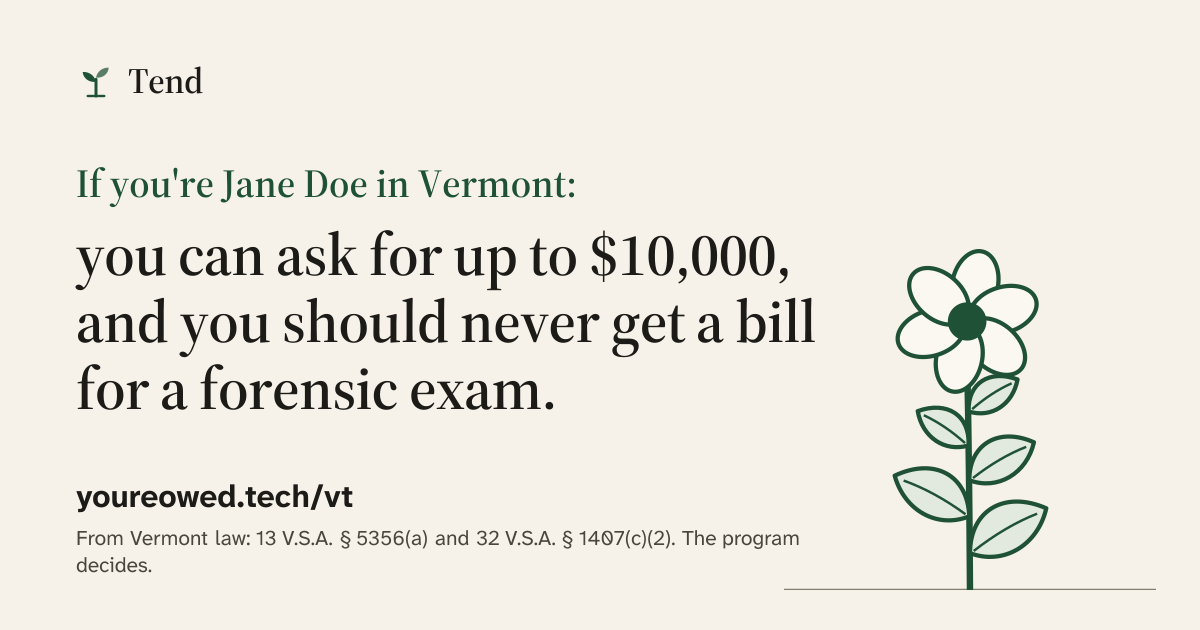
If you're Jane Doe in Vermont: you can ask for up to $10,000, and you should never get a bill for a forensic exam.
Anyone can post this card. It says nothing about the person who shares it, and this page keeps no record of who opens it.
When you are ready
Tend can check your own costs against this law on your device. It never asks what happened, and nothing leaves your device unless you send it.