Law garden / Colorado
If you're Jane Doe in Colorado
What Colorado's crime victim compensation law says, in plain words. Each line links to the exact sentence it comes from.
Crime Victim Compensation, run by Colorado Department of Public Safety, Division of Criminal Justice, Office for Victims Programs (claims are decided by the crime victim compensation board in each judicial district).
Show the law for this line: U.S. DOJ Office for Victims of Crime: Colorado state program directory
U.S. DOJ Office for Victims of Crime: Colorado state program directoryCO-S12
The program's own page, saved by Tend.
- $30,000the most you can ask for in totalC.R.S. 24-4.1-109(2)(b)
- Exam can countin place of a police reportC.R.S. 24-4.1-108(1)(b)
- $0what a forensic exam should cost youC.R.S. 18-3-407.5(3)(b)
What the program can pay for
The most the program can pay for all costs together is $30,000.
Show the law for this line: C.R.S. 24-4.1-109(2)(b)
C.R.S. 24-4.1-109(2)(b)CO-CAP-1
Total compensation is capped at $30,000 per victim (losses above that are not compensable).
Aggregate damages to the victim or to the dependents of a victim exceeding thirty thousand dollars
Medical care
Show the law for this line: C.R.S. 24-4.1-109(1)(a)
C.R.S. 24-4.1-109(1)(a)CO-COV-1
Reasonable medical and hospital costs, and medically necessary devices such as eyeglasses or hearing aids, are covered.
Reasonable medical and hospital expenses and expenses incurred for dentures, eyeglasses, hearing aids, or other prosthetic or medically necessary devices;
Counseling
Show the law for this line: C.R.S. 24-4.1-109(1)(g)
Travel
Show the law for this line: C.R.S. 24-4.1-109(1)(i)
C.R.S. 24-4.1-109(1)(i)CO-COV-4
Reasonable travel costs for medical care or counseling are covered.
Reasonable travel expenses for a victim related to funeral, burial, medical care, or mental health counseling;
Lost pay
Show the law for this line: C.R.S. 24-4.1-109(1)(b)
Home security
Show the law for this line: C.R.S. 24-4.1-109(1.5)(a)(II)and 1 more
C.R.S. 24-4.1-109(1.5)(a)(II)CO-COV-7
Changes to the victim's home needed for safety are covered.
Any modification to the victim's residence that is necessary to ensure victim safety;
C.R.S. 24-4.1-109(1.5)(a)(III)CO-COV-8
Rekeying a car or other lock for the victim's safety is covered.
The rekeying of a motor vehicle or other lock that is necessary to ensure the victim's safety;
Moving
Show the law for this line: C.R.S. 24-4.1-109(1)(l)
C.R.S. 24-4.1-109(1)(l)CO-COV-5
Reasonable relocation costs needed for the victim's safety are covered.
Reasonable relocation expenses for a victim to relocate as necessary to ensure the victim's safety.
Child care
Show the law for this line: C.R.S. 24-4.1-109(1)(k)
Funeral costs
Show the law for this line: C.R.S. 24-4.1-109(1)(e)
What it does not pay for
Pain and suffering is not compensable, and property damage is limited to the listed items (home repair, insurance deductibles, safety changes to the home, rekeying, certain towing or impound fees, and medically necessary devices). Personal property not on that list, such as a phone, is not covered.
Show the law for this line: C.R.S. 24-4.1-109(2)(a)
C.R.S. 24-4.1-109(2)(a)CO-EXC-1
Pain and suffering or property damage expenses other than those specified in subsection (1.5)(a) of this section;
Motor vehicle costs are not covered beyond an insurance deductible and safety rekeying.
Show the law for this line: C.R.S. 24-4.1-109(2)(d)
C.R.S. 24-4.1-109(2)(d)CO-EXC-2
Motor vehicle expenses other than those specified in subsections (1.5)(a)(I)(B) and (1.5)(a)(III) of this section.
The forensic exam
You should not get a bill for a sexual assault forensic exam.
Show the law for this line: C.R.S. 18-3-407.5(3)(b)
C.R.S. 18-3-407.5(3)(b)CO-EXAM-1
A sexual assault survivor does not pay for the evidence-collection forensic medical exam, even if they do not want to take part in the criminal justice process or cooperate with law enforcement. The DCJ SAVE page reads this as the evidence-collection portion of the exam; other exam-related medical costs go through SAVE or Victim Compensation, not this rule.
A victim of a sexual offense shall not bear the cost of a forensic medical examination that includes the collection of evidence that is used for the purpose of evidence collection even if the victim does not want to participate in the criminal justice system or otherwise cooperate with the law enforcement agency, prosecuting officer, or other government official.
When the survivor does not take part in the criminal justice process, the Colorado Division of Criminal Justice pays for the evidence-collection exam.
Show the law for this line: C.R.S. 18-3-407.5(3)(b)
C.R.S. 18-3-407.5(3)(b)CO-EXAM-2
The division of criminal justice in the department of public safety shall pay the cost of the examination.
When the survivor reports to police, the law enforcement agency with jurisdiction pays the direct costs of forensic evidence collection.
Show the law for this line: C.R.S. 18-3-407.5(1)
C.R.S. 18-3-407.5(1)CO-EXAM-3
A law enforcement agency with jurisdiction over a sexual assault must pay for any direct cost associated with the collection of forensic evidence from a victim who reports the assault to the law enforcement agency.
The state SAVE program (Division of Criminal Justice) covers medical fees tied to getting the forensic exam, such as ER, lab, prescription, and physician fees, while funds last. It is the payer of last resort.
Show the law for this line: C.R.S. 18-3-407.7(2)(a)
C.R.S. 18-3-407.7(2)(a)CO-EXAM-4
The program must cover medical fees and costs associated with obtaining the medical forensic examination, including but not limited to emergency department fees and costs, laboratory fees, prescription medication, and physician's fees, as long as funds are available.
The DCJ SAVE page states a per-incident cap of $4,000 for FY 2026, covering the exam and related medical costs, for survivors who make a medical or anonymous report. The cap can change with available funds. Colorado's FY 2026 ended in June, and the page as retrieved in October still showed this figure, so the cap for the current year should be confirmed with DCJ.
Show the law for this line: DCJ SAVE program page, Eligibility
DCJ SAVE program page, EligibilityCO-EXAM-5
For FY (fiscal year) 2026, the current per incident cap payable by the SAVE program is $4,000.
For medical or anonymous reports, SAVE pays the survivor's insurance deductibles and co-pays. Per the same page, the hospital bills the survivor's insurance for related costs only if the survivor asks.
Show the law for this line: DCJ SAVE program page, How Are Medical Forensic Exams Paid For
DCJ SAVE program page, How Are Medical Forensic Exams Paid ForCO-EXAM-6
If the victim makes an anonymous or medical report, the SAVE program will pay for insurance deductibles and co-pays.
Police report
The program asks for a police report. The rules below say when other records can count instead, like a forensic exam.
Show the law for this line: C.R.S. 24-4.1-108(1)(b)
C.R.S. 24-4.1-108(1)(b)CO-REPORT-1
Law enforcement must be notified, but documentation that a forensic exam was done by a licensed or registered nurse or medical provider satisfies this requirement. The board may also waive it in the interest of justice.
The requirement to notify the appropriate law enforcement officials required by this subsection (1)(b) is satisfied if, as the result of the compensable crime that the application is being submitted for, the victim or applicant provides documentation that a forensic examination was conducted by a licensed or registered nurse or medical provider.
Law enforcement must be notified, but documentation that a forensic exam was done by a licensed or registered nurse or medical provider satisfies this requirement. The board may also waive it in the interest of justice.
Show the law for this line: C.R.S. 24-4.1-108(1)(b)
C.R.S. 24-4.1-108(1)(b)CO-REPORT-1
The requirement to notify the appropriate law enforcement officials required by this subsection (1)(b) is satisfied if, as the result of the compensable crime that the application is being submitted for, the victim or applicant provides documentation that a forensic examination was conducted by a licensed or registered nurse or medical provider.
Deadline to apply
Tend has not verified a filing deadline for Colorado. Ask the program before you wait.
Keeping your name and address private
Colorado's Address Confidentiality Program gives survivors of sexual assault, stalking, human trafficking, and domestic violence a legal substitute address and mail forwarding, and state and local government agencies must accept that address.
Show the law for this line: DCS Address Confidentiality Program (ACP) page, introduction
DCS Address Confidentiality Program (ACP) page, introductionCO-ACP-1
The Colorado Address Confidentiality Program (ACP) is a statewide program that provides protected healthcare workers and survivors of stalking/harassment, sexual assault, human trafficking, and domestic violence with a legal substitute address and mail forwarding. Under Colorado law, all state and local government agencies must accept a participant’s substitute address.
By statute, any records, claims, or information a district board or district attorney receives, makes, or keeps to process a crime victim compensation claim are confidential.
Show the law for this line: C.R.S. 24-4.1-107.5(2)
C.R.S. 24-4.1-107.5(2)CO-RECORDS-1
Any materials received, made, or kept by a board or a district attorney to process a claim on behalf of a crime victim under this article are confidential.
How to apply
Mail the appropriate administrator
Show the law for this line: DCJ How to File a Claim page, How to File a Claim section
DCJ How to File a Claim page, How to File a Claim sectionCO-SUBMIT-1
Download and fill out the state application and send it to the victim compensation administrator for the judicial district where the crime occurred.
You can also download and fill out this Victim Compensation Application (PDF) and send it to the appropriate administrator.
Phone 303-239-5719
Show the law for this line: U.S. DOJ Office for Victims of Crime: Colorado state program directory
U.S. DOJ Office for Victims of Crime: Colorado state program directoryCO-S12
The program's own page, saved by Tend.
If you need money soon
A local board may approve an emergency payment before the final decision if waiting would cause undue hardship; the amount follows each board's policy and is deducted from the final award.
Show the law for this line: C.R.S. 24-4.1-112(1)
C.R.S. 24-4.1-112(1)CO-EMERG-1
The board may order an emergency approval to the applicant pending a final decision in the claim if it appears to the board, prior to taking action upon the claim, that undue hardship will result to the applicant if immediate payment is not made.
Good to know before you apply
Anyone hurt by a compensable crime committed in Colorado can apply; Colorado residents hurt elsewhere can apply only if that state or country has no reasonably accessible program they qualify for.
Show the law for this line: C.R.S. 24-4.1-102(10)(c)
C.R.S. 24-4.1-102(10)(c)CO-RES-1
“Victim” also means a person who is a resident of this state and who is a victim of a crime that occurred outside of this state, where the crime would be a compensable crime had it occurred in this state and where the state or country in which the crime occurred does not have a reasonably accessible crime victim compensation program for which the person would be eligible.
Compensation pays only after insurance, public benefits, offender payments, and other sources; the board may deduct those payments from an award.
Show the law for this line: C.R.S. 24-4.1-110(2)
C.R.S. 24-4.1-110(2)CO-COLL-1
The fund is the payer of last resort.
Share this page
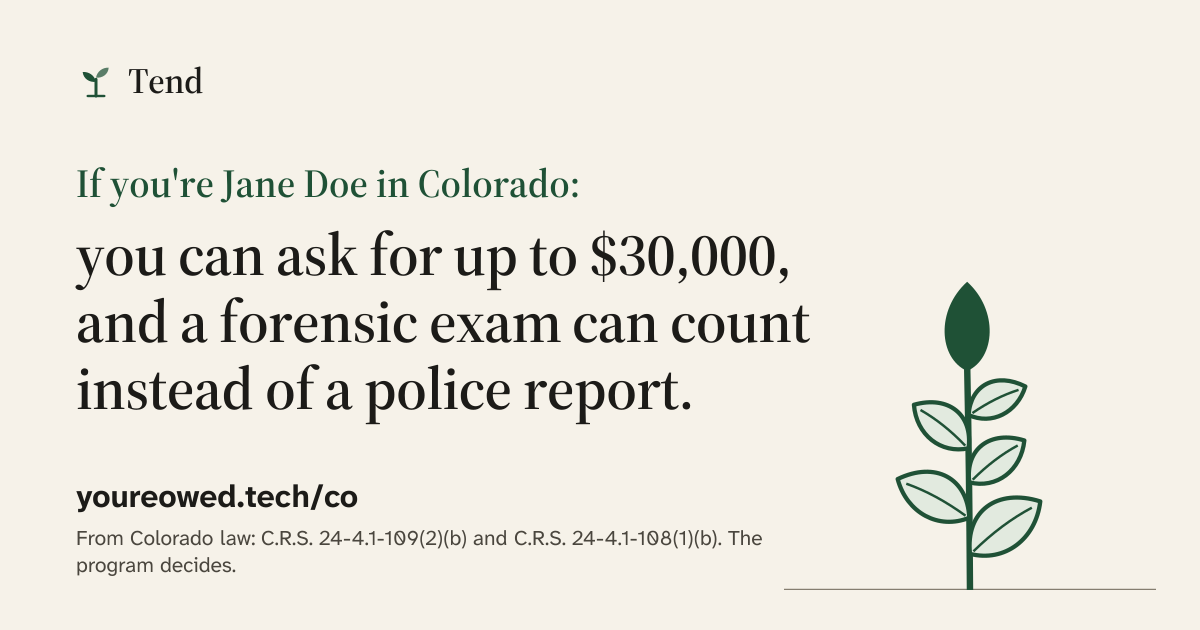
If you're Jane Doe in Colorado: you can ask for up to $30,000, and a forensic exam can count instead of a police report.
Anyone can post this card. It says nothing about the person who shares it, and this page keeps no record of who opens it.
When you are ready
Tend can check your own costs against this law on your device. It never asks what happened, and nothing leaves your device unless you send it.