Law garden / Delaware
If you're Jane Doe in Delaware
What Delaware's crime victim compensation law says, in plain words. Each line links to the exact sentence it comes from.
Victims' Compensation Assistance Program (VCAP), run by Delaware Department of Justice.
Show the law for this line: Delaware DOJ, Victims' Compensation Assistance Program page and FAQs
Delaware DOJ, Victims' Compensation Assistance Program page and FAQsDE-S2
The program's own page, saved by Tend.
Open it on attorneygeneral.delaware.gov (opens in a new tab)
- $25,000the most you can ask for in total11 Del. C. § 9011(d)
- 1 yearto apply, from the date it happened11 Del. C. § 9010(a)(4)
- Police reportthe program asks for one11 Del. C. § 9010(a)(5)
- $0what a forensic exam should cost you11 Del. C. § 9023(d)
What the program can pay for
The most the program can pay for all costs together is $25,000.
Show the law for this line: 11 Del. C. § 9011(d)
11 Del. C. § 9011(d)DE-CAP-1
Total compensation is capped at $25,000, or up to $50,000 for victims who are permanently and totally disabled.
Compensation may not be awarded under the chapter to a claimant in a total amount in excess of $25,000; provided, however, that the Agency may award compensation to victims who are permanently and totally disabled in an amount not to exceed $50,000.
Read this sentence on delcode.delaware.gov (opens in a new tab)
Medical care
Show the law for this line: 11 Del. C. § 9002(10)n.and 1 more
11 Del. C. § 9002(10)n.DE-COV-1
Medical expenses are a covered loss.
n. Medical expenses.
Read this sentence on delcode.delaware.gov (opens in a new tab)
11 Del. C. § 9002(10)q.DE-COV-7
Hospital expenses are a covered loss.
q. Hospital expenses.
Read this sentence on delcode.delaware.gov (opens in a new tab)
Counseling
Show the law for this line: 11 Del. C. § 9002(10)o.
11 Del. C. § 9002(10)o.DE-COV-2
Psychiatric care and mental health counseling are covered losses.
o. Psychiatric care and mental health counseling.
Read this sentence on delcode.delaware.gov (opens in a new tab)
Prescriptions
Show the law for this line: VCAP page, FAQs: Who can get help?
VCAP page, FAQs: Who can get help?DE-COV-9
The program page lists prescription medication among covered costs.
Compensation is available for payment of medical and dental expenses, mental health counseling, prescription medication, lost wages, funeral/burial support, temporary housing and moving or relocation services, crime related expenses and other costs approved by the Agency.
Read this sentence on attorneygeneral.delaware.gov (opens in a new tab)
Dental care
Show the law for this line: VCAP page, FAQs: Who can get help?
VCAP page, FAQs: Who can get help?DE-COV-8
The program page lists dental expenses and prescription medication among covered costs.
Compensation is available for payment of medical and dental expenses, mental health counseling, prescription medication, lost wages, funeral/burial support, temporary housing and moving or relocation services, crime related expenses and other costs approved by the Agency.
Read this sentence on attorneygeneral.delaware.gov (opens in a new tab)
Lost pay
Show the law for this line: 11 Del. C. § 9002(10)r.
11 Del. C. § 9002(10)r.DE-COV-3
Lost past or future earnings caused by a disability from the injury are covered, including vacation, sick, and compensatory time.
r. Loss of past or future earnings, including reimbursement for vacation, sick, and compensatory time, because of a disability resulting from personal injury.
Read this sentence on delcode.delaware.gov (opens in a new tab)
Home security
- Essential personal safety property is capped at $1,500.
Show the law for this line: 11 Del. C. § 9002(10)k.and 1 more
11 Del. C. § 9002(10)k.DE-COV-4
The cost to change locks is covered, along with replacing items seized as evidence.
k. The cost to change locks and replace items seized as evidence.
Read this sentence on delcode.delaware.gov (opens in a new tab)
11 Del. C. § 9002(10)d.DE-CAP-4
d. Essential personal safety property not to exceed $1,500.
Read this sentence on delcode.delaware.gov (opens in a new tab)
Moving
- Moving expenses are capped at $1,000.
Show the law for this line: 11 Del. C. § 9002(10)c.
11 Del. C. § 9002(10)c.DE-CAP-3
c. Moving expenses not to exceed $1,000.
Read this sentence on delcode.delaware.gov (opens in a new tab)
Temporary housing
- Temporary housing is capped at $1,500.
Show the law for this line: 11 Del. C. § 9002(10)b.
11 Del. C. § 9002(10)b.DE-CAP-2
b. Temporary housing not to exceed $1,500.
Read this sentence on delcode.delaware.gov (opens in a new tab)
Child care
Show the law for this line: 11 Del. C. § 9002(10)l.
11 Del. C. § 9002(10)l.DE-COV-6
Child care is covered, limited to the deposit plus 2 months of care by a state-approved or licensed provider.
l. Child care not to exceed the deposit plus 2 months of care by a state-approved or licensed day care provider.
Read this sentence on delcode.delaware.gov (opens in a new tab)
Replacing belongings
Show the law for this line: 11 Del. C. § 9002(10)k.
11 Del. C. § 9002(10)k.DE-COV-5
Replacing items seized as evidence is covered; this is separate from the general bar on property loss.
k. The cost to change locks and replace items seized as evidence.
Read this sentence on delcode.delaware.gov (opens in a new tab)
Crime scene cleanup
- Crime scene cleanup is capped at $1,000.
Show the law for this line: 11 Del. C. § 9002(10)a.
11 Del. C. § 9002(10)a.DE-CAP-5
a. Crime scene cleanup not to exceed $1,000.
Read this sentence on delcode.delaware.gov (opens in a new tab)
Legal help
- If the claimant has a lawyer before the Appeals Board, the Board may award attorney fees of up to $1,000 or 15% of the award, whichever is less, paid on top of the compensation. The lawyer may not charge the claimant anything beyond that award.
Show the law for this line: 11 Del. C. § 9013
11 Del. C. § 9013DE-CAP-6
Such fees shall not exceed $1,000 or 15% of the amount awarded, whichever sum is less, and shall be in addition to the amount of compensation awarded to the claimant.
Read this sentence on delcode.delaware.gov (opens in a new tab)
What it does not pay for
Pecuniary loss does not include property damage, so damaged personal property (for example a phone) is generally not paid. The cost to replace items seized as evidence is the exception.
Show the law for this line: 11 Del. C. § 9002(10)
11 Del. C. § 9002(10)DE-EXCL-1
“Pecuniary loss” means any expenses actually and necessarily incurred as a result of personal injury or death resulting from a crime, but does not include property damage.
Read this sentence on delcode.delaware.gov (opens in a new tab)
The program will not pay for lost, damaged, or stolen property, or for pain and suffering.
Show the law for this line: VCAP page, FAQs: Are there any limits?
VCAP page, FAQs: Are there any limits?DE-EXCL-2
You cannot be paid for lost, damaged, or stolen property, or for pain and suffering.
Read this sentence on attorneygeneral.delaware.gov (opens in a new tab)
The forensic exam
You should not get a bill for a sexual assault forensic exam.
Show the law for this line: 11 Del. C. § 9023(d)and 1 more
11 Del. C. § 9023(d)DE-EXAM-1
Hospitals and health care professionals must give sexual offense forensic medical exams free of charge, and the survivor pays no out-of-pocket cost and does not have to file a compensation application for the exam. The provider bills the patient's insurance first.
The victim of the sexual offense shall not pay any out-of-pocket costs associated with the forensic medical examination and shall not be required to file an application with the Agency.
Read this sentence on delcode.delaware.gov (opens in a new tab)
11 Del. C. § 9023(c)DE-EXAM-2
Hospitals and health care professionals must provide forensic medical exams free of charge to sexual offense victims.
Hospitals and health-care professionals shall provide forensic medical examinations free of charge to the victims of sexual offenses.
Read this sentence on delcode.delaware.gov (opens in a new tab)
The provider may bill your insurance, but not you.
Show the law for this line: 11 Del. C. § 9023(d)and 1 more
11 Del. C. § 9023(d)DE-EXAM-1
Hospitals and health care professionals must give sexual offense forensic medical exams free of charge, and the survivor pays no out-of-pocket cost and does not have to file a compensation application for the exam. The provider bills the patient's insurance first.
The victim of the sexual offense shall not pay any out-of-pocket costs associated with the forensic medical examination and shall not be required to file an application with the Agency.
Read this sentence on delcode.delaware.gov (opens in a new tab)
11 Del. C. § 9023(c)DE-EXAM-2
Hospitals and health care professionals must provide forensic medical exams free of charge to sexual offense victims.
Hospitals and health-care professionals shall provide forensic medical examinations free of charge to the victims of sexual offenses.
Read this sentence on delcode.delaware.gov (opens in a new tab)
The provider must bill the patient's insurance (including Medicaid and Medicare) first; whatever insurance does not cover can be billed to the Victims' Compensation Fund, not the survivor.
Show the law for this line: 11 Del. C. § 9023(c)
11 Del. C. § 9023(c)DE-EXAM-3
Any hospital or health-care professional performing a forensic medical examination shall seek reimbursement for the examination from the patient's insurance carrier, including Medicaid and Medicare, if available. If insurance is unavailable, or does not cover the full costs of the forensic medical examination, the service provider may seek reimbursement from the Victims' Compensation Fund.
Read this sentence on delcode.delaware.gov (opens in a new tab)
Police report
The program asks for a police report. The rules below say when other records can count instead, like a protective order.
Show the law for this line: 11 Del. C. § 9010(a)(5)and 1 more
11 Del. C. § 9010(a)(5)DE-REPORT-1
The crime must be reported to law enforcement within 72 hours, but this is waived if it was reported to protective services or Family Court, the victim has a protection from abuse order, the victim cooperated with law enforcement or an appropriate government agency in a sexual assault case, or the Agency finds the requirement unreasonable.
Where the victim has failed to report the crime to a law-enforcement agency within 72 hours of its occurrence. This requirement is waived in any of the following circumstances: a. The crime has been reported to an appropriate governmental agency, such as child or adult protective services or the Family Court. b. The victim can provide a protection from abuse order. c. The victim has cooperated with law enforcement or an appropriate government agency in cases of crimes involving domestic violence, sexual assault or abuse. d. Where the Agency, in its discretion, determines that the circumstances of the crime or the victim render this requirement unreasonable.
Read this sentence on delcode.delaware.gov (opens in a new tab)
11 Del. C. § 9010(a)(3)DE-REPORT-2
A claim is denied if the victim refused reasonable cooperation with law enforcement.
Where the victim refused to give reasonable cooperation to state or local law-enforcement agencies in their efforts to apprehend or convict the perpetrator of the crime in question.
Read this sentence on delcode.delaware.gov (opens in a new tab)
The crime must be reported to law enforcement within 72 hours, but this is waived if it was reported to protective services or Family Court, the victim has a protection from abuse order, the victim cooperated with law enforcement or an appropriate government agency in a sexual assault case, or the Agency finds the requirement unreasonable.
Show the law for this line: 11 Del. C. § 9010(a)(5)
11 Del. C. § 9010(a)(5)DE-REPORT-1
Where the victim has failed to report the crime to a law-enforcement agency within 72 hours of its occurrence. This requirement is waived in any of the following circumstances: a. The crime has been reported to an appropriate governmental agency, such as child or adult protective services or the Family Court. b. The victim can provide a protection from abuse order. c. The victim has cooperated with law enforcement or an appropriate government agency in cases of crimes involving domestic violence, sexual assault or abuse. d. Where the Agency, in its discretion, determines that the circumstances of the crime or the victim render this requirement unreasonable.
Read this sentence on delcode.delaware.gov (opens in a new tab)
A claim is denied if the victim refused reasonable cooperation with law enforcement.
Show the law for this line: 11 Del. C. § 9010(a)(3)
11 Del. C. § 9010(a)(3)DE-REPORT-2
Where the victim refused to give reasonable cooperation to state or local law-enforcement agencies in their efforts to apprehend or convict the perpetrator of the crime in question.
Read this sentence on delcode.delaware.gov (opens in a new tab)
Deadline to apply
Apply within 1 year of the date it happened.
Show the law for this line: 11 Del. C. § 9010(a)(4)
11 Del. C. § 9010(a)(4)DE-DEAD-1
The claim must be filed within 1 year after the injury, unless the Agency grants an extension or finds the deadline unreasonable in the circumstances.
Where the claim has not been filed within 1 year after the personal injury on which the claim in based, unless an extension is granted by the Agency or the Agency, in its discretion, determines that the circumstances render this requirement unreasonable.
Read this sentence on delcode.delaware.gov (opens in a new tab)
Keeping your name and address private
Delaware's Address Confidentiality Program, run by the Department of Justice, gives certified participants a substitute address and forwards their mail. Victims of sexual assault can apply if they have filed for a protection from abuse order or are named as a victim in a criminal or delinquency case, and they state that they fear future violence from the perpetrator.
Show the law for this line: 11 Del. C. § 9613(1); substitute address under § 9612(a)
11 Del. C. § 9613(1); substitute address under § 9612(a)DE-ACP-1
All of the following persons are eligible to apply to become program participants: (1) A victim of domestic violence, sexual assault, human trafficking, kidnapping, or stalking who has filed for a protection from abuse order or who is or was named as a victim in any criminal or delinquency proceeding
Read this sentence on delcode.delaware.gov (opens in a new tab)
Under Delaware's Freedom of Information Act, the investigative files the Victims' Compensation Assistance Program compiles or maintains are not public records.
Show the law for this line: 29 Del. C. § 10002(o)(14) (records not deemed public)
29 Del. C. § 10002(o)(14) (records not deemed public)DE-RECCONF-1
(14) Investigative files compiled or maintained by the Victims’ Compensation Assistance Program
Read this sentence on delcode.delaware.gov (opens in a new tab)
How to apply
Online https://ccvcde.org
Show the law for this line: VCAP brochure (English), How do I file a claim?
VCAP brochure (English), How do I file a claim?DE-SUB-3
Apply online through the VCAP claim portal at https://ccvcde.org.
If you would prefer to apply online, please visit: https://ccvcde.org
Open the source on attorneygeneral.delaware.gov (opens in a new tab)
Mail 900 N. King Street, 4th Floor Wilmington, DE 19801
Show the law for this line: VCAP brochure (English), How do I file a claim?
VCAP brochure (English), How do I file a claim?DE-SUB-1
Mail the claim form to VCAP at 900 N. King Street, 4th Floor, Wilmington, DE 19801.
You must submit a claim form to get the process started. Your claim can be submitted in the following ways: Mail: 900 N. King Street, 4th Floor Wilmington, DE 19801
Open the source on attorneygeneral.delaware.gov (opens in a new tab)
Fax (302) 577-1326
Show the law for this line: VCAP brochure (English), How do I file a claim?
VCAP brochure (English), How do I file a claim?DE-SUB-2
Fax the claim form to VCAP at (302) 577-1326.
Fax: (302) 577-1326 If you would prefer to apply online, please visit: https://ccvcde.org
Open the source on attorneygeneral.delaware.gov (opens in a new tab)
Phone 302-255-1770
Show the law for this line: Delaware DOJ, Victims' Compensation Assistance Program page and FAQs
Delaware DOJ, Victims' Compensation Assistance Program page and FAQsDE-S2
The program's own page, saved by Tend.
Open it on attorneygeneral.delaware.gov (opens in a new tab)
If you need money soon
An emergency award is possible only on a showing of dire necessity, requested in writing with the claim form, and not until a police report or other official law enforcement documentation is obtained.
Show the law for this line: 1 Del. Admin. Code 301-23.0
1 Del. Admin. Code 301-23.0DE-EMERG-1
The Agency will make an emergency award only upon a showing of dire necessity. The claimant, must, in writing, request an emergency award when submitting his claim form and show just cause as to why such an award should be considered. No such award will be made until the police report or other official documentation from the appropriate law enforcement agency is acquired.
Read this sentence on regulations.delaware.gov (opens in a new tab)
Good to know before you apply
The program covers everyone, including nonresidents, who is a victim of a crime committed in Delaware.
Show the law for this line: 11 Del. C. § 9021(1)
11 Del. C. § 9021(1)DE-RES-1
All persons, including nonresidents of Delaware, who are victims of crimes committed on January 1, 1975, or thereafter within this State
Read this sentence on delcode.delaware.gov (opens in a new tab)
A Delaware domiciliary hurt by a crime in another state may apply if the crime would be compensable in Delaware and that state has no eligible program with equal benefits.
Show the law for this line: 11 Del. C. § 9009(9)
11 Del. C. § 9009(9)DE-RES-2
A person whose domicile is in Delaware and who is the victim or secondary victim of a crime that occurs in another state, possession, or territory of the United States may make an application for compensation if both of the following are true: a. The crimes would be compensable had they occurred in Delaware. b. The placement of the crime occurred in states, possessions, or territories of the United States not having eligible crime victim compensation programs that provide benefits equal to the benefits provided under this chapter.
Read this sentence on delcode.delaware.gov (opens in a new tab)
The award is the loss minus anything the claimant has received or will receive from other sources, including insurance.
Show the law for this line: 11 Del. C. § 9009(1)
11 Del. C. § 9009(1)DE-COLL-1
If a claim is approved, the award must be the amount of pecuniary loss minus the amount the claimant has received or will receive as indemnification from any other source, including any applicable insurance.
Read this sentence on delcode.delaware.gov (opens in a new tab)
Claims for less than $25 are not paid, except in cases of dire hardship.
Show the law for this line: 11 Del. C. § 9011(b)
11 Del. C. § 9011(b)DE-MIN-1
Except in cases of dire hardship, as determined by the Agency, there may not be payment of compensation where the claim is for less than $25.
Read this sentence on delcode.delaware.gov (opens in a new tab)
Share this page
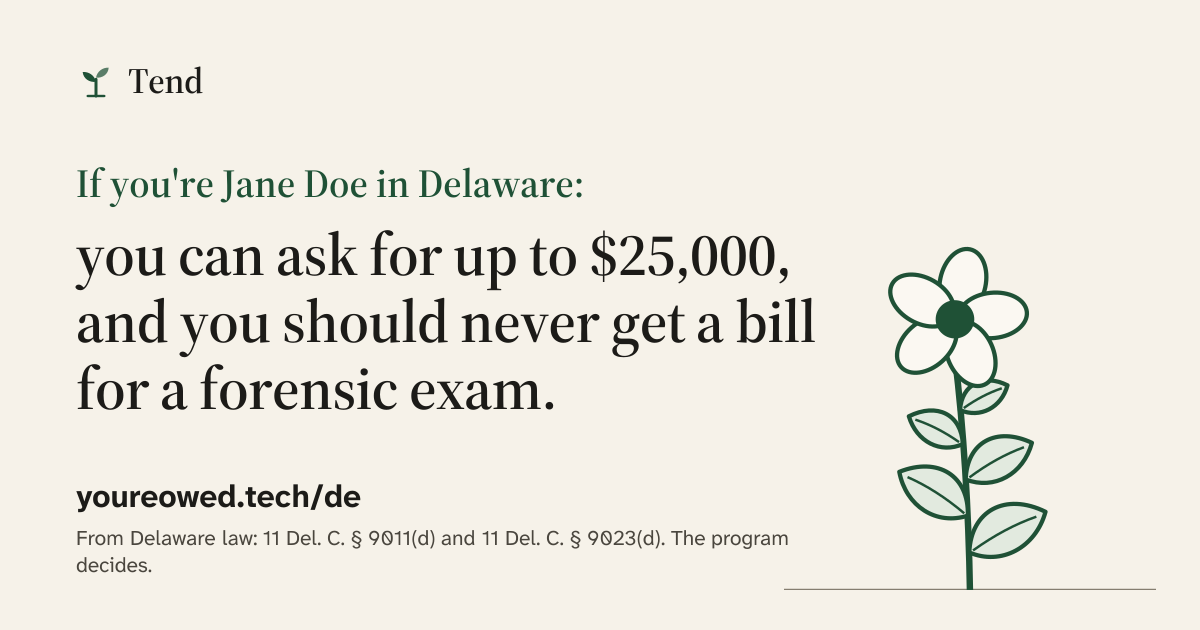
If you're Jane Doe in Delaware: you can ask for up to $25,000, and you should never get a bill for a forensic exam.
Anyone can post this card. It says nothing about the person who shares it, and this page keeps no record of who opens it.
When you are ready
Tend can check your own costs against this law on your device. It never asks what happened, and nothing leaves your device unless you send it.