Law garden / Kentucky
If you're Jane Doe in Kentucky
What Kentucky's crime victim compensation law says, in plain words. Each line links to the exact sentence it comes from.
Crime Victims Compensation Fund Program, run by Public Protection Cabinet, Office of Claims and Appeals, Crime Victims Compensation Board.
Show the law for this line: Crime Victim Compensation Form (revised July 2024)
Crime Victim Compensation Form (revised July 2024)KY-S19
The program's own page, saved by Tend.
- $50,000the most you can ask for in totalKRS 49.370(5)
- $0what a forensic exam should cost youKRS 216B.400(10)(a)
What the program can pay for
The most the program can pay for all costs together is $50,000.
Show the law for this line: KRS 49.370(5)
KRS 49.370(5)KY-CAP-TOTAL
The total award for a claimant cannot exceed $50,000.
Any award made under KRS 49.270 to 49.490 shall not exceed fifty thousand dollars ($50,000) in total compensation to be received by or paid on behalf of a claimant from the fund.
Open the source on apps.legislature.ky.gov (opens in a new tab)
Medical care
Show the law for this line: KRS 49.370(2)(a)
KRS 49.370(2)(a)KY-COV-MEDICAL
Awards cover out-of-pocket expenses, including lost earnings or support and debts reasonably incurred for medical or other services.
Any award made pursuant to KRS 49.270 to 49.490 shall be in an amount not exceeding out-of-pocket expenses, including loss of earnings or support resulting from the injury on which the claim is based and indebtedness reasonably incurred for medical or other services
Open the source on apps.legislature.ky.gov (opens in a new tab)
Counseling
Show the law for this line: KRS 49.370(2)(a)8.
KRS 49.370(2)(a)8.KY-COV-COUNSELING
Mental health counseling needed because of the crime is covered for up to two years, after proper documentation is submitted to the board. There is no separate dollar cap; it counts toward the overall cap.
Mental health counseling, necessary as a result of the injury upon which the claim is based. Mental health counseling: a. Shall be paid for a maximum of two (2) years, but only after proper documentation is submitted to the board
Open the source on apps.legislature.ky.gov (opens in a new tab)
Dental care
Show the law for this line: CVCB FAQ, "What categories of expenses are compensable by the Board?"
CVCB FAQ, "What categories of expenses are compensable by the Board?"KY-COV-DENTAL
The program lists medical and dental expenses as compensable.
Medical/dental expenses;
Travel
Show the law for this line: 802 KAR 3:030 Section 4
802 KAR 3:030 Section 4KY-COV-COURT
Travel, parking, lodging, and meals for attending criminal court proceedings related to the crime can be covered for the victim and the victim's caregiver.
A victim and the victim's caregiver, if applicable, may recover the following types of expenses incurred for purposes of attending criminal court proceedings related to the crime: (1) Travel; (2) Parking; (3) Lodging; (4) Meals;
Read this sentence on apps.legislature.ky.gov (opens in a new tab)
Lost pay
- Lost earnings or lost support are paid at net earnings, up to $500 for each week.
Show the law for this line: KRS 49.370(3)
KRS 49.370(3)KY-CAP-WAGES
the award shall be equal to net earnings at the time of the criminally injurious conduct; however, no award under this subsection shall exceed five hundred dollars ($500) for each week of lost earnings or financial support.
Open the source on apps.legislature.ky.gov (opens in a new tab)
Home security
- Replacing or repairing windows and locks at the victim's home or business damaged in the crime is covered up to $1,500.
Show the law for this line: KRS 49.370(2)(a)5.
KRS 49.370(2)(a)5.KY-CAP-SECURITY
Replacement or repair of windows and locks at the primary residence or business of the victim which were damaged by the commission of the crime, not to exceed one thousand five hundred dollars ($1,500);
Open the source on apps.legislature.ky.gov (opens in a new tab)
Moving
- When the crime happened at the victim's home, moving to a new primary residence for safety within 6 months of the crime is covered up to $2,000. The board may allow relocation costs incurred after 6 months at its discretion.
Show the law for this line: KRS 49.370(2)(a)1.a.
KRS 49.370(2)(a)1.a.KY-CAP-RELOCATION
For the victim and for any child who is the victim's dependent, when the crime was committed at the primary residence of the victim: a. Relocation if the victim is moving from one (1) primary residence to another due to concern for the safety of themselves or other persons at the residence as a result of a crime within six (6) months of the crime, not to exceed two thousand dollars ($2,000). The board may, in its discretion, allow relocation expenses incurred after six (6) months
Open the source on apps.legislature.ky.gov (opens in a new tab)
Temporary housing
- Temporary housing within 30 days of the crime, when the victim cannot stay at home because of the crime, is covered up to $2,000 (this applies when the crime happened at the victim's home).
Show the law for this line: KRS 49.370(2)(a)1.b.
KRS 49.370(2)(a)1.b.KY-CAP-HOUSING
Temporary housing costs incurred within thirty (30) days of the crime, when the victim is unable to stay in the primary residence due to the crime, not to exceed two thousand dollars ($2,000);
Open the source on apps.legislature.ky.gov (opens in a new tab)
Replacing belongings
Show the law for this line: KRS 49.370(2)(a)4.
KRS 49.370(2)(a)4.KY-COV-SEIZED
Items seized by police as evidence can be replaced, up to $500 per item.
Reimbursement for the replacement of items owned by the victim and for any child who is the victim's dependent that were seized by law enforcement as evidence of the commission of the crime, not to exceed five hundred dollars ($500) per item;
Open the source on apps.legislature.ky.gov (opens in a new tab)
Crime scene cleanup
- Crime scene cleanup within 30 days at the victim's home or business is covered up to $2,000.
Show the law for this line: KRS 49.370(2)(a)3.
KRS 49.370(2)(a)3.KY-CAP-CLEANUP
Crime scene cleanup within thirty (30) days of the crime when the crime was committed at the primary residence or business of the victim, not to exceed two thousand dollars ($2,000);
Open the source on apps.legislature.ky.gov (opens in a new tab)
Funeral costs
- Funeral and burial costs cannot exceed $10,000.
Show the law for this line: KRS 49.370(4)
KRS 49.370(4)KY-CAP-FUNERAL
In no event shall an award for funeral expenses exceed ten thousand dollars ($10,000).
Open the source on apps.legislature.ky.gov (opens in a new tab)
What it does not pay for
No award is made for property loss or damage, such as a phone, except where the statute allows it (for example, items seized by police as evidence, or windows and locks).
Show the law for this line: KRS 49.370(6)
KRS 49.370(6)KY-EXCL-PROPERTY
An award shall not be made for any type of property loss or damage, except as otherwise permitted in KRS 49.270 to 49.490.
Open the source on apps.legislature.ky.gov (opens in a new tab)
The program does not pay for pain and suffering, emotional distress, or loss of consortium.
Show the law for this line: CVCB FAQ, "What types of expenses are NOT compensable by the Board?"
CVCB FAQ, "What types of expenses are NOT compensable by the Board?"KY-EXCL-PAIN
Property damage or loss, except as provided in KRS Chapter 49, and pain and suffering, emotional distress, and loss of consortium.
The forensic exam
You should not get a bill for a sexual assault forensic exam.
Show the law for this line: KRS 216B.400(10)(a)and 3 more
KRS 216B.400(10)(a)KY-EXAM-1
When a sexual assault exam is given, no hospital, exam facility, clinician, pharmacist, health department, the survivor's insurer, or the state may charge the survivor for the exam, even if the exam is not completed.
When an examination of a victim of a sexual offense is provided in accordance with this section, no charge shall be made to the victim by the hospital, the sexual assault examination facility, the physician, the pharmacist, the health department, the sexual assault nurse examiner, other qualified medical professional, the victim's insurance carrier, or the Commonwealth for: (a) Sexual assault examinations, whether or not the exam is completed;
Open the source on apps.legislature.ky.gov (opens in a new tab)
KRS 216B.400(10)(b)-(d)KY-EXAM-2
The no-charge rule also covers preventive medication, strangulation assessments, and other tests or services tied to the assault or exam on the same date as the exam, including triage and ambulance costs.
(b) Prophylactic medical treatment; (c) Strangulation assessments; or (d) Other medical tests or services, including triage and ambulance expenses, related to the incident, exam, or treatment which occur on the same date as the original exam.
Open the source on apps.legislature.ky.gov (opens in a new tab)
KRS 216B.400(11)(a)KY-EXAM-3
A survivor cannot be refused an exam or billed for it because they choose not to file a police report, cooperate with law enforcement, or take part in the criminal case.
No victim shall be denied an examination, or billed in violation of subsection (10) of this section, because the victim chooses not to file a police report, cooperate with law enforcement, or otherwise participate in the criminal justice system.
Open the source on apps.legislature.ky.gov (opens in a new tab)
SAEP FAQ, "Can we bill the patient's Insurance?"KY-EXAM-4
The exam program's FAQ says providers should bill the patient's Medicaid or private insurance first, but may not charge a co-pay or deductible.
If a patient has insurance, whether Medicaid or Private insurance, that insurance should be billed first before billing the SAEP, but no co-pay or deductible may be charged as a condition for payment.
The provider may bill your insurance, but not you.
Show the law for this line: SAEP FAQ, "Can we bill the patient's Insurance?"
SAEP FAQ, "Can we bill the patient's Insurance?"KY-EXAM-4
The exam program's FAQ says providers should bill the patient's Medicaid or private insurance first, but may not charge a co-pay or deductible.
If a patient has insurance, whether Medicaid or Private insurance, that insurance should be billed first before billing the SAEP, but no co-pay or deductible may be charged as a condition for payment.
The Crime Victims Compensation Board pays for sexual assault exams and the related no-charge services, at rates set by its regulation.
Show the law for this line: KRS 216B.400(9)(a)
KRS 216B.400(9)(a)KY-EXAM-PAY-1
The examinations provided in accordance with this section and other services provided to a victim pursuant to subsection (10) of this section shall be paid for by the Crime Victims Compensation Board at a rate to be determined by the administrative regulation promulgated by the board
Open the source on apps.legislature.ky.gov (opens in a new tab)
Deadline to apply
Tend has not verified a filing deadline for Kentucky. Ask the program before you wait.
Keeping your name and address private
Kentucky's Safe at Home Program, run by the Secretary of State, protects victims of sexual assault, rape, other sexual crimes, domestic violence, human trafficking, and stalking by letting them use a designated address instead of their real one. It also covers their minor children and anyone living with them, and it is free for Kentucky residents who are U.S. citizens.
Show the law for this line: KRS 14.302(2)-(3)
KRS 14.302(2)-(3)KY-ACP-1
The Safe at Home Program shall be operated with the intent to protect victims of: (a) Domestic violence; (b) Human trafficking; (c) Stalking; (d) Sexual assault; (e) Rape; and (f) Other sexual crimes as defined by KRS 17.500. The Safe at Home Program shall authorize the use of designated addresses for victims, their minor children, and all other individuals residing with the victim.
Open the source on apps.legislature.ky.gov (opens in a new tab)
Under the Crime Victims Compensation Board's regulation, a claimant's or victim's personally identifiable information must stay secure and confidential, and information that could show whether someone filed a claim may not be disclosed to unauthorized people.
Show the law for this line: 802 KAR 3:010 Section 5(3)-(4)
802 KAR 3:010 Section 5(3)-(4)KY-RECCONF-1
A claimant or victim's personally identifiable information shall remain secure and confidential. (4) Information that may be used to determine whether an individual filed a claim with the Board shall not be disclosed to unauthorized individuals.
Read this sentence on apps.legislature.ky.gov (opens in a new tab)
How to apply
Online https://kycc.ky.gov/CVOnline/home
Show the law for this line: 802 KAR 3:010 Section 4(2)(d)
802 KAR 3:010 Section 4(2)(d)KY-SUB-4
A claim can be filed through the Board's online claims portal.
(d) Through the online claims portal at: https://kycc.ky.gov/CVOnline/home
Read this sentence on apps.legislature.ky.gov (opens in a new tab)
Email crimevictims@ky.gov
Show the law for this line: 802 KAR 3:010 Section 4(2)(c)
802 KAR 3:010 Section 4(2)(c)KY-SUB-3
A claim can be emailed to the Board if the whole claim fits in a single email.
(c) By electronic mail to crimevictims@ky.gov, if the document can be sent in one (1) electronic message;
Read this sentence on apps.legislature.ky.gov (opens in a new tab)
Mail Crime Victims Compensation Board, 500 Mero Street, 2 SC1, Frankfort, Kentucky 40601
Show the law for this line: 802 KAR 3:010 Section 4(2)(b)
802 KAR 3:010 Section 4(2)(b)KY-SUB-2
A claim can be mailed to the Board's office in Frankfort.
(a) In person or by private delivery to the Crime Victims Compensation Board, 500 Mero Street, 2 SC1, Frankfort, Kentucky 40601; (b) By mail to the address listed above;
Read this sentence on apps.legislature.ky.gov (opens in a new tab)
Fax 502-573-4817
Show the law for this line: CVCB FAQ (updated August 2024), Where should I send my paper claim form?
CVCB FAQ (updated August 2024), Where should I send my paper claim form?KY-SUB-5
The Board's FAQ says a paper claim form can also be faxed.
Paper claim forms can be submitted to the Board by fax (502-573-4817)
In person Crime Victims Compensation Board, 500 Mero Street, 2 SC1, Frankfort, Kentucky 40601
Show the law for this line: 802 KAR 3:010 Section 4(2)(a)
802 KAR 3:010 Section 4(2)(a)KY-SUB-1
A claim can be dropped off in person or sent by private delivery to the Board's office in Frankfort.
(a) In person or by private delivery to the Crime Victims Compensation Board, 500 Mero Street, 2 SC1, Frankfort, Kentucky 40601;
Read this sentence on apps.legislature.ky.gov (opens in a new tab)
Phone 502-782-8255
Show the law for this line: Crime Victim Compensation Form (revised July 2024)
Crime Victim Compensation Form (revised July 2024)KY-S19
The program's own page, saved by Tend.
If you need money soon
An emergency award of up to $1,000 can be paid before the final decision, and it is deducted from the final award.
Show the law for this line: KRS 49.360(2)(a)-(b)
KRS 49.360(2)(a)-(b)KY-EMERGENCY
The amount of an emergency award shall not exceed one thousand dollars ($1,000); (b) The amount of an emergency award shall be deducted from any final award made to the claimant;
Open the source on apps.legislature.ky.gov (opens in a new tab)
Good to know before you apply
A victim is a person injured or killed by a criminal act in Kentucky.
Show the law for this line: KRS 49.280(5)(a)
KRS 49.280(5)(a)KY-RES-1
"Victim" means a person who suffers personal physical or psychological injury or death from a criminal act in Kentucky as a result of:
Open the source on apps.legislature.ky.gov (opens in a new tab)
Nonresidents who suffer losses from crimes in Kentucky are covered during periods when the board finds federal funds are available.
Show the law for this line: KRS 49.290
KRS 49.290KY-RES-2
"Victim" shall also include nonresidents of this state who suffer losses as a direct result of criminal acts occurring within this state. This section shall be operative only during those time periods during which the Crime Victims Compensation Board determines that federal funds are available to the state for the compensation of victims of crime.
Open the source on apps.legislature.ky.gov (opens in a new tab)
A Kentucky resident hurt by a crime in another state can apply in Kentucky only if that state has no compensation program the victim is eligible for and the crime would be covered had it happened in Kentucky.
Show the law for this line: KRS 49.280(5)(b)
KRS 49.280(5)(b)KY-RES-3
"Victim" shall also mean a resident who is a victim of a crime occurring outside this state if: 1. The crime would be compensable had it occurred inside this state; and 2. The crime occurred in a state which does not have a crime victim compensation program, for which the victim is eligible as eligibility is set forth in KRS 49.310.
Open the source on apps.legislature.ky.gov (opens in a new tab)
Awards are reduced by money received or to be received from the offender, required insurance, public funds, the claimant's own insurance, an emergency award, or donations toward crime expenses.
Show the law for this line: KRS 49.390(1)
KRS 49.390(1)KY-COLLATERAL
Any award made pursuant to KRS 49.270 to 49.490 shall be reduced by the amount of any payments received or to be received by the claimant as a result of the injury from the following sources: (a) From or on behalf of the person who committed the crime; (b) Under insurance programs mandated by law; (c) From public funds; (d) Under any contract of insurance wherein the claimant is the insured or beneficiary; (e) As an emergency award pursuant to KRS 49.360; and (f) From donations made on behalf of the victim or claimant toward expenses incurred as a result of the crime.
Open the source on apps.legislature.ky.gov (opens in a new tab)
Share this page
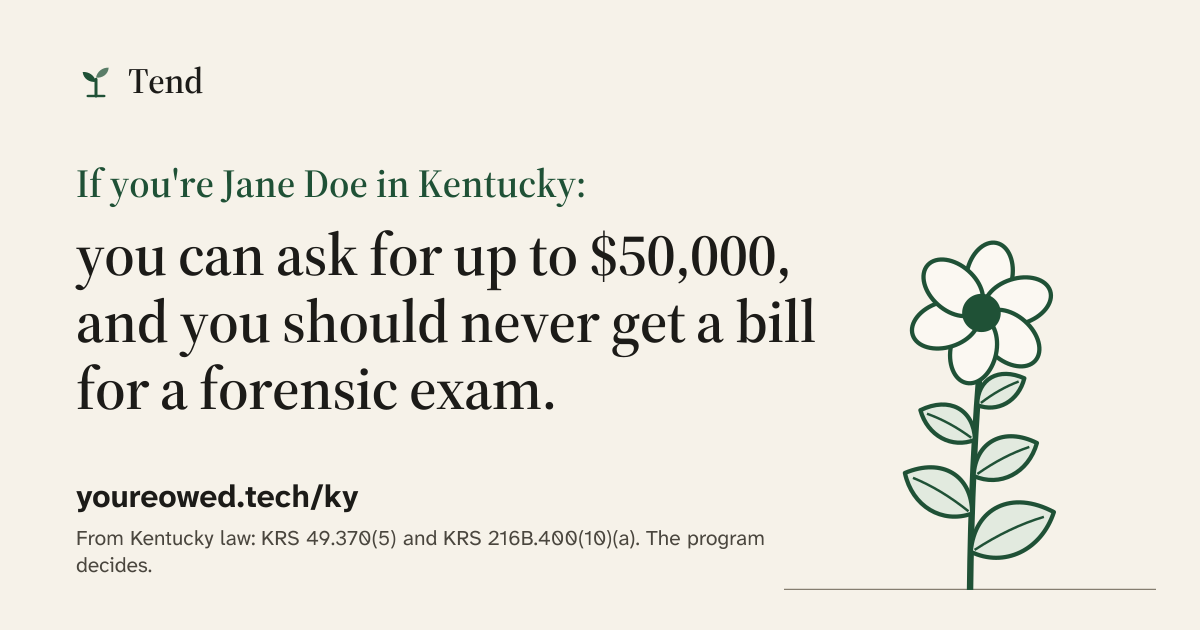
If you're Jane Doe in Kentucky: you can ask for up to $50,000, and you should never get a bill for a forensic exam.
Anyone can post this card. It says nothing about the person who shares it, and this page keeps no record of who opens it.
When you are ready
Tend can check your own costs against this law on your device. It never asks what happened, and nothing leaves your device unless you send it.