Law garden / South Carolina
If you're Jane Doe in South Carolina
What South Carolina's crime victim compensation law says, in plain words. Each line links to the exact sentence it comes from.
Crime Victim Compensation (South Carolina Victim Compensation Fund), run by Office of the Attorney General, South Carolina Crime Victim Services Division, Department of Crime Victim Compensation (DCVC).
Show the law for this line: SC Attorney General, Crime Victim Compensation (program page)
SC Attorney General, Crime Victim Compensation (program page)SC-S2
The program's own page, saved by Tend.
- $15,000the most you can ask for in totalS.C. Code 16-3-1180(C)
- 180 daysto apply, from the date it happenedS.C. Code 16-3-1230(B), (C)
- Police reportthe program asks for oneS.C. Code 16-3-1170(A)(3), (B)
- $0what a forensic exam should cost youS.C. Code 16-3-1350(A)
What the program can pay for
The most the program can pay for all costs together is $15,000.
Show the law for this line: S.C. Code 16-3-1180(C)
S.C. Code 16-3-1180(C)SC-TOTAL-1
Total awards for a victim are capped at $15,000, or up to $25,000 if the advisory board (by a two-thirds vote) and the director agree extraordinary circumstances exist.
The aggregate of award to and on behalf of victims may not exceed fifteen thousand dollars unless the Crime Victim Advisory Board, by two-thirds vote, and the director concur that extraordinary circumstances exist. In this case, the award may not exceed twenty-five thousand dollars.
Medical care
Show the law for this line: S.C. Code 16-3-1180(A)(1)
S.C. Code 16-3-1180(A)(1)SC-MED-1
Reasonable and customary charges for medical services, including mental health counseling, needed because of the crime injury are covered when a licensed professional provides them.
reasonable and customary charges as periodically determined by the board for medical services, including mental health counseling, required and rendered as a direct result of the injury on which the claim is based, as long as these services are rendered by a licensed professional.
Prescriptions
Show the law for this line: DCVC compensation brochure, Services DCVC May Consider For Payment
DCVC compensation brochure, Services DCVC May Consider For PaymentSC-RX-1
The program lists doctor-ordered medicine, equipment, and supplies as expenses it may consider.
Doctor ordered medicine, equipment, supplies
Dental care
Show the law for this line: DCVC compensation brochure, Services DCVC May Consider For Payment
DCVC compensation brochure, Services DCVC May Consider For PaymentSC-DENT-1
The program lists dental and orthodontic services as expenses it may consider.
Dental or Orthodontic Services
Travel
Show the law for this line: DCVC compensation brochure, Services DCVC May Consider For Payment
DCVC compensation brochure, Services DCVC May Consider For PaymentSC-TRANS-1
Mileage is covered only for medical or psychological treatment, with a minimum of 5 miles one way.
Mileage for medical and or psychological treatment only (min. 5 miles one way)
Lost pay
Show the law for this line: S.C. Code 16-3-1180(A)(3)
S.C. Code 16-3-1180(A)(3)SC-WAGE-1
Lost earnings or support are covered if the claimant lost that income for at least two weeks in a row, it is not reimbursed elsewhere, and it stays under the workers' compensation maximum rate in Section 42-1-50; these conditions can be waived in severe hardship cases.
loss of earning or support, provided that: (a) claimant is deprived of that income for at least two consecutive weeks; (b) the loss is not reimbursable; (c) the amount may not exceed the maximum rate provided in Section 42-1-50; (d) conditions (a), (b), and (c) may be waived in severe hardship cases;
Funeral costs
Show the law for this line: SC Attorney General, Crime Victim Compensation program page
SC Attorney General, Crime Victim Compensation program pageSC-FUN-1
Funeral and burial costs of a deceased victim are covered for the claimant who took on the debt. The dollar cap differs between the statute and the FAQ, so no cap is encoded.
Funeral/burial of a deceased victim. The claimant must incur the debt for the funeral/burial
What it does not pay for
The Sexual Assault Program pays for the evidence collection exam on its fee schedule. Fees beyond evidence collection, such as follow-up care, are the victim's responsibility, but the victim can file a regular compensation application to ask the fund to pay them.
Show the law for this line: DCVC Sexual Assault Program provider instructions, Sexual Assault Forensic Medical Examination
DCVC Sexual Assault Program provider instructions, Sexual Assault Forensic Medical ExaminationSC-EXCL-1
Any fees beyond the actual collection of evidence during a forensic examination are the responsibility of the victim. A Victim may submit a Compensation application for payment consideration to the Victims' Compensation Fund for these additional costs.
Mileage for court appearances is not covered.
Show the law for this line: DCVC Payments and Reimbursements At A Glance, Non-covered Expenses
DCVC Payments and Reimbursements At A Glance, Non-covered ExpensesSC-TRANS-2
Mileage for court appearances
Public transportation is listed as not covered.
Show the law for this line: DCVC Payments and Reimbursements At A Glance, Non-covered Expenses
DCVC Payments and Reimbursements At A Glance, Non-covered ExpensesSC-TRANS-3
Public transportation
The program does not pay relocation expenses.
Show the law for this line: DCVC FAQs, relocation
DCVC FAQs, relocationSC-RELO-1
No, DCVC will not assist with any relocation expenses.
Hotel stays are listed as not covered.
Show the law for this line: DCVC Payments and Reimbursements At A Glance, Non-covered Expenses
DCVC Payments and Reimbursements At A Glance, Non-covered ExpensesSC-HOUSE-1
Hotel accommodations
Property loss or replacement is not covered.
Show the law for this line: DCVC compensation brochure, What DCVC Does Not Consider For Payment
DCVC compensation brochure, What DCVC Does Not Consider For PaymentSC-PROP-1
Property Loss or Replacement
Items taken as evidence are listed as not covered.
Show the law for this line: DCVC compensation brochure, What DCVC Does Not Consider For Payment
DCVC compensation brochure, What DCVC Does Not Consider For PaymentSC-PROP-2
Items Taken as Evidence
Personal property is listed as not covered.
Show the law for this line: DCVC Payments and Reimbursements At A Glance, Non-covered Expenses
DCVC Payments and Reimbursements At A Glance, Non-covered ExpensesSC-PROP-3
Personal Property
The program does not pay for crime scene clean-up.
Show the law for this line: DCVC FAQs, What doesn't DCVC pay?
DCVC FAQs, What doesn't DCVC pay?SC-EXCL-2
Crime Scene Clean-up
The program does not pay babysitting expenses.
Show the law for this line: DCVC FAQs, What doesn't DCVC pay?
DCVC FAQs, What doesn't DCVC pay?SC-EXCL-3
Babysitting Expenses
The program does not pay attorney fees.
Show the law for this line: DCVC FAQs, What doesn't DCVC pay?
DCVC FAQs, What doesn't DCVC pay?SC-EXCL-4
Attorney fees
Mortgage or rent payments are listed as not covered.
Show the law for this line: DCVC Payments and Reimbursements At A Glance, Non-covered Expenses
DCVC Payments and Reimbursements At A Glance, Non-covered ExpensesSC-EXCL-5
Mortgage or Rent
The program does not pay for pain and suffering.
Show the law for this line: DCVC FAQs, What doesn't DCVC pay?
DCVC FAQs, What doesn't DCVC pay?SC-EXCL-6
Pain and Suffering
The forensic exam
You should not get a bill for a sexual assault forensic exam.
Show the law for this line: S.C. Code 16-3-1350(A)and 2 more
S.C. Code 16-3-1350(A)SC-EXAM-1
State law says a victim of criminal sexual conduct or child sexual abuse must not bear the cost of the routine medicolegal (forensic) exam.
The State must ensure that a victim of criminal sexual conduct in any degree, criminal sexual conduct with a minor in any degree, or child sexual abuse must not bear the cost of his or her routine medicolegal exam following the assault.
DCVC Sexual Assault Program provider instructions, Sexual Assault Forensic Medical ExaminationSC-EXAM-2
The program's hospital billing instructions say neither the victim nor the victim's insurance, including Medicaid and Medicare, may be billed for the medicolegal exam.
Neither the victim nor their insurance, including Medicaid and Medicare, may be billed for the medicolegal examination.
DCVC sexual assault brochure, LegislationSC-EXAM-5
The program says a sexual assault victim can ask for a forensic exam at no cost whether or not they involve law enforcement.
victims of assault in the State of South Carolina may request, at no cost to them, a forensic examination for sexual assault, regardless of their involvement with law enforcement.
The provider should not bill your insurance for it either.
Show the law for this line: DCVC Sexual Assault Program provider instructions, Sexual Assault Forensic Medical Examination
DCVC Sexual Assault Program provider instructions, Sexual Assault Forensic Medical ExaminationSC-EXAM-2
The program's hospital billing instructions say neither the victim nor the victim's insurance, including Medicaid and Medicare, may be billed for the medicolegal exam.
Neither the victim nor their insurance, including Medicaid and Medicare, may be billed for the medicolegal examination.
The hospital or licensed health care facility files the exam claim directly with the Department of Crime Victim Compensation, which reimburses the facility from the fund, when the offense happened in South Carolina.
Show the law for this line: S.C. Code 16-3-1350(C)
S.C. Code 16-3-1350(C)SC-EXAM-3
may file a claim for reimbursement directly to the Office of the Attorney General, South Carolina Crime Victim Services Division, Department of Crime Victim Compensation if the offense occurred in South Carolina.
The program says it is the only payer for forensic medical exams in South Carolina; providers bill it directly and its fee-schedule payment is payment in full.
Show the law for this line: DCVC sexual assault brochure, Sexual Assault Program
DCVC sexual assault brochure, Sexual Assault ProgramSC-EXAM-4
Sexual Assault Program: DCVC is the Sole Reimbursement Provider for Forensic Medical Examinations in S.C. Health Care Providers will bill DCVC directly; all reimbursements are from a fee schedule and are considered payment in full.
The program's provider guide says a medical forensic exam with no evidence kit collected (NKC) is also paid, so a victim who declines the rape kit is still covered.
Show the law for this line: DCVC Sexual Assault Program provider instructions, Sexual Assault Program Eligibility Criteria (NKC)
DCVC Sexual Assault Program provider instructions, Sexual Assault Program Eligibility Criteria (NKC)SC-EXAM-6
This expense covers victims who decline the rape kit.
Police report
The program asks for a police report. The rules below say when other records can count instead, like a forensic exam.
Show the law for this line: S.C. Code 16-3-1170(A)(3), (B)and 2 more
S.C. Code 16-3-1170(A)(3), (B)SC-REPORT-1
The crime must be reported to the proper authority promptly; a report more than 48 hours after the crime is not prompt unless special circumstances justify the delay.
For the purposes of subsection (A)(3), a crime reported more than forty-eight hours after its occurrence is not "promptly reported", absent a showing of special circumstances or causes which justify the delay.
DCVC sexual assault brochure, Sexual Assault ProgramSC-REPORT-2
For sexual assault, the program says law enforcement is involved in processing a compensation application unless the victim files anonymously.
Please Note: Law enforcement will be involved as the crime victim compensation application is processed, unless the victim files anonymously.
DCVC Sexual Assault Program provider instructions, Anonymous Waiver Reporting CriteriaSC-REPORT-3
For the anonymous route, an eligible sexual assault exam claim must be on file and DCVC must receive a compensation application with "Anonymous" written in section 4 within 180 days of the forensic exam.
DCVC received a Compensation Application with "Anonymous" written in section 4, within 180 days from the date of forensic medical examination.
The crime must be reported to the proper authority promptly; a report more than 48 hours after the crime is not prompt unless special circumstances justify the delay.
Show the law for this line: S.C. Code 16-3-1170(A)(3), (B)
S.C. Code 16-3-1170(A)(3), (B)SC-REPORT-1
For the purposes of subsection (A)(3), a crime reported more than forty-eight hours after its occurrence is not "promptly reported", absent a showing of special circumstances or causes which justify the delay.
For sexual assault, the program says law enforcement is involved in processing a compensation application unless the victim files anonymously.
Show the law for this line: DCVC sexual assault brochure, Sexual Assault Program
DCVC sexual assault brochure, Sexual Assault ProgramSC-REPORT-2
Please Note: Law enforcement will be involved as the crime victim compensation application is processed, unless the victim files anonymously.
For the anonymous route, an eligible sexual assault exam claim must be on file and DCVC must receive a compensation application with "Anonymous" written in section 4 within 180 days of the forensic exam.
Show the law for this line: DCVC Sexual Assault Program provider instructions, Anonymous Waiver Reporting Criteria
DCVC Sexual Assault Program provider instructions, Anonymous Waiver Reporting CriteriaSC-REPORT-3
DCVC received a Compensation Application with "Anonymous" written in section 4, within 180 days from the date of forensic medical examination.
Deadline to apply
Apply within 180 days of the date it happened.
Show the law for this line: S.C. Code 16-3-1230(B), (C)
S.C. Code 16-3-1230(B), (C)SC-DEAD-1
A claim must be filed within 180 days of the latest qualifying event (usually the crime). For good cause the deadline can be extended, but not past four years after the crime, diagnosed manifestation, or death.
A claim must be filed by the claimant not later than one hundred eighty days after the latest of the following events: (1) the occurrence of the crime upon which the claim is based; (2) the death of the victim; (3) the discovery by the law enforcement agency that the occurrence was the result of crime; or (4) the manifestation of a mental or physical injury is diagnosed as a result of a crime committed against a minor. (C) Upon good cause shown, the time for filing may be extended for a period not to exceed four years after the occurrence, diagnosed manifestation, or death.
Keeping your name and address private
South Carolina's Address Confidentiality Program, run by the Attorney General, gives victims of domestic violence, human trafficking, stalking, harassment, or sexual offenses a designated substitute address that state and local agencies and courts must use, plus forwarding of first-class, certified, and registered mail. Applicants apply through an application assistant; there is no fee.
Show the law for this line: S.C. Code 16-25-130(B)
S.C. Code 16-25-130(B)SC-ACP-1
The address confidentiality program is established to protect victims of domestic violence, human trafficking, stalking, harassment, or sexual offenses by authorizing the use of designated addresses for such victims. The program is administered by the Attorney General
Information about people applying for or receiving compensation may not be disclosed except to run the fund or with the applicant's written consent, and the program's records and files are confidential and exempt from the Freedom of Information Act.
Show the law for this line: S.C. Code 16-3-1240
S.C. Code 16-3-1240SC-RECCONF-1
The records, papers, files, and communications of the board, its panel, and the director and his staff must be regarded as confidential information and privileged and not subject to disclosure under the Freedom of Information Act as contained in Chapter 4, Title 30.
How to apply
Mail Department of Crime Victim Compensation Edgar A. Brown Building, Room 401 1205 Pendleton Street Columbia, South Carolina 29201
Show the law for this line: How to Apply for Compensation page
How to Apply for Compensation pageSC-SUBMIT-1
Fill out the whole application, print it, and mail it to DCVC at the Edgar A. Brown Building in Columbia. A local victim advocate can help.
Please complete the application in its entirety, print and mail the application to DCVC: Department of Crime Victim Compensation Edgar A. Brown Building, Room 401 1205 Pendleton Street Columbia, South Carolina 29201
Phone 803-734-1900
Show the law for this line: SC Attorney General, Crime Victim Compensation (program page)
SC Attorney General, Crime Victim Compensation (program page)SC-S2
The program's own page, saved by Tend.
If you need money soon
If an award is likely and waiting would cause undue hardship, emergency awards of up to $500 each, and $1,000 total, can be paid before the final decision and are deducted from the final award.
Show the law for this line: S.C. Code 16-3-1150
S.C. Code 16-3-1150SC-EMERG-1
(1) the amount of each emergency award shall not exceed five hundred dollars; (2) the total amount of such emergency awards shall not exceed one thousand dollars; (3) the amount of such emergency awards must be deducted from any final award made to the claimant;
Good to know before you apply
A victim can file if the offense happened in South Carolina, or if the victim was a South Carolina resident when the crime happened in another state; any amount paid by the other state's program is subtracted.
Show the law for this line: S.C. Code 16-3-1210
S.C. Code 16-3-1210SC-RES-1
(a) the offense was committed in this State; or (b) the victim was a resident of this State when the crime was committed in either another state or outside the United States if the crime is terrorism.
An award can be reduced by payments from the offender or any other private or public source, such as workers' compensation, but not by gifts from family or charitable donations.
Show the law for this line: S.C. Code 16-3-1190
S.C. Code 16-3-1190SC-COLL-1
Any award made pursuant to this article may be reduced by or set off by the amount of any payments received or to be received as a result of the injury (a) from or on behalf of the person who committed the crime, (b) from any other private or public source, including an award of workers' compensation pursuant to the laws of this State or (c) as an emergency award pursuant to Section 16-3-1150; provided, that private sources shall not include contributions received from family members, or persons or private organizations making charitable donations to a victim.
Insurance must be billed first. If the victim has insurance and chooses not to use it, the program will not cover the cost.
Show the law for this line: DCVC Payments and Reimbursements At A Glance, Payer of Last Resort
DCVC Payments and Reimbursements At A Glance, Payer of Last ResortSC-COLL-2
Payer of Last Resort: Insurance must be filed first if a victim has private or public insurance. DCVC is the payer of last resort. If the victim has insurance, and the victim elects not to use his/her insurance, DCVC will not cover the cost.
Private or public insurance is used first, and the program can pay deductibles and co-pays if otherwise eligible.
Show the law for this line: DCVC compensation brochure, Services DCVC May Consider For Payment
DCVC compensation brochure, Services DCVC May Consider For PaymentSC-COLL-3
DCVC is the payer of last resort (Victims' private/public insurance must be used first. DCVC can pay deductibles and co-pays if otherwise eligible)
An award is made only for compensable loss over $100; this can be waived in the interest of justice and must be waived for claimants 65 or older.
Show the law for this line: S.C. Code 16-3-1180(D)
S.C. Code 16-3-1180(D)SC-MIN-1
An award may be made only if and to the extent that the amount of compensable loss exceeds one hundred dollars; however, this limitation may be waived in the interest of justice and must be waived upon a showing that the claimant is at least sixty-five years old.
The $100 deductible is waived for the sexual assault exam.
Show the law for this line: S.C. Code 16-3-1350(D)
S.C. Code 16-3-1350(D)SC-MIN-2
For the purpose of this particular exam, the one hundred dollar deductible is waived for award eligibility under the fund.
Share this page
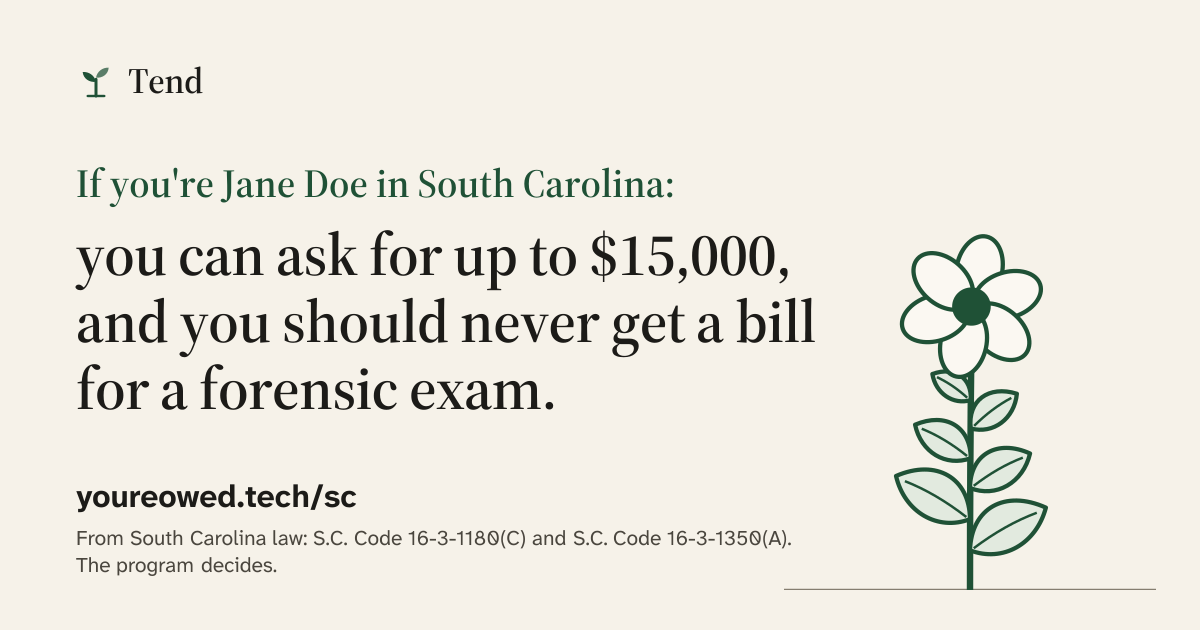
If you're Jane Doe in South Carolina: you can ask for up to $15,000, and you should never get a bill for a forensic exam.
Anyone can post this card. It says nothing about the person who shares it, and this page keeps no record of who opens it.
When you are ready
Tend can check your own costs against this law on your device. It never asks what happened, and nothing leaves your device unless you send it.