Law garden / West Virginia
If you're Jane Doe in West Virginia
What West Virginia's crime victim compensation law says, in plain words. Each line links to the exact sentence it comes from.
Crime Victims Compensation Fund, run by West Virginia Legislative Claims Commission.
Show the law for this line: Crime Victims Compensation Fund home page
Crime Victims Compensation Fund home pageWV-S8
A web page, saved by Tend.
- $35,000the most you can ask for in total, except in some casesW. Va. Code 14-2A-14(g)(1)
- 2 yearsto apply, from the date it happened, with exceptionsW. Va. Code 14-2A-10(b)
- Report or examwithin 96 hours, or later with good cause, and minors need neither; a criminal charge is generally needed tooW. Va. Code 14-2A-14(b)
- $0what the forensic exam itself should cost youW. Va. Code 61-8B-16(b)
Tend saved copies of this page's sources on and checked every quote against those copies word for word. Laws change, so ask the program before you rely on a date or amount.
What the program can pay for
The most the program can pay in total is $35,000, or more in some cases.
Show the law for this line: W. Va. Code 14-2A-14(g)(1)
W. Va. Code 14-2A-14(g)(1)WV-CAP-1
For an injury claim, total compensation to the victim and all other claimants may not exceed $35,000.
Except in the case of death, or as provided in subdivision (2) of this subsection, compensation payable to a victim and to all other claimants sustaining economic loss because of injury to that victim may not exceed $35,000 in the aggregate.
Read this sentence on code.wvlegislature.gov (opens in a new tab)
Medical care
- Reasonable charges for needed medical and psychological care, including eyeglasses, dentures and rehabilitation, are allowable expenses.
Show the law for this line: W. Va. Code 14-2A-3(f)(1)
W. Va. Code 14-2A-3(f)(1)WV-COV-1
Reasonable charges incurred or to be incurred for reasonably needed medical care, including products, services, and accommodations related to medical and psychological care, prosthetic devices, eye glasses, dentures, rehabilitation, and other remedial treatment and care
Read this sentence on code.wvlegislature.gov (opens in a new tab)
Mental health counseling by a licensed counselor
Show the law for this line: Eligibility page, Reimbursable Expenses
Eligibility page, Reimbursable ExpensesWV-COV-2
Mental health counseling by a licensed counselor is a reimbursable expense.
Mental Health Counseling by a Licensed Counselor
Read this sentence on victims.wvlegislature.gov (opens in a new tab)
Dental care
Show the law for this line: Eligibility page, Reimbursable Expenses
Eligibility page, Reimbursable ExpensesWV-COV-6
Dental costs are listed with medical costs as reimbursable.
Medical/Dental Mental Health Counseling by a Licensed Counselor Lost Wages/Income
Read this sentence on victims.wvlegislature.gov (opens in a new tab)
Travel
- Reasonable travel to and from a medical facility is an allowable expense.
- Travel to attend court proceedings in the prosecution is covered up to $5,000. This cap applies to court travel only, not to travel for medical care.
Show the law for this line: W. Va. Code 14-2A-3(f)(6)and 1 more
W. Va. Code 14-2A-3(f)(6)WV-COV-3
Reasonable travel expenses for the transportation of a victim to and from a medical facility.
Read this sentence on code.wvlegislature.gov (opens in a new tab)
W. Va. Code 14-2A-3(f)(4)WV-CAP-3
Reasonable travel expenses not to exceed $5,000 for a claimant to attend court proceedings conducted for the prosecution of the offender
Read this sentence on code.wvlegislature.gov (opens in a new tab)
Lost pay
Show the law for this line: W. Va. Code 14-2A-3(g)and 1 more
W. Va. Code 14-2A-3(g)WV-COV-4
Lost income from work the victim could not do because of the injury counts as economic loss.
"Work loss" means loss of income from work that the injured person would have performed if he or she had not been injured
Read this sentence on code.wvlegislature.gov (opens in a new tab)
W. Va. Code 14-2A-3(g)WV-COV-5
Income lost to attend court proceedings in the prosecution also counts as work loss.
"Work loss" also includes loss of income from work by the claimant, the victim, or the parent or legal guardian of a minor victim who must miss work to attend court proceedings conducted for the prosecution of the offender.
Read this sentence on code.wvlegislature.gov (opens in a new tab)
Moving
- Relocation costs are covered up to $4,500.
Show the law for this line: W. Va. Code 14-2A-3(f)(3)
W. Va. Code 14-2A-3(f)(3)WV-CAP-2
Victim relocation costs not to exceed $4,500
Read this sentence on code.wvlegislature.gov (opens in a new tab)
What it does not pay for
Damaged or stolen property, including money, is not covered.
Show the law for this line: Application packet, information page
Application packet, information pageWV-EXCL-1
No. Damaged or stolen property, including money, is NOT recoverable.
Personal property is not covered, except medically necessary items such as eyeglasses.
Show the law for this line: Eligibility page, Types of Losses Not Covered
Eligibility page, Types of Losses Not CoveredWV-EXCL-2
Personal property (except medically necessary items such as eyeglasses)
Read this sentence on victims.wvlegislature.gov (opens in a new tab)
The forensic exam
You should not have to pay for a sexual assault forensic exam.
Show the law for this line: W. Va. Code 61-8B-16(b)
W. Va. Code 61-8B-16(b)WV-EXAM-1
A medical facility may not collect the cost of the sexual assault forensic exam from the survivor or from the survivor's insurance.
No licensed medical facility may collect the costs of a forensic medical examination from the alleged victim of a violation of this article or from the alleged victim's insurance coverage, if any.
Read this sentence on code.wvlegislature.gov (opens in a new tab)
The provider should not bill your insurance for it either.
Show the law for this line: W. Va. Code 61-8B-16(b)
W. Va. Code 61-8B-16(b)WV-EXAM-1
A medical facility may not collect the cost of the sexual assault forensic exam from the survivor or from the survivor's insurance.
No licensed medical facility may collect the costs of a forensic medical examination from the alleged victim of a violation of this article or from the alleged victim's insurance coverage, if any.
Read this sentence on code.wvlegislature.gov (opens in a new tab)
The West Virginia Prosecuting Attorneys Institute pays the facility for the forensic exam out of the forensic medical examination fund.
Show the law for this line: W. Va. Code 61-8B-16(a)
W. Va. Code 61-8B-16(a)WV-EXAM-2
the West Virginia prosecuting attorneys institute shall pay to a licensed medical facility from the forensic medical examination fund the cost of the forensic medical examination for the alleged victim
Read this sentence on code.wvlegislature.gov (opens in a new tab)
The exam fund does not cover nonforensic care given at the same visit (such as preventive treatment, injury treatment, pregnancy and STI testing); the facility may bill the survivor or their insurer for those.
Show the law for this line: W. Va. Code 61-8B-16(a)(2)
W. Va. Code 61-8B-16(a)(2)WV-EXAM-3
The costs of additional nonforensic procedures performed by the licensed medical facility, including, but not limited to, prophylactic treatment, treatment of injuries, testing for pregnancy and testing for sexually transmitted diseases, may not be paid from the fund: Provided, That nothing in this section shall be construed to prohibit a licensed medical facility from seeking payment for services referred to in this subdivision from the alleged victim or his or her insurer, if any
Read this sentence on code.wvlegislature.gov (opens in a new tab)
Police report
The program asks for a police report, and generally for a criminal charge to be filed. The rules below say when a forensic exam can count for the report, and when no charge is needed.
Show the law for this line: W. Va. Code 14-2A-14(b)and 1 more
W. Va. Code 14-2A-14(b)WV-REP-1
The crime must be reported to law enforcement within 96 hours, but for a sexual offense a forensic medical exam within 96 hours meets the requirement instead. Good cause can excuse a late report or exam, and juvenile victims are exempt.
The commissioner may not approve an award of compensation if the criminally injurious conduct upon which the claim is based was not reported to a law-enforcement officer or agency or, in the case of sexual offense, the victim did not undergo a forensic medical examination, within 96 hours after the occurrence of the conduct, unless it is determined that good cause existed for the failure to report the conduct or undergo a forensic medical examination within the 96-hour period: Provided , That reporting to a law-enforcement officer or agency or a forensic medical examination is not required if the victim is a juvenile in order for a commissioner to approve an award of compensation
Read this sentence on code.wvlegislature.gov (opens in a new tab)
W. Va. Code 14-2A-18WV-REP-2
Beyond the police report, a criminal charge generally has to be filed. It is not required when the offender is unknown or the claimant was a juvenile. It is also not required for an adult claimant when no charges were filed for reasons other than the claimant's own wish and law enforcement confirms the evidence supports that a crime occurred. A conviction is not required.
The filing of a criminal charge shall be a prerequisite for receipt of compensation unless it is determined that no charges were filed due to the identity of the perpetrator being unknown: Provided, That no criminal charges need be filed if: (1) The claimant is an adult at the time the conduct giving rise to the claim occurred and no criminal charges were filed for reasons other than the desire of the claimant and a law-enforcement agency confirms that the available evidence supports a finding that a crime occurred; or (2) the claimant was a juvenile at the time the conduct giving rise to the claim occurred.
Read this sentence on code.wvlegislature.gov (opens in a new tab)
A survivor does not have to report to police or cooperate with law enforcement to get a state-paid forensic exam.
Show the law for this line: W. Va. Code 61-8B-16(c)
W. Va. Code 61-8B-16(c)WV-EXAM-4
Nothing in this section shall be construed to require an alleged victim of sexual assault to participate in the criminal justice system or to cooperate with law enforcement in order to be provided a forensic medical examination pursuant to the provisions of this section.
Read this sentence on code.wvlegislature.gov (opens in a new tab)
The crime must be reported to law enforcement within 96 hours, but for a sexual offense a forensic medical exam within 96 hours meets the requirement instead. Good cause can excuse a late report or exam, and juvenile victims are exempt.
Show the law for this line: W. Va. Code 14-2A-14(b)
W. Va. Code 14-2A-14(b)WV-REP-1
The commissioner may not approve an award of compensation if the criminally injurious conduct upon which the claim is based was not reported to a law-enforcement officer or agency or, in the case of sexual offense, the victim did not undergo a forensic medical examination, within 96 hours after the occurrence of the conduct, unless it is determined that good cause existed for the failure to report the conduct or undergo a forensic medical examination within the 96-hour period: Provided , That reporting to a law-enforcement officer or agency or a forensic medical examination is not required if the victim is a juvenile in order for a commissioner to approve an award of compensation
Read this sentence on code.wvlegislature.gov (opens in a new tab)
Beyond the police report, a criminal charge generally has to be filed. It is not required when the offender is unknown or the claimant was a juvenile. It is also not required for an adult claimant when no charges were filed for reasons other than the claimant's own wish and law enforcement confirms the evidence supports that a crime occurred. A conviction is not required.
Show the law for this line: W. Va. Code 14-2A-18
W. Va. Code 14-2A-18WV-REP-2
The filing of a criminal charge shall be a prerequisite for receipt of compensation unless it is determined that no charges were filed due to the identity of the perpetrator being unknown: Provided, That no criminal charges need be filed if: (1) The claimant is an adult at the time the conduct giving rise to the claim occurred and no criminal charges were filed for reasons other than the desire of the claimant and a law-enforcement agency confirms that the available evidence supports a finding that a crime occurred; or (2) the claimant was a juvenile at the time the conduct giving rise to the claim occurred.
Read this sentence on code.wvlegislature.gov (opens in a new tab)
A commissioner may deny a claim, reduce an award, or reconsider an approved claim if the claimant or victim has not fully cooperated with law enforcement or the claim investigator.
Show the law for this line: W. Va. Code 14-2A-14(d)
W. Va. Code 14-2A-14(d)WV-COND-2
A commissioner, upon a finding that the claimant or victim has not fully cooperated with appropriate law-enforcement agencies or the claim investigator, may deny a claim, reduce an award of compensation, or reconsider a claim already approved.
Read this sentence on code.wvlegislature.gov (opens in a new tab)
Deadline to apply
Apply within 2 years of the date it happened. The rules below cover other cases.
Show the law for this line: W. Va. Code 14-2A-10(b)
W. Va. Code 14-2A-10(b)WV-DEAD-1
The application must be filed within two years after the crime.
All applications for an award of compensation shall be filed within two years after the occurrence of the criminally injurious conduct that is the basis of the application.
Read this sentence on code.wvlegislature.gov (opens in a new tab)
The Fund's page says a victim who was under 18 at the time must apply before turning 20.
Show the law for this line: Eligibility page, Time Limitations for Filing Application
Eligibility page, Time Limitations for Filing ApplicationWV-DEAD-2
The application for an adult victim (18 years or older at the time of crime) must be filed with the Fund within two years of the crime. The application for a minor victim (under 18 year of age at the time of the crime) must be filed with the Fund before the minor’s 20th birthday.
Read this sentence on victims.wvlegislature.gov (opens in a new tab)
Keeping your name and address private
Note: The records rule below covers only a claim for a minor child in an abuse or neglect case. Tend has not verified a West Virginia law that keeps an adult survivor's claim private.
The Secretary of State's Address Confidentiality Program is designed to help victims of sexual assault, domestic violence, stalking and human trafficking deal with government agencies without risking that their home address gets out. You apply in person through an approved application assistant at a local victim service program.
Show the law for this line: WV Secretary of State ACP page; program created by W. Va. Code 48-28A-103(a)
WV Secretary of State ACP page; program created by W. Va. Code 48-28A-103(a)WV-ACP-1
The West Virginia Address Confidentiality Program (ACP) is a program designed to help victims of domestic violence, sexual assault, stalking and human trafficking do business with government agencies and other entities without risking disclosure of their home address.
For a claim filed on behalf of a minor child who is the subject of a civil abuse and neglect petition, the Fund's records and proceedings are confidential and may not be shared with anyone who is not a necessary participant.
Show the law for this line: W. Va. Code 14-2A-11a(b)
W. Va. Code 14-2A-11a(b)WV-RECCONF-1
All crime victims’ compensation fund records and proceedings related to a claim filed on behalf of a minor child who is the subject of a civil abuse and neglect petition are confidential and may not be disclosed to any person who is not a necessary participant in the proceedings.
Read this sentence on code.wvlegislature.gov (opens in a new tab)
How to apply
Online https://www.wvlegislature.gov/Joint/Victims/claim.cfm
Show the law for this line: File Your Crime Victims Claim page
File Your Crime Victims Claim pageWV-SUBMIT-2
A claim can also be filed through the Legislature's online claim form.
Begin your Online Claim Process This online claim form takes you through 5 simple steps to file your Crime Victims claim.
Read this sentence on wvlegislature.gov (opens in a new tab)
Mail CRIME VICTIMS COMPENSATION FUND 1900 KANAWHA BLVD E ROOM W-334 CHARLESTON WV 25305-0610
Show the law for this line: Application packet, cover page instructions
Application packet, cover page instructionsWV-SUBMIT-1
Mail the completed, notarized application to the Crime Victims Compensation Fund in Charleston.
Mail your completed application to: CRIME VICTIMS COMPENSATION FUND 1900 KANAWHA BLVD E ROOM W-334 CHARLESTON WV 25305-0610
Phone 304-347-4850
Show the law for this line: Crime Victims Compensation Fund home page
Crime Victims Compensation Fund home pageWV-S8
A web page, saved by Tend.
Good to know before you apply
The crime must occur in West Virginia, or in a state without a victim compensation program. A nonresident is eligible only if the crime happened in West Virginia, and West Virginia residents are also covered for crimes outside the United States.
Show the law for this line: W. Va. Code 14-2A-3(c); nonresident limit in 14-2A-3(a)(1)
W. Va. Code 14-2A-3(c); nonresident limit in 14-2A-3(a)(1)WV-RES-1
“Criminally injurious conduct” means conduct that occurs or is attempted in this state, or in any state not having a victim compensation program, which poses a substantial threat of personal injury or death and is punishable by fine or imprisonment. “Criminally injurious conduct” also includes criminally injurious conduct committed outside of the United States against a resident of this state.
Read this sentence on code.wvlegislature.gov (opens in a new tab)
Awards are reduced by whatever insurance or other collateral sources pay; the fund pays last.
Show the law for this line: W. Va. Code 14-2A-14(f)
W. Va. Code 14-2A-14(f)WV-COLL-1
The commissioner shall reduce an award of compensation or deny a claim for an award of compensation that is otherwise payable to a claimant to the extent that the economic loss upon which the claim is based is or will be recouped from other persons, including collateral sources
Read this sentence on code.wvlegislature.gov (opens in a new tab)
Share this page
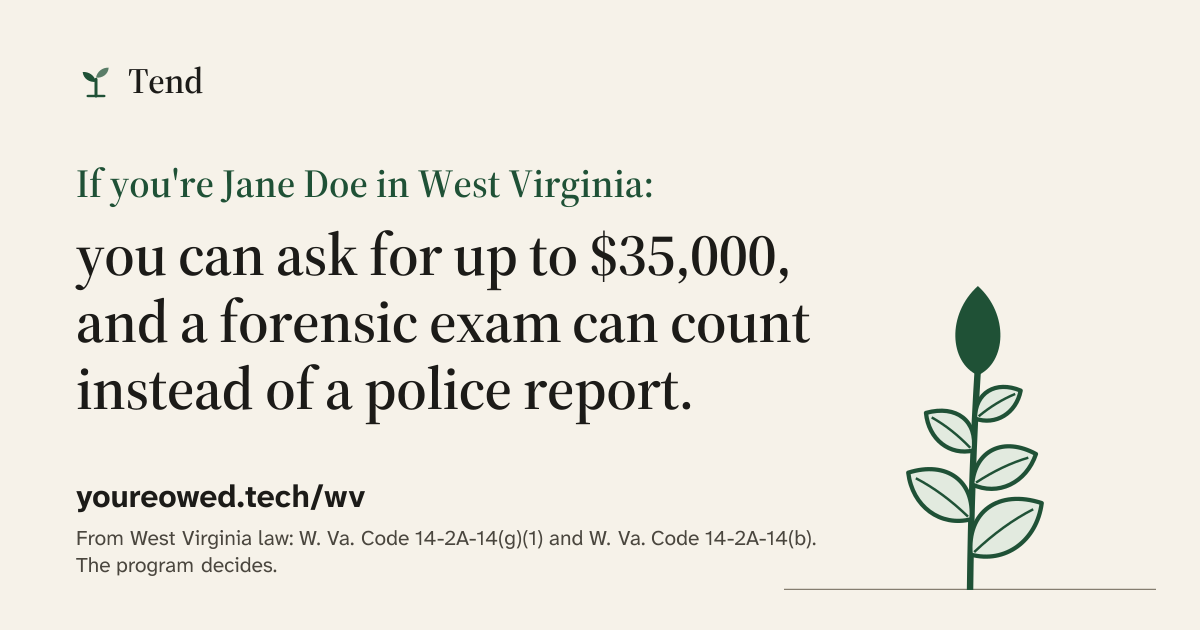
If you're Jane Doe in West Virginia: you can ask for up to $35,000, or more in some cases, and the program generally needs a criminal charge to be filed.
Anyone can post this card. It says nothing about the person who shares it. Tend keeps no list of who opens it, though like any website its host logs each visit's IP address.
When you are ready
Tend can check your own costs against this law on your device. It never asks what happened. Your costs and answers stay on your device unless you send them; the state you pick goes to Tend's server to get its law.